
Just so we’re all on the same page. Please ensure you’ve made yourself acquainted with my disclaimer
By 1850, the United States was rapidly expanding, with settlers moving westward, cities growing, and industry developing. However, daily life varied widely depending on location (rural, urban, frontier), social class, and race.
Population & Demographics
- Estimated U.S. Population: 23.2 million (1850 Census)
- Largest Cities: New York (~500,000), Philadelphia (~400,000), Boston, Baltimore, and New Orleans.
- Diversity: The U.S. included Native Americans, European immigrants, African Americans (both enslaved and free), and Hispanic populations in the newly acquired Southwest(Texas, California, New Mexico, etc.).
Diet & Food
Staple Foods & Drinks
- Meat: Pork (most common), beef, chicken, fish (coastal areas), wild game (frontier).
- Grains: Cornmeal, wheat, oats, rye, barley.
- Vegetables: Potatoes, beans, cabbage, onions, carrots, squash, tomatoes.
- Fruits: Apples, berries, peaches, grapes (in season or dried).
- Dairy: Butter, milk, cheese.
- Sweeteners: Molasses, honey, sugar (expensive in some areas).
- Drinks: Water, coffee, tea, cider, whiskey (especially in the frontier).
Frontier families relied on hunting, foraging, and trading, while urban dwellers bought fresh produce, bread, and meats from markets or street vendors.
Clothing & Fashion
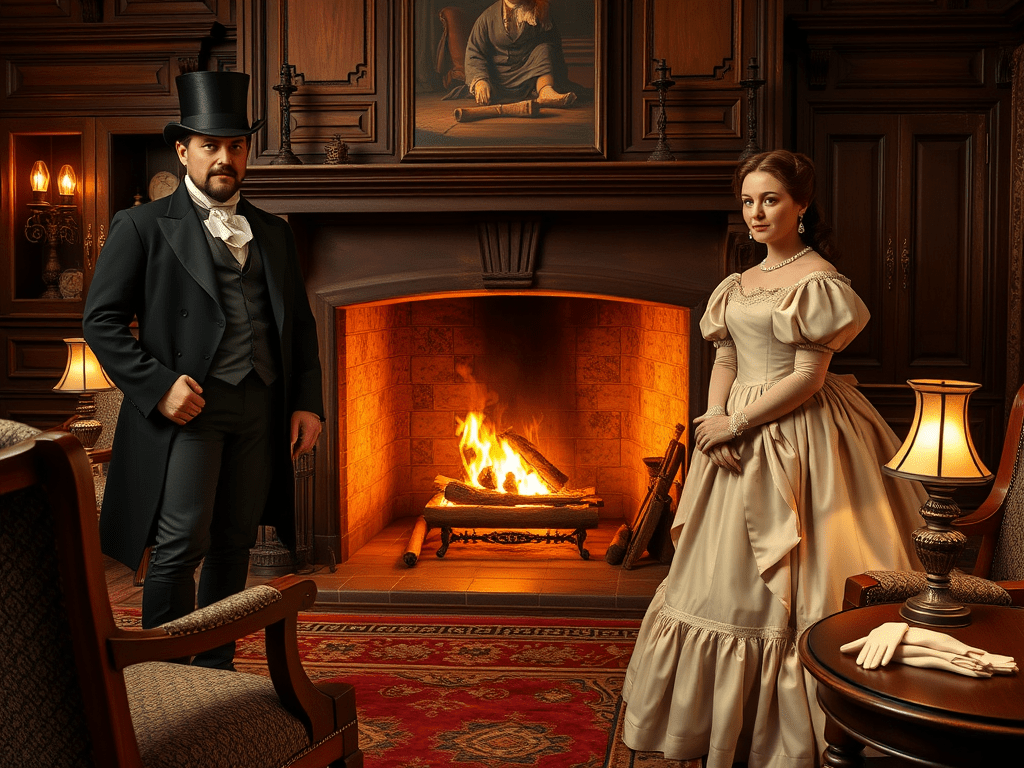
- Men: Wool trousers, linen shirts, waistcoats, and coats. Wealthier men wore cravats and top hats.
- Women: Long dresses, petticoats, bonnets, and shawls. Wealthier women had layered gowns.
- Frontier Clothing: Made from homespun wool, cotton, or buckskin (leather).
- Shoes: Leather boots or hand-sewn shoes.
Clothing was often handmade in rural areas, while wealthier people bought tailored clothing.
Housing & Living Conditions
- Urban Homes: Row houses or wooden frame homes with basic furniture, fireplaces, and candles for light. Wealthier homes had parlor rooms with carpets and wallpaper.
- Rural Homes: Log cabins, wooden farmhouses, or sod houses (in the Midwest plains) with simple furnishings and dirt floors.
- Western Frontier: Many settlers lived in tents or wagons before building log cabins.
- Southern Plantations: Wealthy landowners had large homes, while enslaved people lived in small wooden cabins with poor conditions.
Health & Medicine
- Life Expectancy: If a person survived childhood, they could expect to live 40-50 years on average.
- Child Mortality Rate: 40-50% of children did not survive to adulthood due to disease, accidents, or poor medical care.
- Common Diseases: Cholera, dysentery, typhoid fever, tuberculosis, malaria.
- Medicine: Treatments relied on herbal remedies, bloodletting, and rudimentary surgery (without anesthesia).
Doctors were scarce in rural areas, and most people relied on home remedies.
Social Structure, Marriage & Family Life
- Monogamy was the norm, and marriage was expected.
- Average marriage age: Women (18-22), Men (20-26).
- Children per family: 5-8 children on average, though many did not survive childhood.
- Challenges: High infant mortality, dangerous childbirth, and child labor were common.
Where & When Children Worked
- Farms & Rural Areas: Children as young as 5-7 helped with chores like feeding animals, gathering firewood, and working in fields. By 10-12, they could handle plowing, harvesting, and caring for livestock.
- Factories & Mills: Many children began working in textile mills, coal mines, and glass factories as early as 8-10 years old. They worked 10-12 hours a day in dangerous conditions.
- Apprenticeships & Trades: Boys as young as 10-12 were sent to learn trades like blacksmithing, printing, or carpentry.
- Domestic Work (Mostly Girls): By 6-8 years old, girls helped with cooking, sewing, and cleaning at home. Poorer girls often became maids or nannies by 10-12.
- Street Jobs: In cities, children worked as newsboys, messengers, bootblacks, or peddlers by age 8-12.
Why Did Children Work So Young?
- Families Needed Extra Income: Most families relied on everyone contributing to survive.
- No Child Labor Laws Yet: Laws restricting child labor wouldn’t come until the late 19th and early 20th centuries.
- Education Wasn’t Always an Option: In many areas, school was only available part-time or not at all, especially in rural communities.
Past Times
- Children’s Games: Marbles, hoop rolling, jump rope, stick and hoop, dolls.
- Adult Games: Checkers, chess, cards, gambling, horse racing.
- Music: Fiddles, banjos, pianos, singing at home or in church.
People in urban areas could enjoy theaters and concerts, while frontier families made their own entertainment.
Currency & Economy
- Money: Gold and silver coins, paper banknotes (varied by state).
- Bartering: In rural areas, people often traded goods like livestock, crops, tools, and textiles instead of using money.
- Wages: Factory workers made about $1 per day, while farmers relied on crop yields for income.
Religion, Art & Literature
- Religion: Christianity dominated (Protestantism, Catholicism, Quakerism), with churches being central to social life.
- Art: Portrait painting, folk art, early photography (daguerreotypes).
- Literature: Newspapers, serialized novels, and poetry were popular.
Musical Instruments
By 1850, music was an integral part of American life, played in homes, churches, saloons, and social gatherings. Instruments varied based on region and cultural influences, including European, African, and Indigenous traditions.
Common Musical Instruments & Their Use
- Fiddle (Violin) – The most popular instrument of the time, used in folk, dance music, and classical performances. Fiddles were essential in barn dances, frontier gatherings, and taverns.
- Banjo – Brought by African slaves and adapted in American folk music. Used in minstrel shows, folk music, and early bluegrass-style playing.
- Piano/Forte-Piano – Found in wealthier households, parlors, and performance halls. Played in classical music, parlour songs, and early American compositions.
- Guitar – Used primarily for folk music, cowboy ballads, and accompaniment in informal settings. Spanish and Mexican influences were present in the Southwest.
- Flute – A common woodwind instrument in parlors, orchestras, and church music.
- Harmonica – A portable, cheap instrument popular among travelers, soldiers, and cowboys, used for folk and blues-style playing.
- Brass Instruments (Trumpet, Bugle, Trombone, French Horn) – Common in military bands, orchestras, and formal events. Bugles were used for signaling in the military.
- Drums & Percussion (Bones, Tambourines, Snare Drums) – Used in African American music, marching bands, and folk performances. The “bones” (animal bones clicked together) were common in early folk and minstrel music.
- Dulcimer – A stringed folk instrument played in Appalachian and rural communities.
- Indigenous Instruments (Drums, Rattles, Flutes) – Used in ceremonies, storytelling, and social gatheringsamong Native American tribes.
Common Tools & Technology
- Household Tools: Butter churns, cast-iron stoves, spinning wheels, candle molds.
- Farming Tools: Plows, sickles, scythes, hand-crank mills.
- Industrial Tools: Steam engines, printing presses, textile machines.
- Firearms: Muskets, rifles, pistols (for hunting and defense).
By 1850, trains, steamships, and the telegraph were transforming communication and travel.
Big Moments in America (1800-1850)
This half-century was a wild ride—expansion, war, innovation, extreme weather, and social upheaval all played a role in shaping American culture. Here’s what was happening while people were strumming their banjos and humming ballads:
Westward Expansion & Manifest Destiny
- The U.S. was rapidly expanding during the early 19th century. The Louisiana Purchase of 1803, orchestrated by President Thomas Jefferson, doubled the nation’s size by acquiring vast territories from France, stretching from the Mississippi River to the Rocky Mountains. This acquisition laid the groundwork for future westward expansion, and by the 1840s, families were journeying along the Oregon Trail, packing up their wagons and heading west to settle new lands, fueling the country’s growth and shaping its future.
- The California Gold Rush (1848-1855) triggered a mass migration as people dropped everything to chase riches, sparking a boom in saloons, dance halls, and Western folk music. The discovery of gold in California forever altered the economy and demographics of the United States, contributing to the rapid settlement of the West and hastening California’s statehood. This event not only transformed the region but also had lasting effects on the nation’s development.
- Native American tribes were forcibly removed from their lands through policies like the Indian Removal Act of 1830, leading to tragedies such as the Trail of Tears (1838-1839), where thousands of Native Americans died during the forced marches. The relocation of the Cherokee, Choctaw, Chickasaw, Creek, and Seminole tribes from their ancestral lands in the southeastern U.S. to territories west of the Mississippi River resulted in immense suffering and loss of thousands of lives. This dark chapter remains one of the most tragic moments in U.S. history.
Major Conflicts & Battles
- The War of 1812 (1812-1815), often referred to as the “Second American Revolution,” was fought between the United States and Britain over issues like trade restrictions and British support for Native American attacks on American settlers. Key events like the Burning of Washington in 1814 and the Battle of New Orleans in 1815, which made General Andrew Jackson a national hero, marked the conflict. Though the war ended in a stalemate, it sparked a surge of American nationalism and helped usher in the Era of Good Feelings (1815-1825), a period of relative political unity and optimism.
- The Mexican-American War (1846-1848): The U.S. won, gaining the modern-day Southwest, including California, Arizona, New Mexico, and parts of Utah and Nevada, but it fueled tensions over slavery that would explode into the Civil War a decade later.
- The Panic of 1837: A severe economic depression caused by speculative land deals, bank failures, and a banking crisis, which led to high unemployment, a collapse in the credit system, and an overall financial downturn. This affected the entire nation, especially in the wake of the banking policies of Andrew Jackson and the speculation on land and cotton.
Slavery, Abolition, & Social Change
- The Missouri Compromise (1820) temporarily kept the balance between free and slave states, but the debate over slavery wasn’t going away.
- The Underground Railroad was helping enslaved people escape north, with Harriet Tubman emerging as a major figure.
- Frederick Douglass published his autobiography (1845), exposing the horrors of slavery and gaining international attention.
- The Seneca Falls Convention of 1848, led by influential figures like Elizabeth Cady Stanton and Lucretia Mott, marked the beginning of the organized women’s rights movement in the United States. The convention issued the Declaration of Sentiments, which called for women’s suffrage and equality in legal, political, and social rights, laying the groundwork for future efforts toward gender equality and women’s empowerment.
- The Second Great Awakening (early 1800s):
This religious revival movement, which spread through the U.S. during the early 19th century, emphasized personal salvation and reform. It played a key role in promoting social reforms, including the abolition of slavery and the women’s rights movement. - Mormonism, officially known as The Church of Jesus Christ of Latter-day Saints (LDS Church), emerged as a significant new religious movement during the early 19th century. Founded by Joseph Smith in 1830 in upstate New York, the religion quickly gained followers but also faced intense persecution due to its unique beliefs, including new scripture (The Book of Mormon) and controversial practices such as polygamy. As opposition grew, the group migrated westward. After Smith’s assassination in 1844, leadership passed to Brigham Young, who led the church’s migration to Utah in 1847, where they founded Salt Lake City.
Tech & Cultural Advancements
- Trains revolutionized travel – The Baltimore & Ohio Railroad (1827) became the first passenger rail line, and by the 1850s, steam locomotives were changing how people moved across the country.
- The Telegraph (1844), invented by Samuel Morse, meant people could communicate across long distances almost instantly.
The Morse Code became the standard method of communication for the telegraph. - The rise of factories and the Industrial Revolution transformed the United States, shifting the nation from a primarily farming society to an urban one. In particular, the factory system flourished in the North, where mechanized production of textiles, clothing, and other goods spurred rapid urbanization. As a result, many workers left rural areas to seek factory jobs in the growing cities, leading to significant changes in the labor force and the nation’s economy.
Extreme Weather & Natural Disasters
- The Great Blizzard of 1836 – A brutal storm that paralyzed the East Coast.
- The New Madrid Earthquakes (1811-1812) –
A series of powerful earthquakes struck the New Madrid Seismic Zone in the central U.S. between 1811 and 1812, one of the largest seismic events in American history. The earthquakes caused the Mississippi River to temporarily flow backwards and caused significant damage in the region. - The Year Without a Summer, 1816, was a global climate disaster caused by the massive eruption of Mount Tambora in Indonesia. The eruption released vast amounts of ash and sulfur into the atmosphere, blocking sunlight and causing a dramatic drop in global temperatures. In the United States, this resulted in extreme weather events, including snow and frosts in June, July, and August, which devastated crops, especially in the Northeast. Farmers lost entire harvests of crops like corn and wheat, leading to widespread food shortages, economic hardship, and skyrocketing food prices. New England was hit particularly hard, with famine and financial ruin affecting many families. This volcanic winter created a ripple effect across both the U.S. and Europe, contributing to severe crop failures, famine, and a challenging economic climate.
Entertainment
The Soundtrack of 1850s America: Music on the Frontier, in the Parlors, and Beyond
Music in 1850s America wasn’t just background noise—it was how people told stories, built communities, and got through the daily grind. Whether it was a fiddle and banjo lighting up a barn dance, spirituals echoing through the fields, or a family gathered around a piano in the parlor, music was everywhere.
This was a time before recordings of any kind, so if you wanted music, you had to make it yourself. Folks played fiddles, strummed guitars, or even clicked together bones (yes, literal bones) to keep the rhythm.
From rowdy saloons to church pews to the wide-open frontier, every corner of 1850s America had its own vibe. Below, we’re diving into the the songs they loved, and how this era shaped the music we know today.
- “Swing Low, Sweet Chariot” (c. 1850s) – Traditional Spiritual
- Sung in African American communities, this song carried deep spiritual meaning and was later associated with the Underground Railroad.
- “Camptown Races” (1850) – Stephen Foster
- A lively minstrel tune that became part of American folk music.
- “Old Dan Tucker” (1843) – Dan Emmett
- A classic folk song often played with banjos and fiddles at social gatherings.
- “Arkansas Traveler” (Pre-1850, Traditional)
- A popular fiddle tune used in barn dances and informal performances.
- “Oh! Susanna” (1848) – Stephen Foster
- One of the most enduring American folk songs, played widely across the country.
Additional Artists & Influences:
- Stephen Foster – The most influential American songwriter of the period, composing folk, minstrel, and parlor songs.
- Minstrel Shows – While problematic today, they were a major part of 1850s musical culture, influencing later American folk traditions.
- Sacred Harp Singing – A cappella, shape-note hymn singing popular in rural religious gatherings.
- Mexican & Spanish Ballads – Found in the Southwest, influenced by traditional Spanish music.
- African American Spirituals & Work Songs – Sung by enslaved people and in early black church communities, influencing blues and gospel music.
Adult Recommendations
- Book: The Narrative of the Life of Frederick Douglass, an American Slave (1845) – It became one of the most influential slave narratives of the 19th century, detailing Douglass’s journey from slavery to freedom and exposing the brutal realities of slavery in early America.
- Movie: “The Revenant” (2015) – Set in the 1820s, this film follows frontiersman Hugh Glass as he survives the wilderness, highlighting the dangers and realities of early 19th-century America.
- TV Show: “Texas Rising” (2015) – A historical miniseries depicting the Texas Revolution (1835-1836) and the early years of Texas as a republic.
- Book: Blood Meridian by Cormac McCarthy (1985) – A brutal yet historically rich novel set in the 1840s, portraying lawlessness, Native American conflicts, and violence along the Texas-Mexico border.
- Book: A Lady’s Life in the Rocky Mountains by Isabella L. Bird (1879, but based on her 1850s experiences) – A firsthand account of a woman traveling through the American West in the mid-19th century.
- Movie: “Gangs of New York” (2002) – Set in the 1840s, this film portrays the gritty reality of life in New York City, including immigration, gang violence, and political corruption.
- TV Show: “Into the West” (2005) – A miniseries covering American westward expansion, including the 1820s–1850s, with a strong focus on settler and Native American interactions.
- Podcast: Stuff You Should Know: “History of the Trail of Tears, Part I” – This episode explores the forced relocation of Native American tribes in the 1830s
Children’s Recommendations
- Book: Little House in the Big Woods by Laura Ingalls Wilder (1932) – Set in 1830s Wisconsin, this book provides an immersive look into everyday frontier life.
- Book: The Courage of Sarah Noble by Alice Dalgliesh (1954) – A short historical novel set in the early 1800s, telling the story of a young girl adjusting to frontier life with themes of bravery and adaptation.
- Book: Rebecca of Sunnybrook Farm by Kate Douglas Wiggin (1903, but set in the 1840s) – A classic children’s novel about a young girl growing up in rural America.
- Book: Abe Lincoln: The Boy Who Loved Books by Kay Winters (2003) – A beautifully illustrated picture book that introduces young children to Abraham Lincoln’s early life in the 1810s and 1820s, focusing on his love of learning and growing up on the frontier.
Authentic 1850s American Meal
Using only ingredients and cooking methods available at the time—such as open-hearth cooking, cast iron, and wood-fired ovens.
Breakfast
- Beverage: Black coffee or sassafras tea
- Meal:Johnnycakes with molasses and fried salt pork
- Johnnycakes: Made from cornmeal, water, and salt, cooked on a griddle or in a pan over an open fire
- Fried Salt Pork: Slices of cured pork fried in a skillet, often served with breakfast
Dinner
- Light Snack: Dried apples or pears (dried by hanging or sun-drying)
- Entrée: Roast chicken with pan gravy
- Chicken roasted over a wood fire, with drippings used for a simple flour-based gravy
- Sides:
- Bread Side: Cornbread
- Cornbread: Made from cornmeal, baked in a cast-iron skillet
- Vegetable Side: Stewed root vegetables (carrots, potatoes, turnips)
- Root vegetables slow-cooked in a kettle with butter and salt
- Bread Side: Cornbread
- Dessert: Apple cobbler
- Baked spiced apples with a simple biscuit or pie crust topping
- Beverage: Hard cider or buttermilk
1850s with a Modern Twist
Modern kitchen tools and techniques with historically accurate ingredients.
Breakfast
- Beverage: Fresh brewed espresso-style coffee or chilled iced sassafras tea
- Meal:Johnnycakes with maple syrup and crispy bacon
- Johnnycakes: Made from cornmeal, water, and salt, cooked on a modern griddle, and served warm with butter and maple syrup
- Crispy Bacon: Oven-baked for a crispier, more even texture
Dinner
- Light Snack: Quick-pickled cucumbers with dill and garlic
- Entrée: Herb-roasted chicken with pan-seared gravy
- Chicken roasted in a modern oven with butter, rosemary, and thyme, served with a rich pan gravy
- Sides:
- Bread Side: Buttermilk cornbread
- A fluffier, richer version of cornbread, baked with buttermilk and butter in the oven
- Vegetable Side: Roasted garlic mashed potatoes
- Mashed potatoes with roasted garlic, butter, and cream for a smooth and creamy texture
- Bread Side: Buttermilk cornbread
- Dessert: Apple cobbler with cinnamon-sugar topping
- Spiced apples baked with a sweet biscuit topping, served warm with a drizzle of cream
- Beverage: Sparkling apple cider
 Time Traveling Table
Leave a comment