
Just so we’re all on the same page. Please ensure you’ve made yourself acquainted with my disclaimer
Life in 1930s America
The 1930s in the United States was defined by the Great Depression, economic hardship, environmental disasters (like the Dust Bowl), and major shifts in social structures. Despite these challenges, communities adapted through resilience, resourcefulness, and innovation.
Population
- Population: ~ 122 million people.
- For the first time in U.S. history, more people lived in urban areas than in rural areas.
Largest U.S. Cities
- New York City, NY – 6.9 million
- Chicago, IL – 3.3 million
- Philadelphia, PA – 1.9 million
- Detroit, MI – 1.5 million
- Los Angeles, CA – 1.2 million
Racial & Ethnic Demographics
- White (including European immigrants): ~89% (~109 million)
- Black/African American: ~9.7% (~12 million)
- Hispanic/Latino: ~1.5% (~1.8 million, mostly in the Southwest)
- Asian (Chinese, Japanese, Filipino, etc.): ~0.5% (~600,000)
- Indigenous/Native American: ~0.3% (~330,000)
Daily Life: Diet, Clothing, Housing
Diet & Staple Foods
- With money tight, people relied on cheap, filling foods. Staples included:
- Bread & Butter – Often homemade since store-bought bread was a luxury.
- Beans & Rice – A cheap source of protein.
- Cornmeal-based foods – Cornbread, grits, mush.
- Potatoes – A staple that stretched meals.
- Cabbage & Root Vegetables – Stored well and were inexpensive.
- Canned Goods – People relied on preserved foods when fresh produce was unavailable.
- Meat – Limited for most families; cheaper cuts like organ meats, hot dogs, and Spam became common.
- Milk, Butter, and Eggs – Consumed in rural areas but rationed in cities.
- Coffee & Tea – Essentials for adults, though many stretched supplies with substitutes like chicory.
Clothing
- Homemade & Hand-Me-Downs: With money tight, people repaired, repurposed, and made their own clothes. Flour and feed sacks were even turned into dresses.
- Typical Attire:
- Men – Work shirts, trousers, suspenders, and fedoras or newsboy caps. Suits were still worn but became less common.
- Women – Modest dresses, often with puffed sleeves, and homemade accessories like hats or gloves.
- Children – Wore practical hand-me-downs, often patched up.
Housing
- City Life: Apartments or small houses with basic amenities. Some families took in boarders to afford rent.
- Rural Life: Farmhouses, often lacking electricity or plumbing.
- Shantytowns (“Hoovervilles”): Many homeless families built makeshift shelters in cities after losing jobs and homes.
Health & Medicine
- Childhood Survival Rates: Around 80% of children survived to adulthood, but infant mortality was still high, especially in rural areas.
- Life Expectancy:
- Men: ~58 years
- Women: ~62 years
- Healthcare:
- Very limited—many people couldn’t afford doctors.
- Home remedies were common, and pharmacists acted as informal doctors.
- Vaccinations (diphtheria, smallpox) helped, but antibiotics (like penicillin) weren’t available to the public yet.
- Malnutrition and tuberculosis were widespread.
Family & Social Life
Marriage & Children
- Marriage age: Early to mid-20s for most.
- Family Size: Many families had 3-6 children, though birth rates dropped during the Depression due to economic struggles.
Challenges for Children
- Many had to drop out of school to work and help support the family.
- Malnutrition and illnesses like polio were common.
- Some children were sent to orphanages even if their parents were alive but unable to care for them.
Leisure, Entertainment, & Pop Culture
Games & Pastimes
- Board games – Monopoly (created in 1935) was wildly popular.
- Outdoor games – Marbles, hopscotch, jump rope, stickball.
- Radio – Families gathered around to listen to news, music, and shows (The Shadow, Little Orphan Annie).
- Movies – The “Golden Age of Hollywood” with classics like The Wizard of Oz and Gone with the Wind.
- Music – Swing and jazz dominated, with artists like Duke Ellington, Benny Goodman, and Bing Crosby.
Economy: Work, Money, & Bartering
Conversion Rate: Then vs. Now
- $1 in 1930 → Approximately $18–$20 today (varies based on inflation and purchasing power).
Currency & Bartering
- The U.S. dollar was still the main currency, but bartering became more common in rural areas.
- Major barter items: Eggs, flour, canned goods, livestock, sewing services.
Income & Social Class
Unemployment Rate (1933, peak of the Great Depression):~25% (1 in 4 workers unemployed)
- Average Income:
- Farm Laborer: $250 per year (≈ $4,500 today)
- Factory Worker: $1,200 per year (≈ $22,000 today)
- Teacher: $1,500 per year (≈ $27,500 today)
- Clerk/Secretary: $1,700 per year (≈ $30,000 today)
- Police Officer: $2,000 per year (≈ $37,000 today)
- Skilled Tradesman (Carpenter, Mechanic, Electrician): $2,500 per year (≈ $46,000 today)
- Doctor: $5,000 per year (≈ $90,000 today)
- Corporate Executive/Wealthy Businessman: $10,000+ per year (≈ $180,000+ today)
Cost of Common Items
- Eggs (per dozen): $0.18 (≈ $3.50 today)
- Milk (per gallon): $0.26 (≈ $5.00 today)
- Loaf of bread: $0.09 (≈ $1.75 today)
- A gallon of gasoline: $0.10 (≈ $2.00 today)
- A yard of fabric: $0.35 (≈ $6.50 today)
- A pair of men’s shoes: $3.00 (≈ $55 today)
- A new suit: $25.00 (≈ $450 today)
- Monthly rent (average): $18.00 (≈ $350 today, varies by location)
- New house purchase price: $3,900 (≈ $75,000+ today, depending on the region)
Faith, Art, & Literature
Religion
- Most Americans were Christian, with Protestant and Catholic churches playing major social roles.
- The New Deal brought government assistance, but churches remained key sources of charity.
Art & Aesthetics
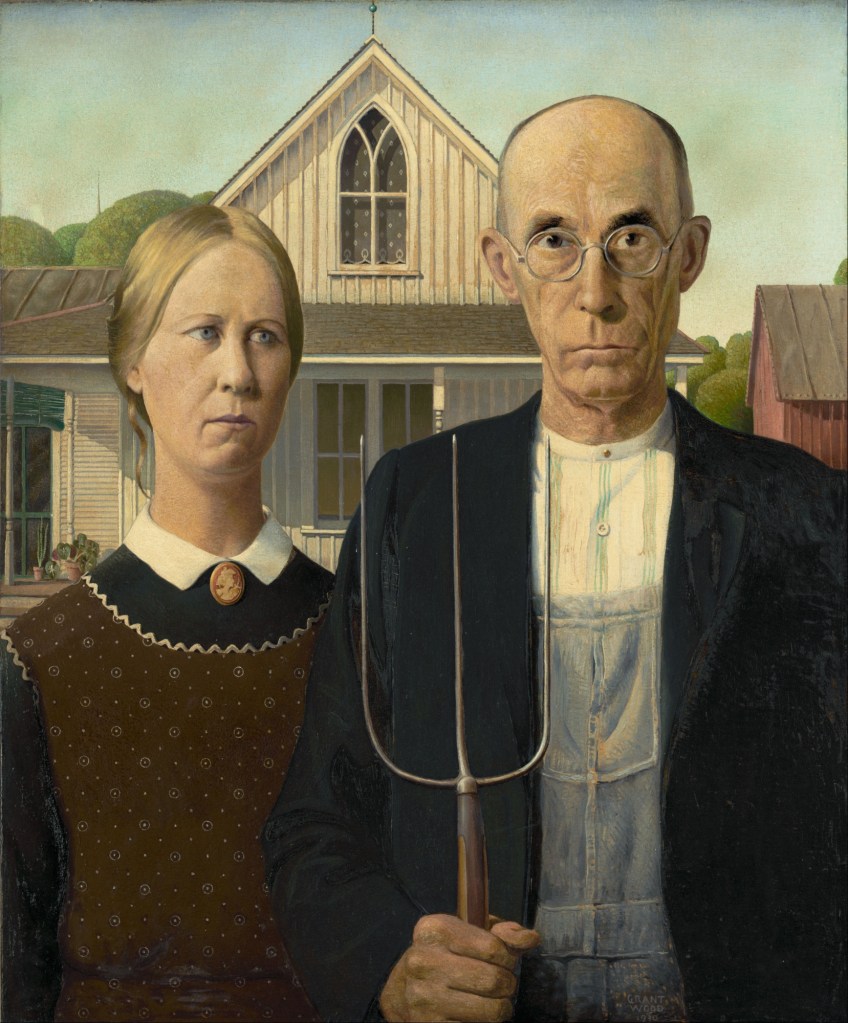
Wood, Grant. American Gothic. 1930, Art Institute of Chicago, Chicago, IL.
- Regionalism Art Movement: Focused on American life, featuring artists like Grant Wood (American Gothic).
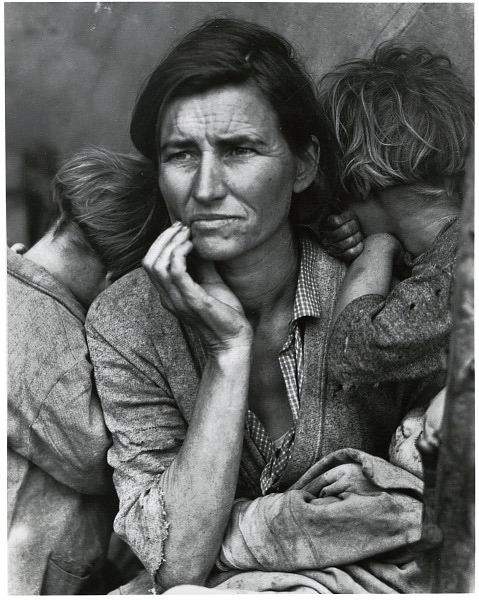
Lange, Dorothea. Migrant Mother, Nipomo, California. 1936, Library of Congress, www.loc.gov/item/2017763020/.
- Photography:
- Dorothea Lange’s Migrant Mother captured the struggles of the time.
- 1935 — Kodachrome film was invented by Kodak. This was a huge leap forward because it made color photography much more practical for average people. Kodachrome produced vivid, beautiful colors and became very popular for home photos, magazine shoots, and even journalism.
Language & Writing
- Newspapers, pamphlets, and radio were main sources of information.
- Slang from the era:
- “Scram!” (Go away)
- “Giggle water” (Alcohol)
- “Dame” (Woman)
Technology & Household Appliances
New Tools & Inventions
- Household Appliances – More homes gained electric refrigerators, washing machines, and vacuum cleaners, but many still relied on iceboxes and hand-washing.
- Transportation – Automobiles became more affordable (Ford Model A).
- Telephones – More common, but party lines (shared lines) were the norm in rural areas.
- Radio – Became the center of home entertainment and news.
Technological & Scientific Advancements
- 1927 – First Successful Transatlantic Flight: Charles Lindbergh completed the first solo nonstop transatlantic flight in The Spirit of St. Louis, making aviation history.
- 1928 – Discovery of Penicillin: While Alexander Fleming made the discovery in Britain, penicillin’s later mass production in the U.S. (during WWII) changed medicine forever.
- 1930 – The Jet Engine Concept: American engineer Frank Whittle developed early designs that would later lead to the first jet engine.
- 1935 – The First Parking Meters: Installed in Oklahoma City, these became a fixture in urban planning.
- 1938 – First Ballpoint Pen Patented in the U.S.: This would later revolutionize how people wrote and took notes.
- 1939 – First Commercial Air Travel Across the Atlantic: Pan American Airways completed the first passenger flights between the U.S. and Europe.
Major Battles & Military Events
- 1921 – Battle of Blair Mountain: The largest armed uprising in U.S. history since the Civil War, where 10,000 coal miners in West Virginia fought for better working conditions against armed forces backed by mine operators.
- 1932 – The Bonus Army March: World War I veterans marched on Washington, demanding early payment of their promised bonuses. The U.S. Army, under General Douglas MacArthur, forcefully removed them.
- 1934 – The Dust Bowl Begins: One of the worst environmental disasters in U.S. history, caused by severe drought and poor farming practices, leading to mass migrations from the Great Plains.
Extreme Weather & Natural Disasters
- 1927 – The Great Mississippi Flood: One of the worst floods in U.S. history, displacing over 600,000 people and leading to significant changes in flood control policies.
- 1935 – The Great Labor Day Hurricane: A Category 5 hurricane that struck the Florida Keys, killing over 400 people and devastating the region.
- 1936 – The North American Heat Wave: One of the deadliest heat waves in U.S. history, exacerbating the effects of the Great Depression and the Dust Bowl.
Cultural & Social Moments
- 1924 – Native American Citizenship Act: Granted U.S. citizenship to all Native Americans, though many continued to face discrimination and were barred from voting.
- 1927 – The First “Talkie” Film, The Jazz Singer: This movie revolutionized Hollywood by introducing synchronized sound to film, ending the silent film era.
- 1929 – The Stock Market Crash: The beginning of the Great Depression, leading to widespread economic collapse and unemployment.
- 1933 – The End of Prohibition: The 21st Amendment repealed Prohibition, bringing back the legal sale of alcohol after 13 years.
- 1936 – Jesse Owens at the Berlin Olympics: An African American track star won four gold medals, defying Adolf Hitler’s racist ideologies and becoming an American hero.
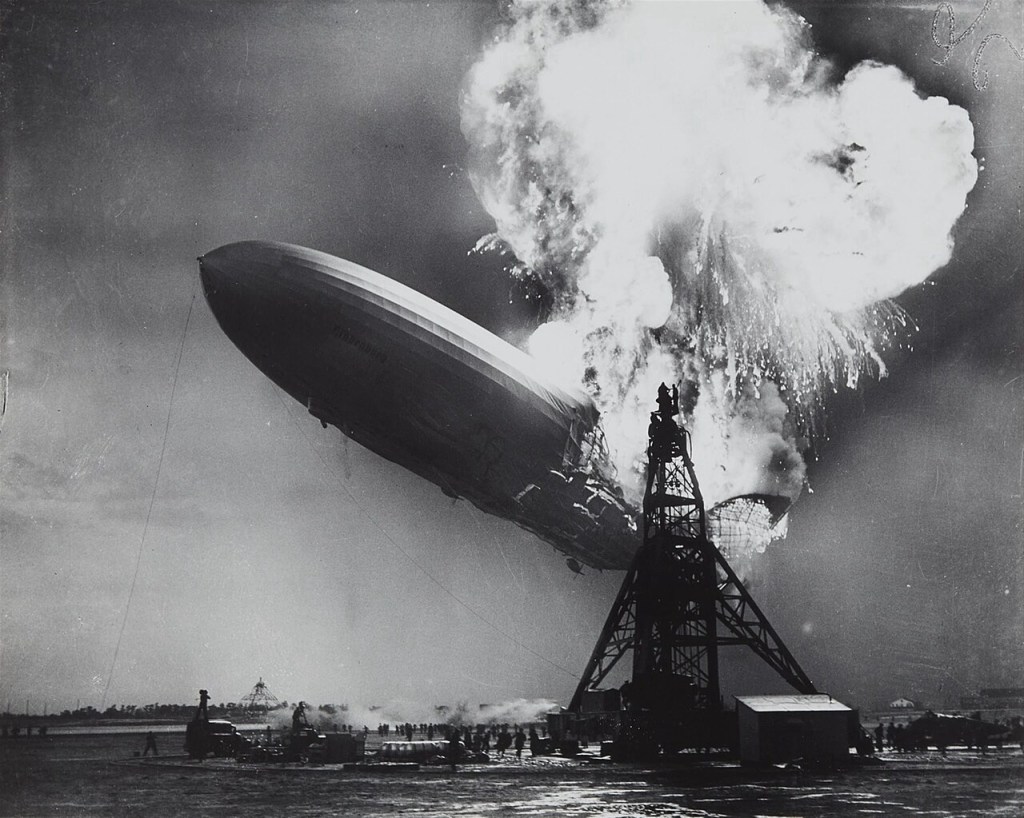
Hindenburg Disaster. 6 May 1937. Photograph by Sam Shere. Wikimedia Commons, https://commons.wikimedia.org/wiki/File:Hindenburg_disaster.jpg.
- 1937 – The Hindenburg Disaster: The German airship Hindenburg caught fire while landing in New Jersey, marking the end of commercial airship travel.
- 1937 – Snow White and the Seven Dwarfs: The first full-length animated feature film, revolutionizing animation and making Walt Disney a household name.
Entertainment
The 1920s and early 1930s were an iconic time for American entertainment, and it’s hard to overstate just how much this decade shaped pop culture as we know it today. The Roaring Twenties brought a surge of creativity and innovation across music, movies, and beyond. Jazz exploded onto the scene, with artists like Louis Armstrong and Bessie Smith becoming household names, setting the stage for a musical revolution that’s still influential today. It was the age of flappers, speakeasies, and the undeniable rhythm of big band jazz that made people want to get up and dance.
Meanwhile, the movie industry was thriving with the introduction of sound in film, marking the beginning of “talkies” and forever changing the cinematic experience. Silent film stars like Charlie Chaplin gave way to the glamorous world of Hollywood icons such as Greta Garbo and Rudolph Valentino. The decade offered a wealth of entertainment, from lavish movie palaces to music that became the soundtrack of a generation’s changing social norms. So, whether you were heading to a jazz club or the latest film screening, the 1920s-1930s were a time when Americans truly found their rhythm in both music and movies.
Playlist
- “Crazy Blues” – Mamie Smith (1920)
- Considered the first recorded blues song by an African American artist, paving the way for future blues musicians.
- “Swanee” – Al Jolson (1920)
- A lively and popular song that became one of Jolson’s biggest hits, capturing the spirit of the early 1920s.
- “Whispering” – Paul Whiteman (1920)
- A best-selling instrumental hit showcasing Whiteman’s orchestra and the rise of jazz-influenced dance music.
- “St. Louis Blues” – Bessie Smith with Louis Armstrong (1925)
- A blues classic featuring Bessie Smith’s powerful vocals and Louis Armstrong’s masterful trumpet playing.
- “My Blue Heaven” – Gene Austin (1927)
- A sentimental ballad that became one of the best-selling songs of the decade, reflecting domestic ideals of the era.
- “Sing, Sing, Sing” (1936) – Benny Goodman
- One of the most iconic swing-era songs, this big band anthem defined the jazz sound of the 1930s.
- “Stardust” (1927) – Hoagy Carmichael
- A timeless jazz standard, this song became one of the most recorded tunes of the early 20th century.
- “Cheek to Cheek” (1935) – Fred Astaire
- Featured in Top Hat, this elegant and romantic song became a defining moment in 1930s music.
Adult Movies/TV Shows/Books
- Book: The Great Gatsby (Book, 1925 & Movie, various adaptations) – F. Scott Fitzgerald’s novel (and its many film adaptations) captures the lavish yet hollow world of the Jazz Age.
- Movie: The Jazz Singer (1927) – The first feature-length film with synchronized sound, marking the transition from silent films to “talkies.”
- Movie: City Lights (1931) – Considered Chaplin’s masterpiece, this silent film (released after the rise of talkies) tells a heartfelt story of the Tramp trying to help a blind flower girl. It’s often ranked among the greatest films ever made.
- Movie: King Kong (1933) – A groundbreaking monster movie that introduced audiences to special effects and stop-motion animation.
- The Grapes of Wrath (Book, 1939 & Movie, 1940) – John Steinbeck’s novel (and later film) about a struggling family during the Great Depression, highlighting the hardships of Dust Bowl migrants.
- Movie: Gone with the Wind (1939) – One of the most famous films of all time, known for its epic storytelling and historical significance.
- Movie: The Wizard of Oz (1939) – An iconic fantasy film that introduced Technicolor magic to audiences and became a pop culture phenomenon.
- Movie: Thoroughly Modern Millie” (1967) – A musical film set in the 1920s, following a young woman’s adventures in New York City.
- Movie: O Brother, Where Art Thou? (2000) – A quirky retelling of The Odyssey, set in Mississippi during the Great Depression, following three escaped convicts on a journey filled with period-accurate music and themes.
- Movie: Public Enemies (Movie, 2009) – A crime drama based on the real-life exploits of Depression-era bank robber John Dillinger, played by Johnny Depp.
- TV Show: Boardwalk Empire (2010-2014) – A critically acclaimed HBO series set in Atlantic City during Prohibition, following the political and criminal underworld of the era.
Children’s Movies/TV Shows/Books
- Book & Movie: Kit Kittredge: An American Girl (2000 book, 2008 movie) – Follows a young girl growing up in Cincinnati during the Great Depression, highlighting how families adapted to economic hardship.
- Book: “The Boxcar Children” by Gertrude Chandler Warner (1924)
A story about four orphaned children creating a home in an abandoned boxcar, highlighting themes of resilience during tough times. - Movie & Comics: Popeye (1929-Present) – Originally a comic strip that debuted in 1929 and later became a cartoon, Popeye reflects Depression-era struggles with humor and themes of perseverance.
- Movie: Annie (1982, based on 1924 comic strip Little Orphan Annie) – Set in the Great Depression, this classic musical follows an optimistic orphan who finds hope in tough times.
- Book: Moon Over Manifest by Clare Vanderpool (2010) – A historical fiction novel about a girl uncovering the past of a small Kansas town during the late 1920s and early 1930s.
- Books: Nancy Drew series by Carolyn Keene (1930) – Launching right at the start of the 1930s, this iconic young detective gave readers a smart, resourceful heroine to admire during tough times.
- Comic Book: Superman (Debuted in Action Comics #1, 1938)
America’s first superhero exploded onto the scene offering hope, justice, and the ultimate power fantasy—perfect for Depression-era kids (and adults). - Comic Book: Batman (Debuted in Detective Comics #27, 1939)
A brooding billionaire turned vigilante? Batman brought a darker, more mysterious energy to comics just before WWII, captivating young readers everywhere.
1930s-Authentic Meal Plan
Breakfast:
- Beverage: Freshly brewed coffee or a glass of milk, depending on availability.
- Meal: A choice of eggs, either scrambled, poached, or fried in lard, or a bowl of cereal such as cornflakes, served with fresh milk or evaporated milk.
Dinner:
- Light Snack: Peanut Butter & Cracker Sandwiches – A simple yet satisfying snack made by spreading peanut butter between two saltine crackers.
- Entrée:Classic Meatloaf – Ground beef mixed with breadcrumbs, onion, salt, pepper, and an egg, shaped into a loaf and baked in a wood-fired or gas oven.Sides:
- Mashed Potatoes – Russet potatoes peeled, boiled, and mashed with butter, salt, and a splash of milk.
- Green Beans – Fresh or canned green beans simmered with a bit of pork fat for flavor.
- Dessert: Wacky Cake – A Depression-era chocolate cake made without eggs, butter, or milk, using flour, cocoa powder, sugar, vinegar, baking soda, water, and oil.
- Beverage: A glass of homemade iced tea sweetened with sugar, or ginger ale for those able to afford bottled soft drinks.
Modern Twist Meal Plan
Breakfast:
- Beverage: A freshly brewed latte or almond milk latte for a modern touch.
- Meal: Fluffy Scrambled Eggs with Whole-Grain Toast – Soft scrambled eggs cooked with butter, served alongside whole-grain toast with avocado spread.
Dinner:
- Light Snack: Peanut Butter & Honey Crostini – Toasted baguette slices topped with creamy peanut butter and a drizzle of honey, adding a modern gourmet spin.
- Entrée:Gourmet Meatloaf with Caramelized Onion Glaze – Classic meatloaf upgraded with a glaze of caramelized onions, balsamic vinegar, and brown sugar for depth of flavor.Sides:
- Garlic Parmesan Mashed Potatoes – Creamy mashed potatoes with roasted garlic, Parmesan cheese, and a drizzle of olive oil.
- Sautéed Green Beans with Almonds – Fresh green beans sautéed with butter, garlic, and slivered almonds for a crunchy, nutty enhancement.
- Dessert: Decadent Dark Chocolate Wacky Cake – The classic recipe remains but is enhanced with espresso powder and a touch of sea salt for richness.
- Beverage: A chilled herbal iced tea infused with citrus and mint, or a homemade ginger spritzer using fresh ginger syrup and sparkling water.
 Time Traveling Table

Leave a comment