
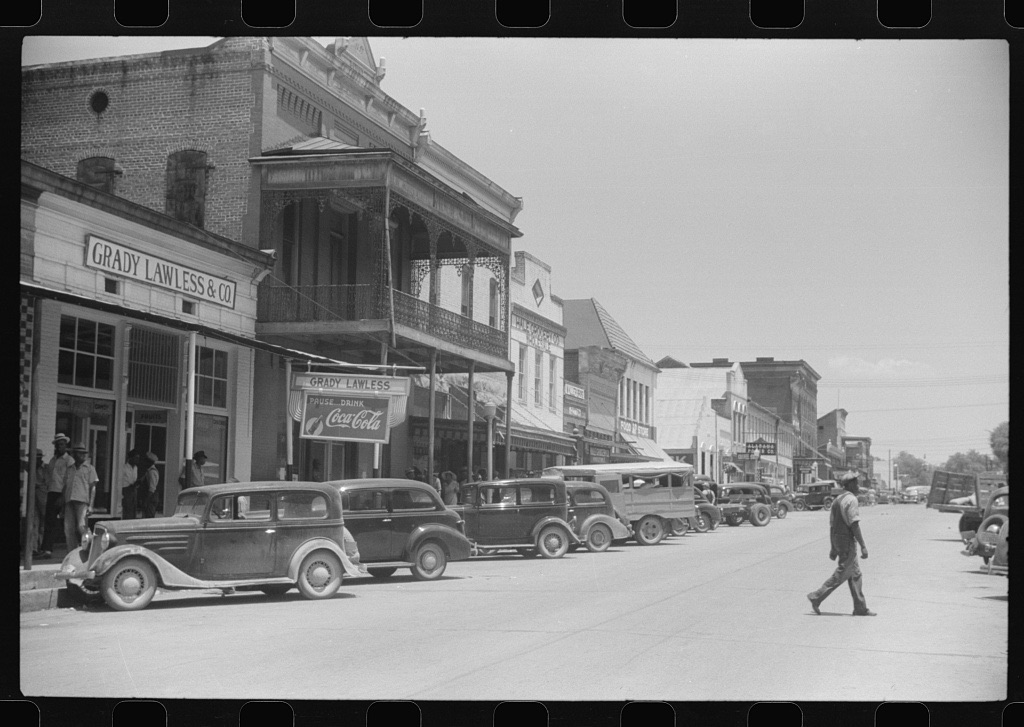
Delano, Jack, photographer. Main street of Greensboro, Alabama. Alabama Greensboro United States, 1941. May. Photograph. https://www.loc.gov/item/2017749564/.
Just so we’re all on the same page. Please ensure you’ve made yourself acquainted with my disclaimer
Population
- Estimated U.S. Population: 132,164,569 people
- This was an increase of about 7% from the 1930 Census
Biggest Cities
- New York City, New York
Population: 7,454,995
By far the largest city, more than triple the size of the next biggest city. It was a major center for finance, culture, and immigration. - Chicago, Illinois
Population: 3,396,808
A booming hub for manufacturing, meatpacking, and railroads. Chicago was an essential part of America’s industrial power. - Philadelphia, Pennsylvania
Population: 1,931,334
Known for its shipbuilding and manufacturing industries, Philadelphia was a key East Coast industrial city. - Detroit, Michigan
Population: 1,623,452
Center of the American automobile industry (home to Ford, General Motors, and Chrysler), and soon would become vital to WWII manufacturing efforts. - Los Angeles, California
Population: 1,504,277
A fast-growing city fueled by Hollywood, aviation, and military contracts, it was transforming into a major American metropolis.
Daily Life: Diet, Clothing, and Housing
Diet
- Staple Foods:
- Meats: Beef, chicken, pork (but rationed during WWII).
- Bread: Homemade or bakery-bought white and wheat bread.
- Vegetables: Potatoes, carrots, cabbage, corn.
- Canned Goods: Green beans, tomatoes, peaches (especially during wartime shortages).
- Drinks: Coffee, tea, milk, homemade lemonade, water.
- Sweets: Sugar was rationed during WWII; honey and molasses were used more often.
- Victory Gardens: During WWII, Victory Gardens were a way for Americans to support the war effort by growing their own food, reducing pressure on the commercial food supply. People cultivated vegetables in backyards, empty lots, schoolyards, and even rooftops. By 1944, these gardens produced nearly 40% of all vegetables grown in the U.S.
Clothing
- Men: Suits, fedoras, suspenders. Even casual wear was formal by today’s standards.
- Women: Dresses with fitted waists and padded shoulders, stockings (rationed), and practical shoes.
- Children: Simple cotton shirts, overalls, and dresses.
- WWII Impact: Clothing was more utilitarian due to fabric rationing (introduced “make do and mend” culture).
Housing
- Typical Homes: Modest, often two bedrooms, one bathroom, wood-framed or brick.
- Appliances: Iceboxes (early refrigerators), stoves (wood or gas-powered), radios (centerpiece of home entertainment).
- Suburbs: Post-WWII, suburban neighborhoods started booming with the GI Bill.
Health and Medicine
Life Expectancy
- If you survived childhood, your average life expectancy was about 63-65 years.
- Infant mortality rate: About 4-5%.
Healthcare
- Antibiotics: Penicillin was discovered earlier but mass-produced during WWII, saving millions of lives.
- Vaccines: Smallpox and diphtheria vaccines existed.
- Doctors: Made house calls; hospitals were basic by modern standards.
Social Structures
Marriage and Family
- Marriage Age:
- Women: Around 20-22 years old.
- Men: Around 22-24 years old.
- Monogamy was the societal norm.
- Children: Families often had 3 to 4 children, though during the Great Depression era leading into the 1940s, birth rates slightly declined.
Challenges for Children
- Many kids worked on farms.
- Schooling was more common but education past 8th grade was not guaranteed in rural areas.
- Health issues like polio, scarlet fever, and mumps were significant threats.
Games & Leisure
- Games:
- Board Games: Monopoly, Checkers, and Sorry!
- Old Maid, Go Fish, and War
- Outdoor Play: Hopscotch, Marbles, Red Rover, Marbles, Stickball (a street version of baseball), Jump rope and double-dutch
- Radio Shows: The radio was the centerpiece of home entertainment. With some popular shows being “Fibber McGee and Molly,” “The Shadow,” and news broadcasts
- Movies: Huge entertainment — drive-in theaters became popular. Most adults saw movies weekly (many theaters offered double features for $0.25–$0.50).
- Reading: Newspapers were essential for news and entertainment. Series like “Nancy Drew” and “The Hardy Boys” were popular at the time for children. “The Grapes of Wrath” was popular for adults.
- Social Dancing: Ballrooms and dance halls were hot spots — swing dancing and jitterbug were king. Live music from big bands was a central part of social nightlife.
- Church, Community & Civic Clubs: Church attendance was high and central to social life.
- People joined groups like: American Legion, Rotary Club, Ladies’ Aid Societies
- Live Events: County fairs, church picnics, and town parades were major social gatherings. Many towns also had live theater, traveling shows, or patriotic events (especially during WWII).
- Popular Plays & Theatre
Broadway and regional theaters were still strong (though Broadway slowed during the war years). Notable plays of the 1940s include:- The Glass Menagerie (1944) — Tennessee Williams’ breakout play
- Death of a Salesman (1949) — Arthur Miller’s groundbreaking American tragedy
- Oklahoma! (1943) — Revolutionary for musicals; huge cultural moment
- Arsenic and Old Lace (1941) — Dark comedy; very popular and adapted into a film
- South Pacific (1949) — Musical by Rodgers and Hammerstein; tackled race and war themes
Money and Economy
$1 in 1940 is roughly equal to $22.29 today (2025 dollars).
Income
- Average annual income:About $1,300–$2,000 a year (≈$28,977 – $44,580 today)
- Average Salaries
- Farm Laborer: about $500/year (≈ $11,145 today).
- Elementary School Teacher: about $1,200/year (≈ $26,748 today).
- Factory Worker: about $1,400/year (≈ $31,202 today).
- Police Officer: about $1,600/year (≈ $35,664 today).
- Nurse: about $1,700/year (≈ $37,893 today).
- Secretary: about $1,900/year (≈ $42,351 today).
- Engineer: about $3,000/year (≈ $66,870 today).
- Doctor: about $5,000/year (≈ $111,450 today).
Economy
- During WWII, factories switched from consumer goods to wartime production (planes, tanks, weapons), causing many shortages on everyday items.
- After the war, the U.S. experienced one of the largest economic booms in history — people had saved money during wartime rationing and now had cash to spend. The middle class grew rapidly, and the idea of the “American Dream” — owning a home, a car, and raising a family — became a reality for many.
Cost Common Purchases
- Loaf of Bread: about $0.10 (≈ $2.23 today).
- Pound of Coffee: about $0.21 (≈ $4.68 today).
- Movie Ticket: about $0.25 (≈ $5.57 today).
- Dozen Eggs: about $0.27 (≈ $6.02 today).
- Gallon of Milk: about $0.52 (≈ $11.59 today).
- Pair of Shoes: about $3.00 (≈ $66.87 today).
- New Car: about $850 (≈ $18,946 today).
- Average monthly rent: about $27–$30 per month (≈ $600–$670 per month today)
- New Home (Average Price): about $3,000 (≈ $66,870 today).
Religion and Faith
- Faith was central to daily life.
- Protestant Christianity was the dominant faith, followed by Catholicism and Judaism.
- Church attendance was high, and churches were community hubs.
Art and Culture
Defining Art Styles
- This decade saw a shift from realism (art that looks like real life) to abstraction (art based on ideas, emotion, and movement).
- American Regionalism: Artists like Grant Wood (famous for American Gothic) painted rural American life.
- Abstract Expressionism (starting late 1940s): Artists like Jackson Pollock began introducing new experimental styles.
- Photography: Dorothea Lange captured everyday American struggles through her photographs.
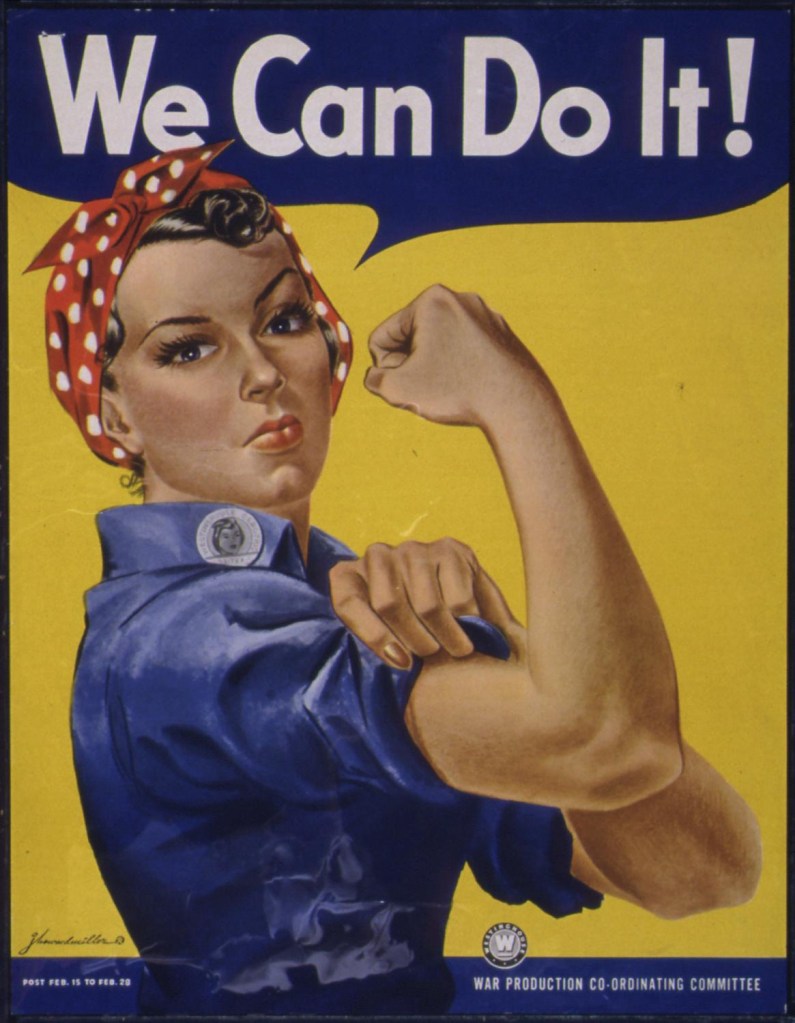
War Production Co-Ordinating Committee, United States Creator. We Can Do It! Rosie the Riveter. United States of America, 1942. Photograph. https://www.loc.gov/item/2021669753/.
- Patriotism and wartime propaganda (especially in posters and government-commissioned murals)
Writing and Language
- Popular Authors: John Steinbeck (The Grapes of Wrath), Richard Wright (Native Son).
- Writing was realistic, often dealing with struggles from the Great Depression and WWII.
- Language: Formal English in writing; more colloquial speech patterns were developing.
Tools and Appliances
Common Tools
- Manual typewriters
- Hand-operated washing machines
- Iceboxes for cooling food
- Hand-cranked egg beaters
- Rotary dial telephones
- Wood-burning or gas stoves
New Appliances Introduced
- Refrigerators (more homes started getting electric ones by late ’40s)
- Electric Mixers (like Sunbeam Mixmaster)
- Washing Machines (early electric models, though still rare)
- Television (VERY rare until late 1940s; post-war boom in TV sales)
Key Events and Advancements in America
1. World War II (1941-1945)
- Attack on Pearl Harbor (December 7, 1941):
- This surprise attack by Japan on the U.S. naval base at Pearl Harbor, Hawaii, led the United States to enter World War II. This moment was a pivotal turning point in U.S. military and global involvement.
- Major Battles:
- Battle of Midway (June 1942): A decisive naval battle in the Pacific, which shifted the balance of power in favor of the U.S. against Japan.
- D-Day (June 6, 1944): Allied forces, including U.S. troops, launched a massive invasion on the beaches of Normandy, France, which marked the beginning of the end for Nazi Germany.
- Battle of the Bulge (December 1944 – January 1945): The last major German offensive on the Western Front, which ultimately failed and paved the way for the Allied victory.
2. The Manhattan Project (1942-1945)
- The Manhattan Project was a top-secret initiative that developed the first nuclear weapons. The culmination of this project led to the bombings of Hiroshima and Nagasaki in 1945, hastening the end of World War II and forever changing global politics and technology.
3. The Homefront During WWII
- Rationing and War Bonds: The U.S. government introduced wartime rationing for essentials like food, gas, and clothing to support the war effort. Citizens were also encouraged to buy war bonds to finance military operations.
- Women in the Workforce: With so many men serving in the military, women entered the workforce in large numbers, taking on roles in factories, offices, and elsewhere — a significant cultural shift that had lasting impacts on gender roles in the workplace.
4. Civil Rights Movement: Early Foundations
- Executive Order 8802 (1941): Signed by President Franklin D. Roosevelt, this order prohibited racial discrimination in the defense industry and government, a major step in the fight for civil rights.
- Desegregation of the Military: While the military remained segregated during WWII, the groundwork for desegregation was laid, eventually leading to Executive Order 9981 by President Harry S. Truman in 1948, which ordered the desegregation of the armed forces.
5. The GI Bill (1944)
- The Servicemen’s Readjustment Act of 1944, commonly known as the GI Bill, provided veterans returning from WWII with benefits such as low-cost mortgages, low-interest loans, and tuition assistance for education. This helped foster the post-war economic boom, increased access to higher education, and enabled many to buy homes.
6. The Birth of the United Nations (1945)
- Following the devastation of World War II, the United Nations was established in 1945 with the goal of promoting international cooperation and maintaining peace. The U.S. was a founding member and has remained one of the most influential powers within the organization.
7. The Start of the Cold War (1947)
- The Truman Doctrine (1947) and the Marshall Plan (1948) were early steps in U.S. efforts to contain the spread of communism, marking the beginning of the Cold War. The U.S. began to assist European countries recovering from WWII, while tensions between the U.S. and the Soviet Union grew.
8. Significant Cultural Moments
- Hollywood Golden Age: The 1940s were a defining decade for Hollywood, with the rise of films like “Casablanca” and “Citizen Kane”, which set standards for the film industry.
- Swing and Jazz Music: Big Band, swing, and jazz reached their height during the 1940s, with artists like Duke Ellington, Glenn Miller, and Frank Sinatra becoming cultural icons.
- The Launch of the Drive-In Movie Theater: The first drive-in theater opened in 1933, but the 1940s saw an explosion in their popularity as more Americans embraced car culture.
9. Extreme Weather
- 1947 Texas and Oklahoma Drought: The drought of 1947 had significant agricultural and economic impacts on the Great Plains and Southwest. This period of extreme weather hurt farmers, leading to crop failures and financial struggles in the region.
- The 1949 Pacific Northwest Earthquake: A major earthquake occurred in the Pacific Northwest, particularly impacting Seattle, Washington. It was a key event that helped boost the understanding of seismic activity in the U.S.
10. The Baby Boom (1946-1964)
- Post-WWII Baby Boom: With soldiers returning from the war, there was a sharp increase in birth rates, which led to a population explosion and cultural changes. The Baby Boom had profound social and economic consequences that shaped America for decades. From 1940 to 1947, birth rates increased by about 37%
A Pop Culture Snapshot of 1940s America
The 1940s weren’t just about ration books, victory gardens, and shoulder pads—they were also a cultural powerhouse. With the world in flux and the U.S. emerging from the Great Depression into war and postwar recovery, Americans leaned hard into their entertainment. And in doing so, they helped shape the golden age of music, film, and literature.
Music? Think jazz, big bands, and the croon of Bing Crosby. This was the era where swing ruled the airwaves, and jukeboxes were basically emotional support machines. You weren’t living unless you’d slow danced to Glenn Miller’s “Moonlight Serenade” or belted out “Boogie Woogie Bugle Boy” in the kitchen with your sisters.
Movies? Golden Age Hollywood was in full swing. Picture Casablanca smoldering on the silver screen, Judy Garland making us believe in rainbows, and Disney enchanting families with Dumbo—an elephant with ears and a whole lot of heart. Even in the middle of war, Americans lined up for movie magic and matinees, because escapism was more than a luxury—it was necessary.
Books? While the kids were devouring Nancy Drew mysteries and cheering for The Hardy Boys, adults were tackling stories that made sense of a chaotic world. The written word became a vehicle for both comfort and courage—something to hold onto in a time when everything else was shifting.
Entertainment didn’t just reflect the times—it defined them. Whether through song lyrics, silver screen scripts, or plot twists in a detective novel, culture was quietly (and sometimes loudly) guiding values, sparking hope, and building a sense of shared American identity.
So grab your popcorn (or your powdered milk cocoa) and dive in—we’re about to explore the hits, the heroes, and the cultural game-changers that made the 1940s unforgettable.
Playlist
“Boogie Woogie Bugle Boy” — The Andrews Sisters (1941)
- Upbeat, fun, and a patriotic WWII classic that became one of the defining songs of the decade.
“I’ll Be Seeing You” — Billie Holiday (1944)
- A soulful, poignant ballad that became an emotional anthem for many during World War II.
“Take the ‘A’ Train” — Duke Ellington (1941)
- A quintessential jazz standard with smooth, lively rhythms — representing the height of the Big Band jazz era.
“Night and Day” — Frank Sinatra (1942)
- A classic crooner tune by Sinatra, showcasing his romantic ballad style, very much of the 1940s sound.
“Chattanooga Choo Choo” — Glenn Miller (1941)
- Another iconic track from Glenn Miller’s orchestra, blending catchy lyrics with lively big band sound.
Adult Movies/TV Shows/Books
- The Best Years of Our Lives (1946, Film)
A very famous movie about American soldiers returning home after World War II, struggling to adjust to civilian life. - Band of Brothers (2001, TV Miniseries)
Though produced later, this HBO series is a stunningly accurate depiction of the WWII American experience (paratroopers in Europe). - The Grapes of Wrath (1940, Film and Book by John Steinbeck)
Captures the hard reality of American families (especially poor farmers) leading right into the early 1940s — heavily associated with the era. - A Tree Grows in Brooklyn (1945, Film and Book by Betty Smith)
A classic coming-of-age story set in Brooklyn during the early 20th century — very popular with 1940s readers and very true to daily life. - The Philadelphia Story (1940, film)
A romantic comedy of classic high-society meets personal transformation. - Pearl Harbor (2001, film)
Though a modern film, it dramatizes the infamous 1941 attack with a sweeping romance and war backdrop. - Saving Private Ryan (1998, film)
Directed by Steven Spielberg and starring Tom Hanks, this WWII drama is known for its brutally realistic depiction of the D-Day invasion. Though a later film, it remains one of the most respected portrayals of American soldiers’ experiences in the 1940s. - Citizen Kane (1941, film)
Often cited as the greatest film ever made, Orson Welles’s groundbreaking drama about media magnate Charles Foster Kane revolutionized cinematic storytelling. Its non-linear narrative, deep-focus cinematography, and symbolic depth made it a powerful critique of power and American ambition.
Children’s Movies/TV Shows/Books
- Dumbo (1941, Disney Animated Film)
Simple, emotional, and completely iconic to 1940s childhood — fits perfectly! - Make Way for Ducklings (1941, Book by Robert McCloskey)
A beloved children’s book about a duck family living in Boston — classic, gentle, and a staple of American childhood in the 1940s. - Little House on the Prairie (TV Show based on Books, 1970s-1980s, but set earlier)
While the story is set in the late 1800s, the TV show became massively iconic in the 1940s revival of wholesome American pioneer life. The original books were widely read in the 1940s. - Bambi (1942, Disney Animated Film)
One of the most important Disney films of the decade, showing nature, life, loss, and innocence — all major themes of 1940s childhood culture. - The Poky Little Puppy (1942, Picture Book by Janette Sebring Lowrey)
One of the original Little Golden Books, it became one of the best-selling children’s books of all time, reflecting the post-war boom in children’s publishing. - Captain America Comics (First published in 1941)
Introduced at the height of WWII, Captain America was the patriotic superhero who took on Nazis before the U.S. had even entered the war. He quickly became a symbol of courage, justice, and resilience—hugely popular among American kids in the 1940s and a beloved character to this day.
1940s Authentic Meal Plan
(Using only ingredients and tools available in a 1940s American kitchen)
Breakfast:
- Leftover Bread Pancakes
(Made from day-old bread crumbs, milk, egg, a spoonful of sugar, and fried on a cast-iron skillet until golden.) - Beverage:
Hot black coffee or a glass of fresh cow’s milk.
Light Snack:
- Oatmeal Honey Bread
(A thick slice of homemade oatmeal bread, sweetened with a touch of honey. Served plain or spread with butter.)
Dinner:
- Entrée:
Chicken and Dumplings
(Stewed chicken with carrots, celery, and onion, simmered slowly on the stove. Dumplings made from scratch — flour, baking powder, lard or butter, and milk — dropped directly onto the bubbling stew to cook.) - Side:
Stewed Tomatoes
(Canned tomatoes simmered with butter, breadcrumbs, salt, and a spoonful of sugar until tender.) - Beverage:
Fresh brewed iced tea, sweetened lightly with sugar and served over ice blocks from the icebox.
Dessert:
- Apple Brown Betty
(Sliced apples layered with buttered breadcrumbs, sprinkled with cinnamon and sugar, baked in a wood-fired or gas oven until bubbling and golden.)
Modernized 2025 Meal Plan
(Same spirit, but with modern ingredients, tools, and a slight elevation in flavor and presentation)
Breakfast:
- Leftover Bread Pancakes
(Blend day-old brioche or artisan bread with whole milk, egg, vanilla extract, and a touch of cinnamon. Pan-fry in butter until crispy outside, custardy inside.) - Beverage:
Fresh-ground coffee made in a French press, with optional cream and sugar.
Light Snack:
- Oatmeal Honey Bread
(Thick-cut slice of artisanal oatmeal honey bread, served lightly toasted with whipped butter or almond butter.)
Dinner:
- Entrée:
Chicken and Dumplings
(Sous-vide or oven-roasted chicken thighs for extra tenderness, shredded into a rich homemade broth flavored with fresh thyme and rosemary. Modern biscuit dumplings made with buttermilk and a pinch of smoked salt, cooked fluffy over the broth.) - Side:
Stewed Heirloom Tomatoes
(Rainbow heirloom tomatoes gently simmered in brown butter with fresh basil, shallots, and a hint of balsamic vinegar for depth.) - Beverage:
Herbal iced tea infused with lemon verbena and a splash of agave syrup, served over crushed ice.
Dessert:
- Apple Brown Betty
(Honeycrisp apples layered with spiced oat crumble instead of breadcrumbs, lightly sweetened with maple syrup and baked. Served warm with a dollop of vanilla bean whipped cream.)
 Time Traveling Table
Leave a comment