
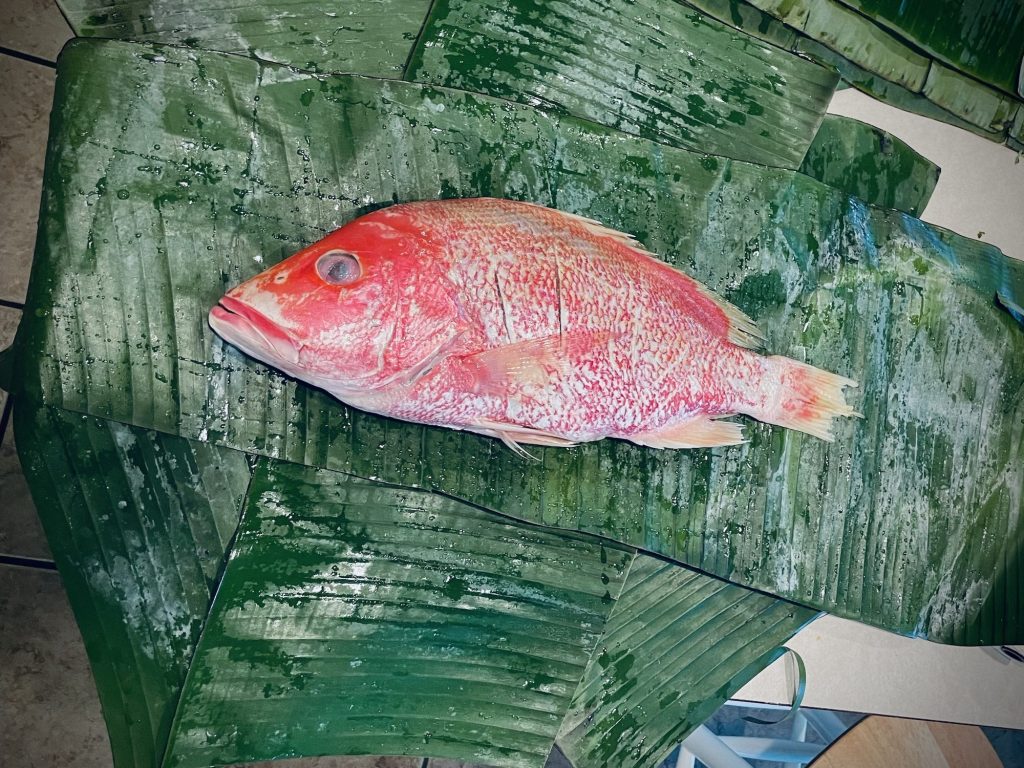
Okay, so while I am actually not a fan of seafood, I decided to do this anyway. While at my local Mexican market, I saw a whole red snapper and I was like, “OMG! If any time was the time, now is it!” Bringing this home was an adventure, my children were instantly fascinated and wanted to touch it (my son even poked the poor fish right in the eye). They thought it was the coolest thing.
Now, here’s the wild part: red snapper isn’t just “a fish.” It’s been part of coastal diets for literally thousands of years. If we were back in 13,000 BC, this catch could have been roasted over an open fire by early fishing communities along the Gulf of Mexico or Pacific coastlines, its firm flesh flavored simply with gathered herbs and wrapped in leaves to trap in moisture. Fishing back then wasn’t just about dinner, it was survival, tradition, and often community celebration. The bones could be turned into tools, as nothing went to waste.
So while my kids loved inspecting the raw fish, the moment it emerged cooked from its banana leaf wrap, they gave a collective “ew.” I can’t blame them, we’ve eaten seafood before, but never a whole fish. We’ve done the typical sanitized, fillet-from-the-store. Completely whitewashed from where this meat actually came from. Still, the whole thing was a blasty blast level of new. My husband and son took charge of fire duty while the women prepped the fish, because… some things never change. When it came off the heat, perfectly moist and not at all dry, I felt like I’d just unlocked an ancient cooking achievement.
Another unexpected perk? I basically got to do a full-on biology lab dissection. Did you know red snapper have teeth? And a tongue? (Yes, I tried the tongue, it tasted just like the rest of the meat.) The bones were sharp and flexible, and I could instantly see how ancient peoples might have used them as sewing needles. My dog happily handled the eyeballs, so waste not, want not.
All in all, I feel victorious. I came. I cooked. I conquered. And for just a moment, I felt like I was right there with those first coastal fishers, thousands of years ago, making a meal that’s stood the test of time.
So if you feel curious enough to try, just remember, you’re not just cooking dinner, you’re connecting with thousands of years of tradition. Don’t let fear of the unknown stop you. This will be delicious, aromatic, and something to remember.
Ingredients
- Whole red snappers
- Coarse salt
- Optional stuffing: nopal slices, wild onion, citrus slices (modern touch), or extra herbs
- 4–6 large banana leaves, wiped clean (sub for agave)
- Natural fiber or kitchen twine (or just fold leaves tightly)
Prepare the Fish
- Score both sides of each fish (3–4 diagonal cuts) which helps it cook evenly. FYI: Either my knives are dull or you really gotta put some effort into this.
- Give it a rinse inside and out and pat dry. No extra water inside or outside; you want steam from the fish juices, not waterlogging.
- Give it a little salt massage on both sides before its spa date.
- Banana Leaves:
- Prep the banana Leaves. Banana leaves are stiff and can tear easily if you try to wrap them raw. Softening them makes them flexible and less likely to crack, which causes leaks and uneven cooking.
- Rinse both sides under cold water to remove dust, dirt, or any tiny critters.
- If there’s a thick central rib, trim it down with kitchen scissors so it’s not bulky when folded. You can keep the rib to act as skewers or fire starters if you want.
- Soften
- Over flame method (best for firepit cooking): Hold each leaf about 4–6 inches above low flames or hot coals, moving slowly so the heat passes over the surface. You’ll see the green turn brighter and glossy, and the leaf will suddenly feel floppy.
- Boil: If you can’t do flame-softening, place the leaves in a pot of boiling water for 30 seconds.
- Wrap tightly in banana leaves.
- Base layer: Lay 2 banana leaves overlapping in the middle like a big “+” sign. You want the overlap in the center so there’s no gap for steam to escape.
- Second layer: Rotate another 2 leaves 45° on top of the first cross so they overlap differently. This double-crisscross helps catch juices and keeps it sealed even if one layer tears or chars (as the outside most definitely will).
- Place the fish in the center with its head and tail both inside the leaves.
- Fold the bottom leaf over the fish, then the top leaf over, like closing a blanket.
- Fold in the sides, tuck them under the fish slightly so it’s snug.
- Check for gaps, if you see any open seams, patch them with smaller banana leaf pieces.
- Tie with twine or strips of softened banana leaf (or just fold seam-side down)
Cook the Fish
- Lay wrapped fish directly over the hot coals (or on a stone/grill grate just above them). Place the wrapped fish seam-side down first, this helps steam the fish and set the seal.
- Rule of Thumb for Whole Banana Leaf Wrapped Fish
- Cook for ~10 minutes per pound at a medium-hot fire (375–400°F / 190–200°C),
- Plus 5 extra minutes total for the banana leaves to steam and infuse flavor.
- Flip once halfway through (gently, use 2 spatulas or large tongs and a wide plate, or if your like my husband: yardworking gloves)
- Remove from grill, keep wrapped, rest 5 minutes.
Check Doneness:
- Insert a twig or knife, the fish should flake easily and steam visibly.
- Internal temp (if using a thermometer): 145°F
- No pink or translucent flesh
How to Serve
- Set the fish on a big platter or board. Let it rest a minute.
- Gently peel off the skin from the top side.
- Take a fork or spoon and slide the meat off the top fillet, away from the spine. It should lift easily. No bones.
- Once the top fillet is off, carefully lift the spine from head to tail. The whole skeleton will usually come off in one piece.
- Now you have the bottom fillet, clean and bone-free. Peel skin, serve.
A Little History Lesson
Would people in Mexico in 13,000 BC have used banana leaves for cooking? Unfortunately no, cause SURPRISE banana plants are not native to Mexico.
Bananas (Musa spp.) are native to Southeast Asia and were introduced to the Americas much later, around the 16th century, by Portuguese and Spanish explorers. I still went ahead and used them as this was the most easily accessible GIANT leaf for this for me.
What Could They Have Used Instead?
In 13,000 BC Mexico, people did wrap and steam food, but using native materials, such as:
Agave Leaves
- Common across central and northern Mexico. Large, fibrous, and fire-resistant. Roasting agave was a major food tradition.
- Leaves could be used to wrap small fish, seeds, or root vegetables for steaming.
Maize Husks (later)
- Once maize was domesticated (~5000–3000 BC), corn husks became the standard for wrapping (as in tamales).
- But not available yet in 13,000 BC.
Large Wild Leaves
- Possibly from chaya, anona family, or other local, broad-leafed plants.
- Used more for covering or layering, not always wrapping tight like banana leaves.
 Time Traveling Table
Leave a comment