
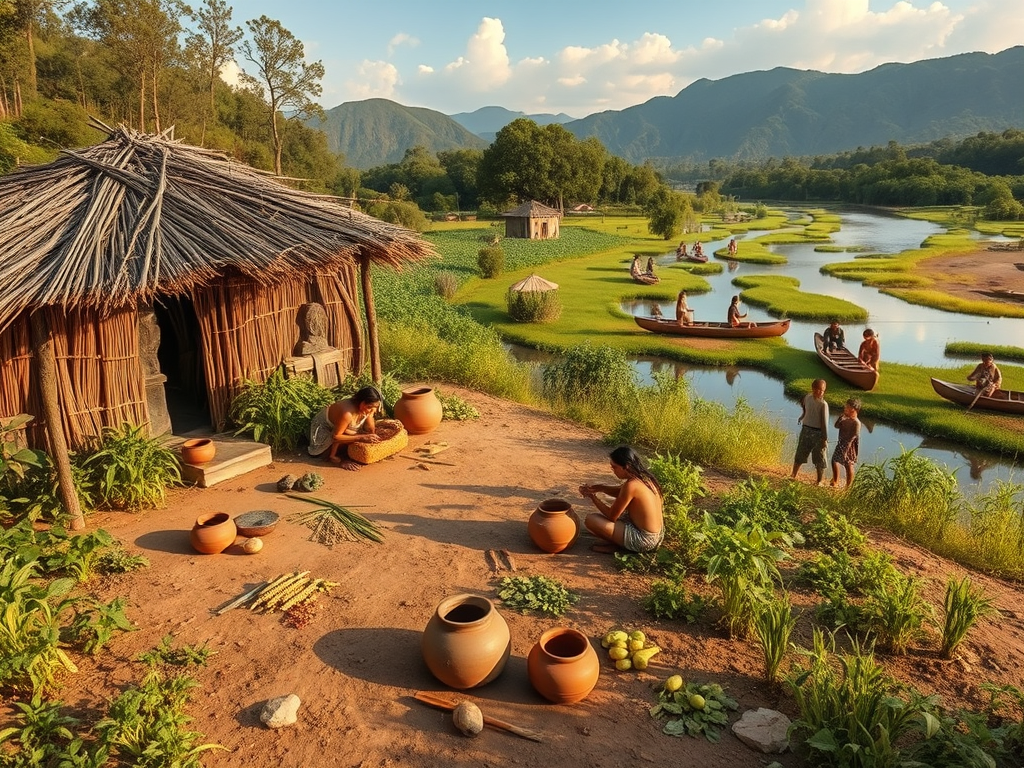
Travel back 5,000 years to the valleys of ancient Mexico, where families were just beginning to settle into farming life. In this post, we’ll uncover how people built their homes, fed their children, and found meaning in their days, long before pyramids or empires rose.
Just so we’re all on the same page. Please ensure you’ve made yourself acquainted with my disclaimer
Home Life
Step inside an ancient household: these early farming families lived in simple, earth-and-reed dwellings where space was shared, sleep followed the rhythm of the sun, and everyday “appliances” were grinding stones and dried gourds.
Estimated total population: roughly 10,000–300,000 people
Typical Home
A typical farming family hut was roomy enough for the family’s daily life but small by any later urban standard. Archaeologists working in early villages (for example in the Valley of Oaxaca) commonly recover one-room, rectangular wattle-and-daub houses of roughly ~18–28 m² (~190–300 square feet ). In plain village terms: a single open chamber where cooking, sleeping, storage, and craft all happen together. This one-room pattern is the standard story for early villages.
Sleep
- Beds: the universal “bed” is the petate (a woven reed mat). It’s a rolling mat that doubles as seating and bed rolled up in the day, unrolled at night or as needed. Petates are everywhere in the record and ethnographic analogy.
- Sleep schedule: people rose with first light and retired not long after dusk. Artificial light (small clay lamps, hearth embers) is scarce and dim; after dark is rest, story, and repair time, not late-night tasks. Hearth and embers define the household night.
- Napping: midday rests were likely routine, especially in hot seasons, shade under house eaves, beneath trees, or near water. In warm months the day’s work rhythm commonly breaks around the hottest hours; a mother grinding at a metate will pause, chats and small children may nap in the shade.
What was new since 5000 BC? What had changed in the household?
Between 5000 BC and 3000 BC the big household transformations in parts of Mesoamerica include:
- Fired clay vessels (ceramics): these begin to spread into parts of Mesoamerica, pottery communities appear regionally after 3000 BC in some coastal and valley zones, once households had clay ollas they could boil and store more reliably, which changes cooking (from only hot-stone roasting to pots and stews) and storage practices. (Important caveat: pottery appears earlier in South America and spreads northward; in Mesoamerica the process is uneven and region-by-region.)
- More permanent house architecture: intentional wattle-and-daub walls and thatch roofs replace more ephemeral shelters in many settled communities, producing the one-room house clusters we excavate. These houses support storage pits and more permanent craft areas.
Everyday household objects that mattered
- Metate / mano: daily grinding stone; household hearthstone neighbor.
- Petate (woven reed mat): bed, seat, and social marker in the domestic space.
- Clay pots and storage jars (ollas, if present regionally): for boiling, stewing, and holding maize/beans/water; once pottery arrives it changes cooking and storage.
- Hearth / three-stone stove area: the home’s energetic and symbolic center. Three stones set in a triangle form the classic fogón: fire burns in the middle, pots or a clay comal rest on top. It’s practical, portable, and later takes on deep cosmic symbolism.
- Textiles and bags: woven agave and cotton items for carrying, sleeping, and storage; evidence shows fiber craft as essential household technology.
- Calabash gourds and wooden bowls: natural containers (pre- and alongside early pottery) for liquids and seeds; multipurpose household vessels.
Fashion & Beauty Standards
Before looms and embroidered tunics, fashion in 3000 BC Mexico was simple but meaningful. What you wore was shaped by climate, available fibers, and cultural ideals of beauty. From woven wraps and fiber skirts to hairstyles, ornaments, and body paint, style was as much about identity as practicality.
Quick Note: I’ve got to be honest here… the archaeological record for fashion around 3000 BC in Mesoamerica is pretty thin. For this period, there are rare direct finds (bits of textiles, fiber impressions), we assume patterns that carry forward over centuries, and comparisons with later Indigenous traditions. It’s a little detective work, a little educated guesswork.
What did people wear?
- Materials: coarse agave/maguey fibers and wild plant bast were the everyday fibers, cotton existed but was likely limited and regionally patchy at 3000 BC. Skin, woven reeds, and simple stitched plant-fiber garments were common in small farming hamlets.
- Silhouettes (how they draped it): imagine wraps and simple panels, a rectangle of woven fiber tied at the shoulder, a short loin-cloth for working men, and simple wrap-skirts for women that could be folded and belted. There were no tailored, multi-piece outfits yet, garments were practical and multipurpose.
- Fastenings & closures: cords, ties, simple pins made of bone or shell. Knotted cords and twisted fiber belts kept wraps in place; necklaces and pins could help hold cloaks or mantles.
- Jewelry: Shell beads & pendants and worked stones were prized items and travel-goods, small beads strung on fiber could indicate status or origin.
Hair, facial hair, and grooming
- Hair: People likely wore long hair tied or plaited (women often plaited or wrapped hair; men tied back hair for work).
- Facial hair: variable; many early New World populations show limited facial hair, but for 3000 BC the safe statement is: functional grooming (trimming when needed)
How they kept clean
- Daily washing: water-accessible groups bathed in rivers or ponds; otherwise, wiping with water, ash, and plant suds was the norm.
- Soap plants & saponins: people used saponin-rich plants (yucca, soapwort family relatives) to make suds for washing hair, cloth, and bodies. The process is simple: crush roots/leaves, agitate in water, use the foam. This plant-soap technology is widespread among Indigenous groups and very likely part of the cleaning toolkit.
Average bodies
Caveat: These numbers come from later archaeological samples (after 3000 BCE). Earlier populations likely showed similar ranges, but height varied regionally and depended heavily on nutrition.
- Men’s average height (later Preclassic samples, ~not exact for 3000 BCE):
- ~160–165 cm (5’3”–5’5”)
- Women’s average height (later Preclassic samples):
- ~147–150 cm (4’10”–4’11”)
- Body build: Expect more robust, active physiques, shaped by daily farming, hunting, and heavy carrying, rather than today’s more sedentary builds.
Diet
In 3000 BC Mexico, meals came out of a mixed world of gardening, foraging, fishing, and hunting. Maize was starting to take center stage, but farming didn’t instantly erase foraging. Most households ran a blended economy where milpas (gardens), wild harvests, small game, and fish all still mattered.
Staples
- Maize / corn: this was moving from side dish to the heart of the meal. Communities were planting it more and more, then grinding it at home on the metate into flour or soft dough. Evidence from starch grains shows that in some regions corn had already become a daily staple. Think early forms of masa, tortillas, and porridge-style dishes.
- Squash & pumpkin: People ate both the soft flesh and the seeds (pepitas). But squash was more than food, its sprawling vines covered the soil, keeping it moist, blocking weeds, and protecting the garden from erosion. Together with maize and beans, squash formed part of the early milpa system, an integrated field where crops grew side by side, each supporting the others.
- Beans (frijoles): Beans were the perfect partner to maize, adding protein to the diet and, through their roots, putting nitrogen back into the soil. By this period they were becoming part of the early milpa system, where maize, beans, and squash were grown together in the same field.
- Amaranth, tubers, wild greens, cactus fruit: regional complements: coastal and lowland zones had tubers and fruits; highlands leaned on wild greens and seed processing.
- Protein from hunting & fishing: deer, rabbit, small mammals, birds, fish, and aquatic resources where available (seasonal and local, not always daily).
How much of the day was about food?
- Planting & tending: When fields were planted and growing, a household’s dawn to mid-morning and late-afternoon hours were often spent in the milpa: hoeing, weeding, re-tying vines.
- Processing & preparation: Much of the non-field day (mid-morning, after lunch, evening) was taken up by processing (grinding, shelling, drying, storing) and animal processing and butchery when available. Grinding on the metate was a recurring daily chore.
- Foraging & hunting: Hunting and fishing were seasonal and opportunistic, not full-time for settled households; groups still invested time in collecting wild plants and small game. For semi-sedentary groups, expect a mixed schedule: gardens most days, foraging/hunting interspersed seasonally.
On the Menu in 3000 BC Mexico
Step into the Early Agricultural period, long before pots and pans as we know them. Meals came from open fires, pit ovens, and stone tools, with ingredients limited to what the land offered. Simple? Yes. But also the foundation of Mexican cuisine as we know it.
Early Day
- Amaranth porridge: paired with roasted squash seeds for protein, topped with a handful of fresh-foraged berries like blackberries or raspberries.
- Drink: plain water, sometimes infused with fruit pulp (like cacao pulp if found).
Midday (Light food / while working or traveling)
- Handful of nuts and seeds: pine nuts, pepitas, or popped amaranth.
- Seasonal fruit: prickly pear cactus fruit, guava, or capulín cherries.
- Roasted tubers or roots: dug up and eaten warm or cooled from the fire.
Evening
- Turkey stew: Turkey stewed with squash and early beans, seasoned with stone-ground chilies, and finished with wild greens.
- Extra seasonal food:
- Charred cactus pads (nopales).
- Fresh or roasted fruits if abundant.
Sweet Treat (Seasonal / Occasional Dessert)
- Roasted agave hearts: sweet, caramel-like after slow cooking.
- Fresh fruit: guava, prickly pear, or berries if in season.
Common Drinks
- Plain water, flavored with fruit or herbs.
- Fresh agave sap (aguamiel).
- Simple herbal infusions (like hoja santa or epazote leaves steeped in water).
Modern Kitchen, Ancient Roots
Inspired by 3000 BC Mexico, this version adapts early flavors for today’s home kitchen. We swap fire pits for skillets and stone tools for blenders, adding small enhancements while keeping the heart of the tradition alive.
Breakfast
- Creamy amaranth porridge with a drizzle of honey, finished with salted toasted pepitas and a mix of fresh berries (blackberries, blueberries, raspberries)
- Drink: lightly infused water with citrus or a splash of herbal tea (mint, epazote, or hoja santa).
Afternoon Snack
- Trail mix of pepitas, toasted amaranth, and roasted nuts.
- Fresh seasonal fruit: guava, prickly pear, or even papaya.
- Roasted sweet potato wedges.
Dinner
- Modern turkey stew: Turkey simmered with black beans, butternut squash, chilies, onion, and garlic, finished with fresh herbs (such as cilantro or epazote) and topped with toasted pepitas.
- Extra seasonal food:
- Grilled cactus pads with a squeeze of lime.
- Side of fresh fruit salsa (guava, prickly pear, or mango as a modern addition).
Dessert
- Roasted agave syrup drizzle over grilled fruit (pineapple or prickly pear).
- Fruit compote (berries and guava, lightly cooked down).
Drinks
- Sparkling water with fresh herbs.
- Light herbal tea (mint, hoja santa, or lemongrass).
- Optional: craft cider or a light agave-based drink (pulque-inspired).
Climate & Environment
In 3000 BC Mexico, climate and landscape varied wildly, from cool highlands to humid coasts and dry northern plains, each shaping what people could grow, hunt, and build.
Quick note: Scientists can’t pull exact weather stats like daily humidity from 3000 BC. Instead, they look at clues in nature (things like lake levels, ancient pollen, or cave deposits) to get a picture of temperature and rainfall patterns. Any numbers here are best viewed as reasoned estimates, based on that kind of evidence, rather than precise readings.
1. Northwestern Coast & Gulf of California (the coastal plains of Sonora, Sinaloa, and Baja’s northern shores)
- Average temperature: ~20–24°C (68–75°F)
- Humidity & Rainfall: Seasonal rains provided enough moisture for shrublands and riverside vegetation, and humidity likely ranged from about 60–80% in the rainy season to 25–45% in the dry season
- How it feels: Warm, dry air most of the time, like standing in direct midday sun on a clear day. When the rains arrive, the air feels thick and heavy for a few hours before quickly drying again.
- Landscape: Coastal plains with thorny scrub and tall columnar cacti, salt flats near tidal channels, and small green strips along rivers and streams where freshwater kept gardens growing.
2. Northern High Plains (the Chihuahuan Desert and surrounding high plateaus in northern Mexico)
- Average temperature: ~12–18 °C (54–64 °F) (range depends on elevation; lower basins toward the warmer end).
- Humidity & Rainfall: semi-arid, with occasional seasonal storms. Humidity likely ranged from about 50–75% during the rainy season to 20–45% in the dry season
- How it feels: Warm during the day but cool at night, with evenings that can feel crisp. When summer storms arrive, the air briefly feels heavy and humid, then quickly sharpens and cools.
- Landscape: High grasslands with patches of agave and yucca, broad mesas, and intermittent streams and seasonal wetlands where people could fish or trap.
3. Central Highlands & Valley of Mexico (the volcanic highlands around Mexico City and nearby states)
- Average temperature: 12–16 °C (54–61 °F) on valley floor (~2,200 m), with higher elevations experiencing cooler periods and shifts in forest and tree-line vegetation.
- Humidity & Rainfall: Seasonal rains around 3000 BC provided enough water for milpa gardens and terrace farming. Humidity was likely 60–80% in the valley lowlands and 40–60% on the surrounding slopes.
- How it feels: Cool and slightly damp in the mornings, mild and comfortable for daytime work, with evenings that call for a light blanket.
- Landscape: volcanic basins with shallow lakes and marshes, oak and pine on slopes, milpa clearings and river corridors used for early gardening and seasonal foraging.
4. Balsas River & Pacific Hills (the Balsas River region and foothills of Guerrero and Michoacán)
- Average temperature: ~22–26 °C (72–79 °F), warm enough year-round to support early maize farming
- Humidity & Rainfall: a tropical seasonal pattern, with wet and dry seasons. Rainfall during the wet season supported riverside vegetation and early gardens, and humidity likely ranged from about 70–90% in the rainy season to 40–60% in the dry season.
- How it feels: Hot and humid during the day working in the milpa, with evenings heavy and sticky, carrying the earthy smell of wet plants and river valleys.
- Landscape: Steep river canyons with forests along the Balsas River, seasonal streams, and flat terraces or river-edge gardens where early maize was grown and stored.
5. Gulf Coast & Yucatán Lowlands (from Veracruz’s coast through the interior of the Yucatán Peninsula)
- Estimated mean annual temperature: 24–26 °C (75–79 °F)
- Humidity & Rainfall: Rainy-season humidity was likely 80–95%, while the dry season was 60–80%.
- How it feels: a heavy, wet blanket of air, sweat clings to your skin, and evenings bring the steady thud of tropical rain on leaves and calabashes.
- Landscape: Flat limestone plains with sinkholes and small caves, natural freshwater pools, coastal mangroves along the Gulf, and patches of tropical forest where people gathered fruit, roots, and firewood.
Health
Explore life expectancy, healthcare practices, and common dangers.
- Life expectancy: 40s-50s
- Childhood survival: ~40–60% of children survive to the teen years/adulthood
Common health problems & causes of death
- Infant & childhood infections: Diarrhea, pneumonia, and other infections were major killers for kids under 5, often caused by contaminated water, parasites, and malnutrition.
- Nutritional stress / growth problems: Maize-heavy diets sometimes lacked enough protein and micronutrients, leading to seasonal shortages and growth disruptions in children.
- Dental disease: Relying on maize raised rates of cavities, causing pain, infection, and sometimes more serious health issues.
- Anaemia & bone stress markers: Signs like porotic hyperostosis appear in many bones, showing childhood stress from poor nutrition or infection, though exact causes vary.
- Trauma & accidents: Broken bones and blunt injuries were common from work, travel, or falls; violence occurred but varied by region and time.
- Maternal mortality & childbirth risks: Giving birth was dangerous, with complications and infection contributing to high female adult mortality.
Social & Family Structure
Most houses from this time were one-room homes, probably for a small family (parents and kids, maybe an elder or sibling). In some villages, several houses stood close together, forming family clusters that shared tools, storage areas, and cooking fires.
Average age at first marriage
- Females: ~15–19
- Males: ~17–24
Childhood & Parenthood
What was it like to be a kid—or raise one?
The big challenges for parents
- Child survival and worry: The biggest fear for parents was losing a baby or toddler, many didn’t make it past the first few years. Parents lived with quiet grief and constant worry, knowing every bowl of atole and every night’s rest could mean survival.
- Feeding and workload: Daily chores like grinding corn, carrying water, farming, and foraging filled every hour. Parents had to juggle work and childcare, often weaning kids early onto soft maize porridge to keep up with the demands of survival.
- Disease and injury: Parasites, diarrhea, and infections were common, especially for infants. Without medicine or clean water, even small sicknesses or injuries could turn dangerous.
The big challenges for children
- Hard work early on: Even small children helped with daily chores — carrying water, watching fires, helping grind maize. Childhood meant learning to work, not long hours of rest.
- Injuries & accidents: With open fires, stone tools, and rough terrain, kids could get burned, cut, or fall while helping adults.
- Weather & environment: Harsh sun, sudden rainstorms, and occasional droughts added to daily strain — children were exposed to the same elements as adults.
- Learning by doing: Mistakes were part of learning — children learned through imitation and practice, which sometimes meant real risks in adult-style work.
Pets
- Dogs: The only clearly domesticated animal of the time. They lived closely with people, helping hunt, cleaning up scraps, guarding the home, and sometimes used in rituals or as food. For kids, dogs were playmates and little protectors.
Leisure & Recreation
How did people have fun?
Adults
Popular games / competitive pastimes
- Competitive games: People likely held small contests like wrestling, spear throwing, or mock hunts. These weren’t just for fun, they helped train hunting skills and gave everyone a chance to prove themselves or earn respect in the group.
Entertainment & free-time activities
- Communal feasting & drinking: feasts tied to harvest, rites, funerals and alliances; social time for storytelling and gossip.
- Ritual dance & music: drumming, rattles, whistles, flutes, and group movement that bind community and connect to spiritual life.
- Craft circles: weaving textiles, shaping stone tools, stringing beads and pottery (where present) that combine work with socializing and gossip.
- Storytelling: elders recite myths, origin stories, trickster tales, this is the “theater” of the village and a chief pastime after dark.
Children & Families
Popular children’s games & toys
- Dolls & figurines: small clay/wood figures used as toys and practice for caregiving.
- Tag, hide-and-seek, chase games: universally common and very likely.
- Make-believe hunting & tool play: child-sized grinding stones, tiny carrying baskets, toy bows. Play that rehearses adult roles.
Culture, Language & Religion
Discover how people in 3000 BC Mexico made sense of their world — through early spiritual practices, shared traditions, and the beginnings of languages that connected their communities.
Religion & spiritual life
- Sacred places: People saw caves, springs, and lakes as powerful, living spaces. They often left small offerings there
- Home rituals: Families used small clay figurines shaped like people or animals during household ceremonies — for things like fertility, birth, protection, and honoring the dead. These show up in early villages, especially in the highlands, and tell us how spiritual life was part of daily home life.
- Healers and ritual experts: Even before formal “priests,” some people held special knowledge — tending fires, helping with births, or reading signs from nature. Ritual, healing, and medicine were all closely connected.
Art
- Clay figurines & small sculpture: simple human/animal figurines used in households and burials.
- Pigment & rock art: painted panels and rock art (stylized animals, hands, dots) are present in many regions and were likely meaningful markers of story, territory, and ritual.
- Shell & stone beads / worked bone: personal adornment and exchange goods, showing skill and aesthetics in small objects.
- Early utilitarian decoration: painted or incised cooking vessels (where pottery appears regionally) and decorated gourd surfaces for everyday ritual use.
Languages
- Languages: People across what’s now Mexico spoke many different languages and dialects. Linguists think some major language families, like early Uto-Aztecan, may already have existed in the north. It was a diverse mix of speech, not one shared tongue.
- Communication & memory: There was no true writing system yet. People passed down stories, traditions, and knowledge through speech, songs, storytelling, and ritual performance kept history alive.
Music & Instruments
Music in 3000 BC Mexico was simple but powerful — made from what the land offered. People used bone flutes, rattles, and hand drums to keep rhythm for dances, ceremonies, and daily work, blending sound with spirit and community.
1. Rattles (gourds, seed-filled containers)
- What: hollow gourds or leather/wood cases filled with seeds, pebbles or beans; sometimes decorated.
- How used: shaken in rhythm for dance and ritual, to mark time in songs, and as accompaniment for storytelling or seasonal ceremonies (harvest/seed rites). Rattles are also handy in household music while grinding or weaving.
2. Whistles, clay flutes and ceramic aerophones (ocarina precursors)
- What: small whistles, tubular flutes, and simple clay aerophones/ocarina types.
- Evidence & dating: Archaeologists have found early musical instruments made of clay and bone in ancient Mexican sites. Some clay flutes and whistles may date as far back as around 3000 BC, and bone or reed flutes from places like Oaxaca show that people were already making and playing simple wind instruments.
- How used: Small whistles were likely played at home, while flutes were used in public rituals, dances, or ceremonies, as they could carry simple melodies.
3. Bone flutes & reed pipes
- What: instruments carved from bird/wild mammal bone or made from hollow reeds.
- How used: personal music, small ensembles, ritual lament or shepherding/hunting signals. Bone flutes are portable and could be played by a single person during work or vigil.
4) Shell trumpets / conch horns
- What: marine shells modified into mouth-blown trumpets.
- How used: long-range signaling (boats, gatherings), dramatic calls in ritual and processions, or to punctuate feasts and hunts. These make one loud, droning tone, perfect for ceremony.
5) Struck objects, clappers & stomping
- What: clapped hands, struck stones, wooden clappers, stomping patterns on packed earth.
- How used: timekeeping for dances, accompaniment for vocal songs, and communal rhythm when fewer crafted instruments are present.
How music was used socially
- Ritual & religion: Music marked important moments — hums, rattles, and shell calls accompanied planting, harvest, and ancestor ceremonies. Household figurines and ritual offerings show music was part of these practices.
- Work & memory: Songs made repetitive chores like grinding, weaving, and canoeing easier and helped remember important things like seed lists or stories.
- Feasting & social life: Drums, rattles, and flutes set the rhythm for dances at feasts and reinforced social bonds and status.
- Signaling & communication: Loud whistles and shell trumpets helped people call across fields, canyons, or lakes, whether to gather, warn, or organize.
Media You Can Watch or Read Today
Continue your journey with these books and movies.
Adults
Quick Note: There aren’t any movies, TV shows, or novels set in Mexico around 3000 BC — this early agricultural period is barely represented in popular culture.
- Onyx Equinox (Crunchyroll)
Language: English (original); Dubbed/Subtitled: Spanish available
Anime-style series where a boy is chosen by the gods to save humanity. Uses Aztec and Maya mythologies, older kids can get a sense of how Indigenous peoples imagined gods, rituals, and sacred struggles. - “The Art of Mexican Cooking” by Diana Kennedy
Language: English
While focusing on traditional Mexican cuisine, this cookbook offers insights into the ingredients and cooking methods that have roots in ancient Mesoamerican food practices.
Kids
- Maya and the Three (Netflix)
Language: English (original); Dubbed/Subtitled: Spanish and other languages available
Ages: 8–14
A colorful animated miniseries rooted in Mesoamerican myth. It’s not set in 3000 BCE, but it introduces kids to warrior heroes, maize deities, and cosmic battles that reflect very old traditions. - Las Leyendas (Netflix)
Language: Spanish (original); Dubbed/Subtitled: English available
Ages: 8–12
A supernatural adventure series that draws heavily on Mexican folklore and Indigenous monsters, blending historical references with humor and spooky fun. Great for kids who like myth and mystery. - ¡Vamos a la milpa! (Children’s picture book, Spanish)
Language: Spanish (original); English not widely available
Ages: 5–9
A story introducing kids to the milpa (maize–bean–squash field system), central since ancient times. While modern in telling, it connects directly to farming practices that began around 3000 BC. - The Corn Grows Ripe — Dorothy Rhoads (Book, English)
Language: English (original); Translated: Spanish editions exist
Ages: 9–12
Newbery Honor book about a Maya boy in the Yucatán learning responsibility through planting maize. While set in a later Maya context, the themes of maize cultivation and family echo back to Archaic roots. - Tales of the Feathered Serpent (Graphic novel, English)
Language: English; not yet widely translated
Ages: 10–14
Independent graphic novel weaving Indigenous myths of Quetzalcoatl into heroic adventures. Stylized art gives kids a visual sense of pre-Columbian aesthetics.
Life in 3000 BC Mexico was all about tending gardens, grinding maize, and navigating rivers and seasonal rains—would you thrive in a world of early villages, open-fire cooking, and daily connection to the land, or would you miss your modern comforts? Share your thoughts below or tag me on social!
 Time Traveling Table
Leave a comment