
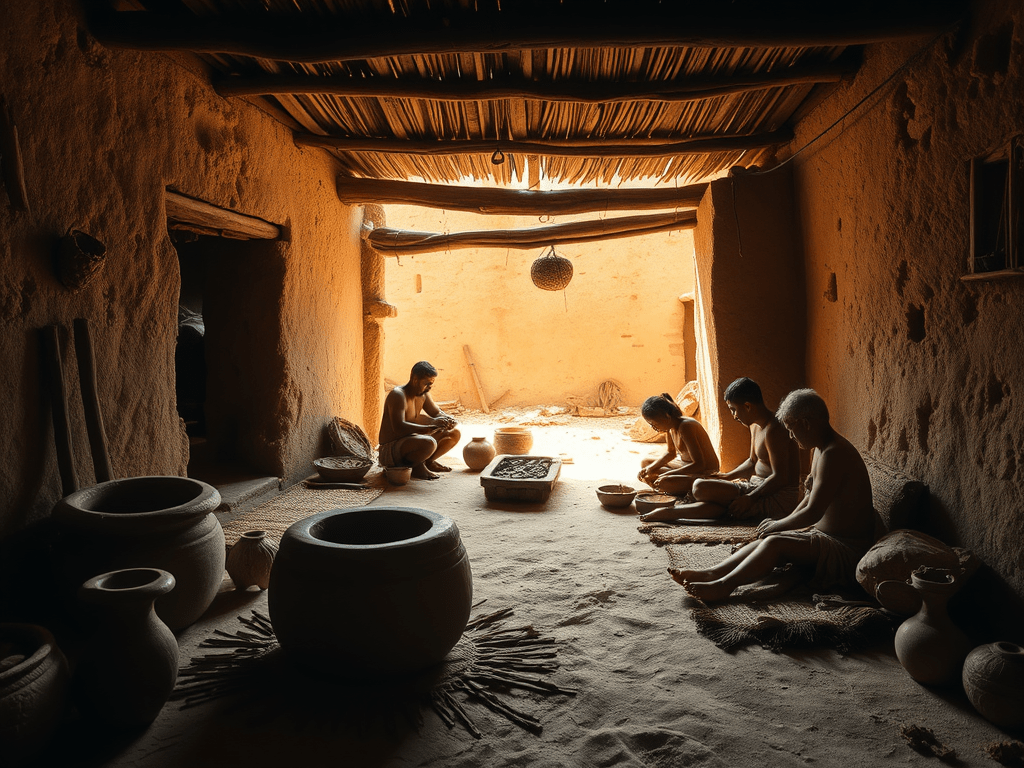
Before empires and conquistadors, life moved to the rhythm of rain and maize. In this post, we’ll step inside that world, not the grand temples or wars, but the quiet rhythm of daily life that sustained it all: homes built by hand, food grown with care, and traditions that still echo through the heart of Mexico today.
Just so we’re all on the same page. Please ensure you’ve made yourself acquainted with my disclaimer
The Home: Heart of Daily Life
Step into their house: how big was it, what did it look like, and how did people sleep or stay clean?
Around 0 BC, many families in central and southern Mexico lived in compact, multipurpose homes made from materials like adobe (mud brick), wattle-and-daub (stick + clay), or volcanic stone when available.
- Archaeological studies of Mesoamerican households show that grinding tools (manos & metates) and hearths were commonly found in domestic contexts, indicating food prep occurred inside typical houses.
- The average size? Around 20–35 m² (215–375 ft²), basically the size of a modern living room.
Sleep & Rest
Life was oriented around natural cycles rather than clocks:
- People slept after dusk and woke with the morning light, archaeological inference from hearth and household spatial layouts suggest early bedtimes and use of natural light.
- Household sleeping surfaces often included woven mats (petates) or simple platforms.
- Short midday rests (“naps”) were likely common, especially for those working the fields under the hot sun.
Fashion & Beauty Standards
Clothing wasn’t just “covering” the body, it declared who you were: your community, your role, your place in the world.
Clothing & Accessories
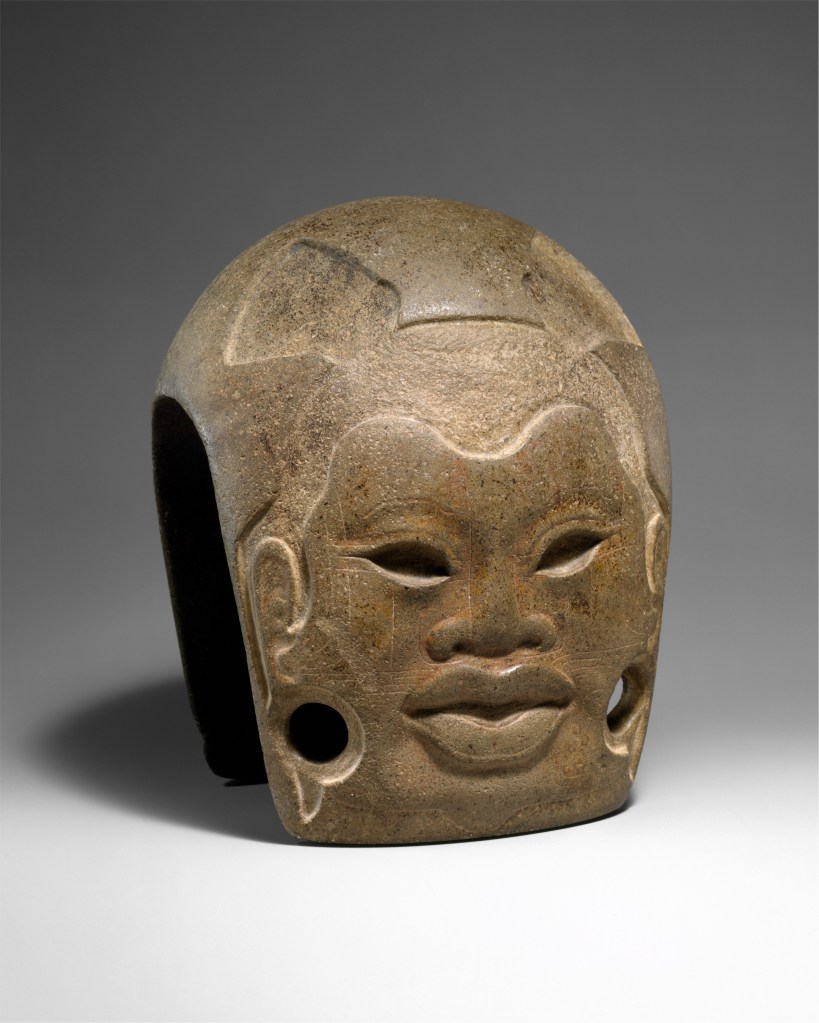
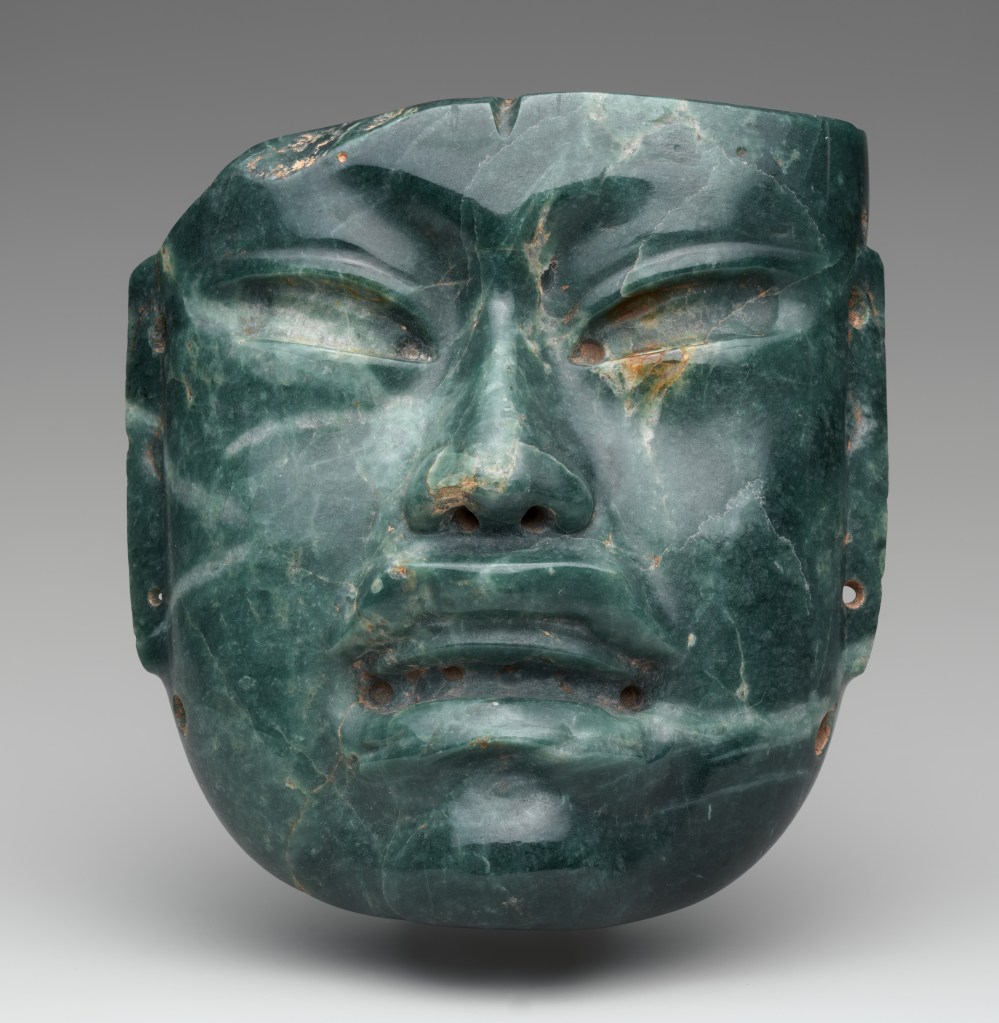
This is a stone belt ornament, meant to sit over a padded cloth or leather belt. The face would’ve stared out at the world while the plain side pressed against the wearer’s stomach. The big almond eyes probably once held shiny inlays. Even the small drilled holes near the ears hint that this little stone ancestor might’ve worn ear ornaments too.
Materials & silhouettes
- The fabrics were mostly cotton (in lowland zones) or fibres from plants like maguey/agave in more arid or higher-elevation zones.
- For women: a simple wrap-skirt (or loin‐cloth style) plus a draped or folded upper cloth; for men: a loincloth or simple wrap around the waist, sometimes with a sleeveless tunic.
- Fastenings were minimal: cloths tied with cords or sashes, maybe a simple belt; no modern buttons or zippers.
- Accessories: sandals when the terrain allowed, maybe woven bracelets, ear ornaments made of shell or stone, and often nose, ear, or lip piercings in higher status or ritual contexts.
Hair, Grooming & Beauty Norms
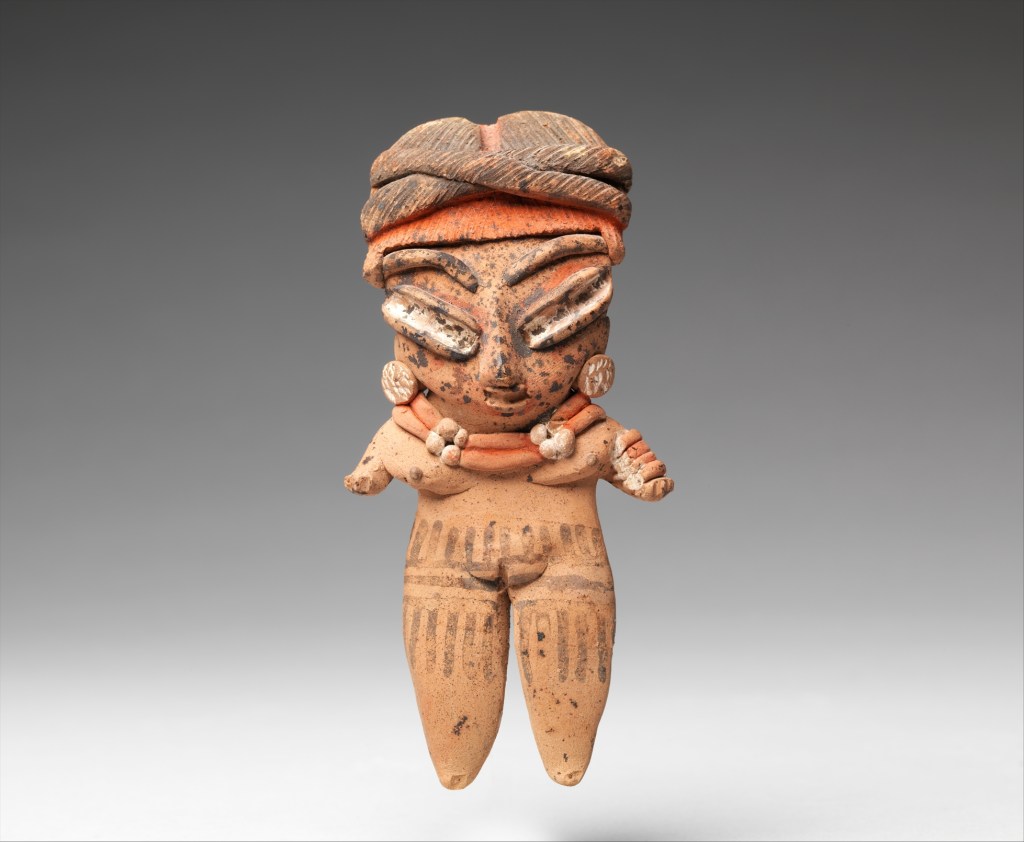
The artist kept her body minimal but made her head, jewelry and hairstyle pop, telling us that identity and adornment were major deals even ~2,000 years ago.
Hair & facial hair
- Most men likely kept their hair relatively short or tied up, especially if they worked in fields or craft; some elite men might have wear longer hair or styled it for ceremony.
- Women commonly wore their hair braided, maybe tied up or coiled on the head with ribbons or bands.
- Facial hair wasn’t a big feature among ancient Mesoamerican men, not because shaving was fashionable, but because most Indigenous men naturally grew very little facial hair. Those few hairs that did appear were usually plucked or rubbed away with obsidian flakes or pumice as part of grooming rituals, so even the sparse growth some men had was often deliberately removed.
- Tattoos, scarification, or body painting existed: bodily decoration was part of identity and ritual.
Body Modification
From the moment of birth to adulthood, the body was treated as a living canvas for ones identity. Beauty, lineage, devotion, and strength could all be worn, marked in ways both permanent and sacred. These were statements of belonging, signaling lineage, community ties, and even spiritual vocation.
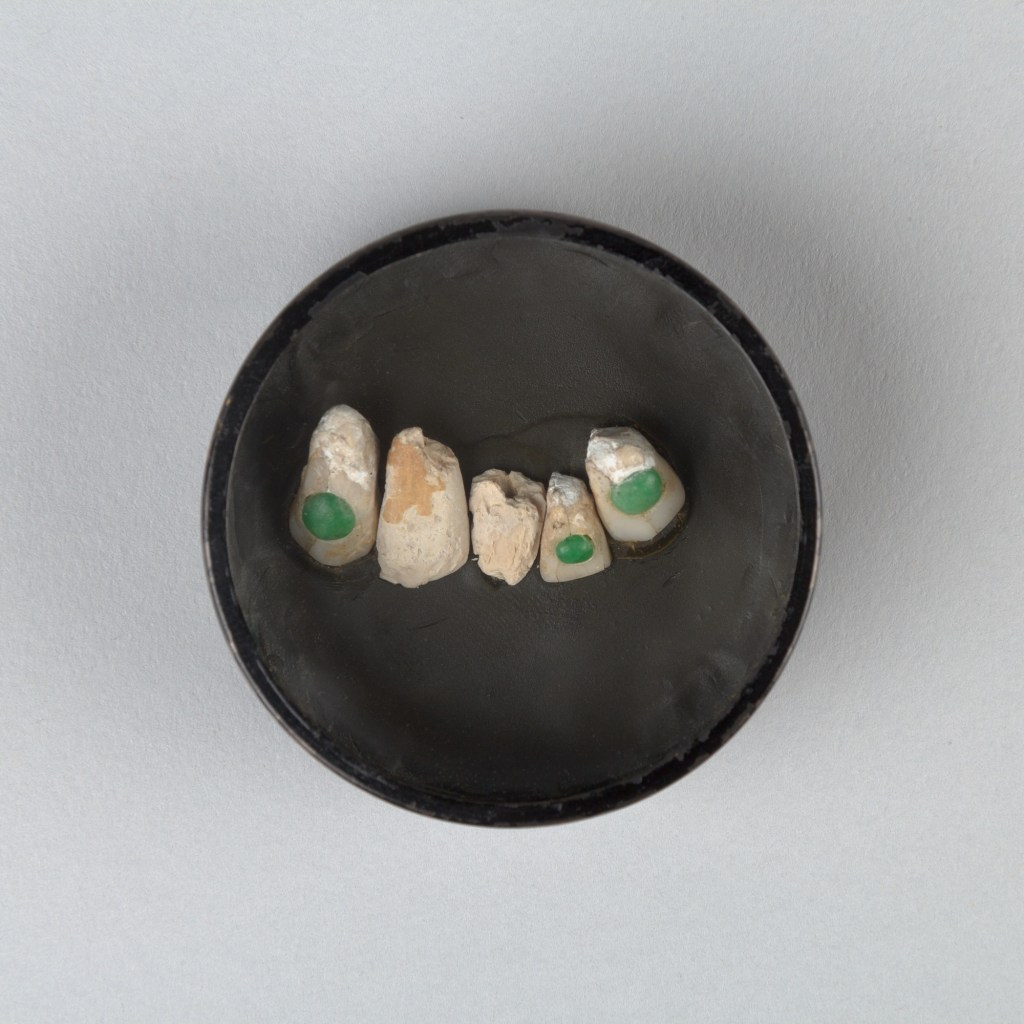
Human tooth with jadeite inlay, Met Museum Collection.
A real Late Preclassic showstopper, this tooth has a tiny piece of jadeite set right into the enamel.
- Dental Modifications:
- Dental filing & inlays: Tiny holes were drilled into the front surface of incisors or canines and filled with jade, pyrite, hematite, turquoise, or obsidian.
- Meaning: Beyond beauty, these often symbolized status, courage, or spiritual alignment with deities linked to jade (fertility and life).
- Filing & shaping: Teeth were sometimes filed into points, notches, or geometric patterns using abrasive stones or sand paste. This practice appears by the Late Preclassic (~400 BC onward) in multiple regions, including Oaxaca and the Maya lowlands.
- Meaning: Pointed or patterned teeth may have symbolized refinement, bravery, or initiation into adulthood. For elites, it reinforced their distinction from commoners.
- Dental filing & inlays: Tiny holes were drilled into the front surface of incisors or canines and filled with jade, pyrite, hematite, turquoise, or obsidian.
- Cranial Shaping: Cranial modification began in infancy, using cloth bands or wooden boards to mold the skull as it developed.
- Common forms:
- Tabular erect: Flattened forehead and back of head, giving a tall profile (common among central and southern Mesoamerican elites).
- Oblique or slanted: Sloped forehead and elongated cranium, sometimes with upward tilt, especially in Maya and Gulf regions.
- Annular: Circular binding, creating conical or rounded elongation (seen in western regions and early Formative burials).
- Common forms:
- Piercing & Ornaments:
- Ears:
- Earspools (tunnels/discs): The most common and meaningful piercing. Materials ranged from bone, shell, and jade to gold or copper (later).
- Symbolism: Size and material reflected status and community; a single earspool could “speak” lineage or social role.
- Placement: Both ears; sometimes extended to lobes so wide they framed the jawline.
- Nose:
- Septum piercings: Carved plugs of jade, obsidian, or shell; worn by both men and women of rank.
- Meaning: Linked to breath, life force (ik’), and communication with the divine.
- Lips:
- Labrets (lip plugs): Common among elites; carved from stone or shell, often symbolic of speech, fertility, or transformation.
- Other Piercings:
- Tongue perforations: Usually ritual, not decorative, part of bloodletting ceremonies, especially for nobles and priests.
- Navel or chest piercings: Less common, but some evidence in highland iconography suggests symbolic connections to life-giving and sacrifice.
- Ears:
- Scarification: Controlled cuts or burns forming raised patterns, often on the face or shoulders. More common in lower-status groups and warriors.
- Tattooing: Less frequently preserved archaeologically but described in postclassic accounts; inked patterns represented personal protection, courage, or dedication to a god.
Physical build
- Average male stature: ~164–166 cm (5′4″–5′5″)
- Average female stature: ~147–150 cm (4′10″–4′11″)
Cosmetics
Yep, they used “beauty products” in their own way and took cleanliness seriously.
Soaps & cleansers
- Many plant-based cleansers existed: ashes, clay, plant saps, rubbed onto skin and rinsed.
- Public bathing or steam bath rituals (temazcal) existed in many Mesoamerican cultures, used for physical and spiritual cleansing.
Cosmetics & ornaments
- They used ochre (red clay) and other mineral pigments for body/face paint and dyeing hair or ornamentation.
Diet & Daily Meals
Explore what they grew, hunted, cooked, and craved.
Views on Food
According to ancient Mesoamerican tradition, people themselves were born from maize. In the sacred story recorded centuries later in the Popol Vuh (which preserves much older oral beliefs) the gods first tried shaping humans from mud, then from wood, but both failed: the figures crumbled or lacked spirit. Only when the gods ground yellow and white maize kernels, mixed them with water, and formed flesh from the dough did true humans emerge, people with hearts, thought, and gratitude. Because of this, maize was not merely food; it was the substance of humanity itself, the bridge between earth and divine creation, eaten daily as an act of remembering who they were.
Meals weren’t quick or solo, families and communities gathered, worked, ate, and gave thanks together. Sharing food meant sharing life and land.
Food rituals: harvest times, first maize, offerings to ancestors, eating was a bridge between humans and the tlalli(earth).
Staple Foods & Drinks
Here are the heavy-lifters of the diet (and the drinks) around 0 BC in Mesoamerica:
Staples:
- Maize (corn): the foundation
- Beans: often grown alongside maize.
- Squash (and its seeds): part of that celebrated trio.
- Secondary plants & wild foods: amaranth, wild greens, fruits, insects, turkeys, fish (depending on region).
Typical drinks:
- Atole (corn-based gruel/drink): warm, nourishing.
- Corn-dough ferment drinks like pozol in some regions.
- Water, wild plant teas, beverages made from maize or other plants.
Food Production
Here’s how daily work around food likely broke down (with regional and seasonal variation):
Farming (milpa system):
- Families typically managed a milpa (mixed-crop field) of maize + beans + squash + chilli.
- Planting, weeding, harvesting were key parts of the year, most time of daylight during growing season was devoted to this.
Foraging & hunting:
- Wild plants, roots, fruits, insects filled out diet (especially in seasons when fields were resting or in less-fertile zones).
- Small game (rabbits, deer depending on locale), fish (in river/coastal zones), birds (turkeys) supplemented diet.
Trading & markets:
- Surplus from milpas, craft produces (textiles, tools) were traded in nearby settlements or with travelling merchants.
- Exchange meant variety: different maize types, wild goods, crafts.
OG Meal
All ingredients and tools native to Mesoamerica; based on Late Formative foodways.
Morning
- Warm Maize Gruel: Ground maize simmered in water until thick; seasoned with a pinch of salt and crushed chili or amaranth seeds. Served warm in gourd bowls.
- Side: Toasted pumpkin seeds.
- Drink: Water infused with hoja santa or wild mint.
Midday / Early Afternoon Snack
- Toasted Maize & Fruit Foraging: A handful of drying maize kernels or coarse maize meal mixed with ground amaranth, eaten dry or stirred into water.
- Slices of roasted sweet potato or wild fruit (tuna cactus, guava, or zapote).
- Occasionally, strips of dried fish or rabbit for field energy.
- Drink: Cool water from a gourd.
Evening
- Roasted Peccary with Corn Cakes & Ash-Roasted Sweet Potatoes
- Peccary meat rubbed with chili, salt, and epazote; roasted on hot stones beside the fire.
- Thick maize cakes cooked on the clay comal until lightly charred.
- Sweet potatoes roasted in ashes until caramelized.
- Sides: A small clay bowl of chili-tomatillo mash sat by the hearth, crushed by hand, spooned sparingly over maize cakes and roasted peccary along with wilted wild greens seasoned with chili and salt.
- Drink: Warm maize atole or mild pulque.
Dessert
Sweet foods were not part of everyday meals, honey and fruit were limited seasonal luxuries.
When available:
- Amaranth-Honey Cakes: ground amaranth seeds pressed with stingless-bee honey and sun-dried.
- Fresh fruit such as guava, zapote, or prickly-pear slices.
Modern Meal
Inspired by the 0 BC meal, adapted for modern kitchens while preserving its earthy rhythm. Cast-iron replaces clay, the oven mimics the hearth, and the aroma of roasted corn and sweet potato still fills the air.
Morning
• Creamy Cornmeal Porridge with Amaranth & Chili Honey: Cornmeal simmered in milk or water; finished with toasted amaranth, honey, and a dash of chili flakes. Top with roasted pumpkin seeds or fruit.
Drink: Mint–hoja santa tea or citrus-spiked water.
Afternoon Snack
- Mini Corn Cakes with Sweet Potato Chips: Pan-grilled masa cakes served with crisp roasted sweet-potato chips.
- Optional dip: avocado-lime mash or pepita-chili spread.
- Drink: Sparkling water with guava or prickly-pear syrup.
Evening
- Chili-Rubbed Pork with Corn Cakes & Honey-Roasted Sweet Potatoes
- Pork shoulder marinated in chili, epazote (or oregano), lime, and salt; grilled or oven-roasted.
- Served with fresh corn cakes and sweet potatoes glazed in honey and sea salt.
- Sides: Served with a spoonful of Ancestral Green Salsa, and avocado slices.
- Drink: Pulque-style mocktail (sparkling water + agave + lime + salt).
Dessert
- Amaranth & Honey Bites with Cacao Dust: Toasted amaranth mixed with honey and a drop of vanilla. Rolled into small balls, chilled briefly, then dusted with cocoa nibs or cinnamon.
- Optional pairing: A sip of hot chocolate made with dark cacao and chili for a post-dinner warmth.
Climate & Environment
How did geography and weather shape daily life?
1. Northern Highlands (Chihuahua – Zacatecas belt)
- Summer:
- Highs: ~36 °C (97 °F)
- Lows: 18 °C (64 °F)
- Winter:
- Highs: ~ 23 °C (73 °F)
- Lows: 2 °C (36 °F)
- Humidity feel: dry, crisp air; sweat evaporates fast, skin and lips chap easily; shade feels instantly cooler.
- Climate: semi-arid plateau with strong sun, windy afternoons, brief summer rains.
- Landscape: rolling steppe and desert grassland dotted with cactus, mesquite, and yucca.
2. Central Highlands (Valley of Mexico – Puebla – Toluca)
- Summer:
- Highs: ~ 27 °C (81 °F)
- Lows: ~13 °C (55 °F)
- Winter:
- Highs: ~22 °C (72 °F)
- Lows: ~7 °C (45 °F)
- Humidity feel: comfortable; air feels light and clean but slightly moist in mornings; evenings need a shawl or cloak.
- Climate: mild, temperate high-elevation basin with dry winter and rainy summer.
- Landscape: fertile volcanic valley surrounded by forested mountains; lakes, marshes, and patchwork milpas; tall pines and oaks blanketing slopes.
3. Pacific Lowlands (Guerrero – Colima – Jalisco coast)
- Summer:
- Highs: ~ 33 °C (91 °F)
- Lows: ~25 °C (77 °F)
- Winter:
- Highs: ~ 30 °C (86 °F)
- Lows: 22 °C (72 °F)
- Humidity feel: sticky and heavy; clothes cling, shade helps only a little; ocean breeze offers momentary relief.
- Climate: tropical wet–dry; long humid rainy season, short hot dry season.
- Landscape: lush coastal plain with mangroves, palms, and broadleaf forest running up into foothills; rivers meander through dense greenery alive with insects and birds.
4. Gulf & Yucatán Lowlands (Veracruz – Tabasco – Yucatán Peninsula)
- Summer:
- Highs: ~34 °C (93 °F)
- Lows: ~24 °C (75 °F)
- Winter:
- Highs: ~30 °C (86 °F)
- Lows: 20 °C (68 °F)
- Humidity feel: heavy and wet; the air feels “thick,” hair stays damp, everything smells of greenery and soil; even nights stay warm.
- Climate: hot, tropical, extremely humid with summer rains and brief dry winters.
- Landscape: low limestone plain covered in dense jungle; vines, ceiba and palm trees, hidden cenotes; constant chorus of frogs and birds.
5. Southern Highlands (Chiapas – Oaxaca mountains)
- Summer:
- Highs: ~ 23 °C (73 °F)
- Lows: ~14 °C (57 °F)
- Winter:
- Highs: 19 °C (66 °F)
- Lows: 9 °C (48 °F)
- Humidity feel: cool but moist; mornings wrapped in fog, afternoons warm and breezy; skin feels dewy, not sweaty.
- Climate: subtropical mountain climate with distinct rainy and dry seasons; frequent mist, steady rainfall.
- Landscape: forested ridges and deep valleys, pine–oak woodlands giving way to cloud forest; terraces and small clearings for maize and beans.
Population & Top Cities
Where were people living, and how many were there?
- Estimated Total Population: 2,000,000 – 4,000,000 people
- The population was densest in three zones:
- Central Highlands (Valley of Mexico, Puebla, Toluca, Morelos)
- Oaxaca Valley,
- Gulf & Pacific lowlands.
- Much of northern Mexico remained sparsely populated, with small farming villages and mobile foraging groups adapted to the dry highlands.
Top 5 Most Populated Cities
1. Monte Albán – Valley of Oaxaca

Estimated population: ~17,000 – 25,000
Why it mattered:
- The Zapotec capital, already thriving with temples, plazas, and carved stelae.
- Sat high on an artificial ridge overlooking three valleys, symbolically “between earth and sky.”
- Center of Zapotec writing, astronomy, and political control, the earliest true city in Mexico.
2. Teotihuacán – Valley of Mexico
Estimated population: ~40,000 – 50,000
Why it mattered:
- Emerging as the region’s largest planned settlement, broad avenues, grid layout, obsidian workshops.
- Though the full height comes later, its foundations are laid around this time.
Why it matters: Marks shift from many small centres to mega-city life in Mexico.
3. Cholula – Puebla-Tlaxcala Valley
Estimated population: ~10,000 – 15,000
Why it mattered:
- One of the oldest continuously occupied cities in the Americas.
- Important religious and commercial center, where early building phases of the Great Pyramid of Cholula began in the Preclassic period, the structure eventually grew to a base around 300 × 315 metres (~984 ft × 1,033 ft) and a volume of about 4.45 million m³, making it the largest pyramid in the Americas by bulk.
- Served as a crossroads between central highlands and Gulf trade routes.
4. San José Mogote – Northern Oaxaca Valley
Estimated population: ~3,000 – 5,000
Why it mattered:
- One of the earliest Zapotec urban centers, precursor to Monte Albán’s culture.
- Known for early public architecture and carved monuments showing ranked society and ritual life.
5. Tres Zapotes – Veracruz Lowlands
Estimated population: around 5,000 – 8,000
Why it mattered:
- A successor to the Olmec heartland, bridging Olmec traditions and later Gulf Coast cultures.
- Important for early calendar inscriptions (Long Count stelae) and regional trade in rubber, cacao, and shell.
Economy & Jobs
How did people earn a living—and was money even used?
Currency & Barter
What they used & how trade worked
- There was no standard coinage like we have today. The equivalent of money in many cases was barter or exchange of goods with value. For instance, trade in goods like textiles, cacao beans, feather plumes, obsidian, jade, shell — all of which could carry value.
- Important barter/trade items:
- Obsidian tools or blades: widely exchanged.
- Textiles and cotton cloth: high value in certain zones.
- Feathers, shells, jade: prestige items.
- Cacao beans and salt
Class Structure & Income
“Calli” (household) vs “teccalli” (lord-house) in later Nahua sources shows the institutional distinction of noble vs common household, which likely has deep roots.
Class divide & roles
- Families who owned land (fields, milpas) or had control of production (tools, craft, textiles) had higher status.
- Many folks were farmers, artisans, day-labourers (working the fields, grinding maize, making tools). They would have lower economic “income” (in barter/goods) than those who had craft specialization or urban status.
- A clear rich/poor divide existed: elites (ritual leaders, large land-holders, urban craft-owners) vs common farmers/foragers. Social mobility was limited.
Job & Income
So around 0 BC in Mexico, people didn’t earn “salaries” or use coins the way we do today, as barter and tribute ran the economy. Farmers, craft-workers, and traders exchanged what they produced for what they needed, or sometimes for access and privilege (the right to use land, join a ritual, or owe service to a local leader). A fixed wage system just didn’t exist yet, everything depended on relationships, reciprocity, and obligation.
Since we can’t know actual “income” numbers in coins, I’ll give a list of 8 common job types in ~0 BC Mexico, from lower to higher status, and approximate “income” in barter terms (very broad & illustrative), think “units of barley & maize equivalent” rather than pesos. Use this as contextual scale, not actual historic data.
- Day-labourer in milpa (weeding/harvesting for someone else): low income, maybe “1 unit of maize + small share of beans”.
- Household craft worker (making basic pottery, mats): somewhat more stable, “2-3 units of maize + woven cloth payment”.
- House servant or field assistant tied to a larger household: “3-4 units + textiles”.
- Local trader/market vendor (selling produce or simple crafts): “5-7 units + ability to trade for small luxury item”.
- Skilled artisan (observation: specialized pottery, stone-carver): “8-12 units + part of textiles/feathers exchange”.
- Merchant traveling goods (regional): “12-20 units + some prestige goods like jade/shell”.
- Urban craft master or land-owner controlling production (fields + craft): “20-30 units + rights to tribute/surplus”.
- Elite priest-landowner/urban ruler class: highest “income” in goods, power, and tribute, “30+ units + luxury goods, land, labour of others”.
Health
Explore life expectancy, healthcare practices, and common dangers.
- Life expectancy if you survived childhood: ~40–55 years, some elders in stable farming communities reached 60 +, especially among the well-fed or high-status families.
- Child survival rate: only ~50–60 % made it past age 15 (most deaths occurred between ages 1–4)
Common Causes of Death & Health Problems
Cities concentrated risk: smoke, crowding, polluted water. Rural life had cleaner air but fewer medical options.
- Top causes: childhood infections, malnutrition, childbirth, injuries, parasites
- Maternal mortality: very high, childbirth was dangerous
- Dental wear: severe tooth abrasion from stone-ground maize
- Occupational stress: joint pain, spinal wear from grinding and farming
Medicine & Healing Practices
Healing blended body and spirit. Illness wasn’t just “disease”, it meant imbalance with the earth or gods.
- Primary healers: midwives, herbalists, community elders
- Key tools: plants, minerals, steam, ritual cleansing
- Common treatments:
- Temazcal (sweat bath) for cleansing & fever
- Poultices of herbs: cacao leaves, aloe, chile, copal resin
- Bloodletting & ritual purification for spiritual balance
- Dental hygiene: chewing sticks, rinses of salt or herbal infusions
Social Factors & Health Divide
Health mirrored class. A farmer’s worn knees told his status as clearly as a noble’s jade earspools.
- Elites: better food (diet variety, less labour stress)
- Commoners: heavier workloads which contributed to joint damage, anemia, fatigue
- Urban poor: exposure to smoke, close quarters, parasites
Social & Family Structure
Who lived together—and who held the power?
Family Units
- Predominantly extended or multi-generational households rather than just nuclear.
- Households often included parents, children, grandparents, maybe younger siblings, and sometimes servants or craft-workers.
- Separate ‘elite’ households show more architectural elaboration and larger compounds.
At places like La Laguna, Tlaxcala (around 100 BC – AD 100), archaeologists found that some houses were bigger or had nicer things, showing there were small differences in wealth. But most families still worked together, shared food storage areas, and used the same spaces for rituals or celebrations. In other words, households stayed tightly connected, extended families lived and cooperated as a single unit for generations.
Marriage Customs
- Monogamy
- Appears to have been the norm in most farming and village communities.
- Arranged marriages
- Families or lineages likely played a key role in choosing spouses.
- Marriages served to strengthen social, economic, and ritual alliances, not just personal affection.
- Age at Marriage
- Women: Mid to late teens
- Men: Late teens to early twenties
- Post-Marriage Residence:
- Couples rarely moved into a single “husband’s house.” New households typically formed next to one of their families, most often near the woman’s parents. Over time, they might build a separate home within the same compound or along the village plaza.
- This arrangement kept the bride’s mother and sisters close for childcare, food preparation, and ritual duties.
- The groom contributed labor to his in-laws’ fields or craftwork until the couple gained independence.
- This arrangement kept the bride’s mother and sisters close for childcare, food preparation, and ritual duties.
- Couples rarely moved into a single “husband’s house.” New households typically formed next to one of their families, most often near the woman’s parents. Over time, they might build a separate home within the same compound or along the village plaza.
- Status Differences:
- Among higher-status or temple-affiliated families (e.g., Zapotec elites at Monte Albán), residence tended to be patrilocal, near the husband’s lineage lands or ancestral tombs. This reflected inheritance patterns and ancestor veneration focused on the male line.
- Household Structure:
- For most people, marriage meant joining a cluster of homes rather than a single dwelling. Shared courtyards connected generations; daily life and work flowed between houses. The household functioned as a living network of kin—communal, interdependent, and deeply rooted in the landscape.
Childhood & Parenthood
What was it like to be a kid—or raise one?
Family life was the center of the world, not a side detail. Kids weren’t coddled or ignored, they were folded right into work, ritual, and survival. Love looked different but ran deep.
Ups & Downs of Being a Parent
- Children = survival: More hands meant more labor and more security in old age.
- Pride in skill-teaching: Parents passed down crafts, farming techniques, songs, a living lineage.
- Spiritual continuity: Offspring kept the family’s spirit alive through offerings and remembrance.
- Community belonging: Births strengthened kin ties; the whole household gained status.
- Shared joy in milestones: First steps, first woven cloth, first successful hunt, all celebrated communally.
- High child mortality: Many infants didn’t survive disease, famine, or accidents. Every birth carried both joy and dread.
- Constant labor: Parents farmed, cooked, hauled water, and crafted from dawn to dusk; there was little time for play.
- Food insecurity: Drought or crop failure could wipe out a year’s effort; parents rationed and worried through dry seasons.
- Health risks for mothers: Childbirth was dangerous; infection or hemorrhage could end a life quickly.
- Raising through ritual cycles: Parents had to teach children sacred calendars, taboos, and manners in a world where offending gods was serious business.
- Offending the gods wasn’t about “sin” the way we think of it today, it was about throwing the balance of the world out of tune. A forgotten offering, a ritual done on the wrong day, wasting food, mocking sacred symbols, even stepping into a ritual space without purification, any of these could “disturb” the harmony between people and the divine. For example:
- Skipping offerings to the rain or maize gods could be blamed for drought or crop failure.
- Breaking taboos like eating restricted foods during a festival or interrupting a ceremony was believed to invite illness or bad luck to the household.
- Disrespecting sacred fire or water could offend the elemental spirits who sustained life.
- So parents raised their kids to tread carefully, to thank, not take. Ritual life was an education in humility, it reminded everyone that humans didn’t control nature, they negotiated with it.
- Offending the gods wasn’t about “sin” the way we think of it today, it was about throwing the balance of the world out of tune. A forgotten offering, a ritual done on the wrong day, wasting food, mocking sacred symbols, even stepping into a ritual space without purification, any of these could “disturb” the harmony between people and the divine. For example:
Ups & Downs of Being a Child
- Constant learning: Childhood was apprenticeship. Everything was hands-on (weaving, grinding maize, tending fields, shaping clay, helping prepare food). Skills passed through imitation and repetition rather than lectures.
- Strong family network: Parents, grandparents, aunts, uncles, and cousins formed a protective web. A child rarely faced the world alone; kinship meant comfort, supervision, and shared responsibility.
- Connection to nature: Life outdoors (rivers, fields, animals) kids grew with seasons and soil.
- Ritual inclusion: Children participated in dances, offerings, festivals, learning pride and belonging.
- Identity from birth: Each child’s name carried cosmic meaning. Their birth date on the 260-day sacred calendar, the tonalpohualli(Nahua) or piye (Zapotec), defined part of their destiny, like an astrological sign woven into real life.
- The Sacred Calendar & Naming: Time was alive; every day held a personality and divine charge. The 260-day cycle paired 20 day-signs (Jaguar, Flower, Rain, Wind, etc.) with 13 numbers, creating unique combinations.
- When a baby was born, priests or diviners read the day’s energy to advise the family (which rituals to perform, what traits to nurture, and which gods to honor).
- A child born on “9 Eagle” might be named something invoking strength or vision: traits linked to the eagle sign.
- A baby born on “3 Rain” might be tied to fertility and storms, associated with Tlaloc or Cocijo (rain deities).
- This day wasn’t just a birthday, it was believed to shape the child’s temperament, strengths, and even their life path or vocation.
- Hard work early: Kids joined field, kitchen, or craft tasks as soon as they could walk steadily.
- Strict discipline: Respect and obedience were drilled, mistakes could earn scolding or chores, not hugs.
- Limited playtime: Games existed (ball-play, stick games), but only after duties.
- Health hazards: Disease, malnutrition, and accidents took many before adulthood.
- Expectations of maturity: By adolescence you were expected to contribute like an adult: work, marry, obey.
Parenting Style & Norms
- Discipline: firm but purposeful; correction through chores or mild punishment, always tied to teaching respect and social harmony.
- Affection: quiet and practical: shown through feeding, protection, storytelling, not overt physical affection.
- Expectations: children owed obedience, modesty, and help; parents owed guidance and protection.
💭 Think “gentle but structured survival parenting,” affection expressed through competence and belonging, not indulgence.
Pets
- Dogs were most common: guardians, hunting helpers, spiritual companions in death.
- Turkeys & ducks were semi-domestic for food and ritual use.
- Parrots & songbirds were kept for feathers and company among elites.
Cultural Expectations of Children
Childhood was less about “finding yourself” and more about “earning your place.”
- Obedience: defiance shamed the whole household.
- Labor: participation in household production from early age.
- Education: informal, through imitation and oral teaching; elite children learned ritual calendars and lineage lore.
- Marriageability: for girls, tied to domestic skill and reputation; for boys, to industriousness and reliability.
Leisure & Recreation
Even in a world of constant labor and ritual duty, people carved out time to rest, play, and celebrate. Work and pleasure blurred, the same hands that planted maize also clapped to music and tossed clay balls in festival games.
Adult
Music, Dance & Ritual
- Dancing was both recreation and religion. Drumbeats, flutes, rattles, and shell trumpets guided community dances in plazas.
- Dances honored gods, harvests, and ancestors; each community had its own steps and rhythms.
- During festivals, men and women danced in circles or lines, movement offered to the gods as thanks for rain or maize.
Sport & Games
- Physical sports:
- The Mesoamerican ballgame (ōllamaliztli) was the great sport, played with a solid rubber ball struck by hips, forearms, or knees through stone rings or against walls.
- Games were held in sunken courts beside temples and could symbolize the cosmic struggle of day and night.
- Players trained for strength and grace; tournaments drew whole towns.
- Wrestling and mock combat also appeared in some regions, likely as training or festival entertainment.
- The Mesoamerican ballgame (ōllamaliztli) was the great sport, played with a solid rubber ball struck by hips, forearms, or knees through stone rings or against walls.
- Board & chance games:
- Patolli: A gambling and divination game using beans marked with dots and a cross-shaped board, very similar to later Aztec versions. Players wagered food, cloth, or trinkets, and success was seen as partly fated, a reflection of cosmic order.
- Chimalli or dice-style games: Some evidence suggests early counting or throwing games using pebbles or carved tokens.
Festivals & Feasts
- Harvest festivals celebrated maize, rain, and fertility, people feasted, danced, drank pulque (fermented maguey sap).
- Market days doubled as social events: trade, gossip, matchmaking, musicians, dancers, and storytellers all filled the square.
- Religious ceremonies blended public worship with community leisure, music, offerings, and food everywhere.
Theater & Performance
- There were no formal theaters, but ritual performance was everywhere, costumed priests reenacted myths with masks, dance, and song.
- Dramatized ceremonies (corn goddess, rain god) filled plazas; everyone knew the stories.
Children & Family
Games & Play
- Mini ballgames with small rubber or cloth balls imitated adults.
- Rolling-ring or disk games (precursors to hoop-play) using clay or stone rings.
- Clay dolls and corn-husk figures for storytelling.
- Riddles & song games taught memory and wit.
Festivals & Holidays
- Harvest and rain feasts: children carried flowers or small offerings.
- Market days: sensory wonderland, colors, smells, and musicians.
- Seasonal rituals: dances and songs rehearsed for weeks; even toddlers joined the rhythm.
Culture, Language & Religion
Explore the worldview, values, and art of the time.
Zapotec (Valley of Oaxaca) – rising to regional power
- Where: Monte Albán, high ridgeline above Oaxaca’s three valleys.
- Status (arc): Growing → early height during the Late/Terminal Formative (≈100 BC–AD 200).
- Why they matter: First durable highland state in Mexico: planned hilltop city, terrace agriculture, courts, tombs, early writing & calendrics.
- Religion & ritual: Ancestor veneration; hilltop plazas, carved slabs (“Danzantes”), tomb cults; incense, offerings, ballgame.
- Art & style: Carved stone reliefs; gray wares; later classic Zapotec urns take shape; early glyphs on monuments.
- Language & writing: Zapotecan (Oto-Manguean) family; early Zapotec script on stelae and tombs.
Teotihuacan (Basin of Mexico) – the giant in the making
- Where: Northeast of modern Mexico City, in the Basin of Mexico.
- Status (arc): Rising—urbanization begins ~100 BC; true imperial “height” comes later (AD 200–550).
- Why they matter: Early city planning (orthogonal grid, Avenue of the Dead), obsidian industry, long-distance ties.
- Religion & ritual: Fire/rain/earth deities; ballgame courts; large public ceremonies; (later) monumental pyramids.
- Art & style: Early talud-tablero steps in; pottery workshops; later famous murals.
- Language & writing: Language uncertain; limited glyphic signs (not like Maya); power communicated via iconography.
West Mexico Shaft-Tomb Tradition (Nayarit–Jalisco–Colima) — flourishing
- Where: Pacific-side states of Nayarit, Jalisco, Colima.
- Status (arc): At/near height c. 300 BC–AD 300.
- Why they matter: Distinct mortuary culture (deep shaft tombs with family chambers) and extraordinary hollow ceramic figure tableaux of feasts, ballplayers, warriors, houses.
- Religion & ritual: Ancestor-focused tomb cults; feasting; conch trumpets; ballgame scenes.
- Art & style: Bold, naturalistic hollow ceramics; architectural models showing houses & communal life.
- Language & writing: No known local script; linguistic affiliation uncertain (later region hosts Cora/Huichol, Purepecha nearby—don’t project directly back to 0 BC)
Epi-Olmec / Isthmus of Tehuantepec (Veracruz south) — successor to the Olmec
- Where: Gulf lowlands of southern Veracruz/Tabasco and the Isthmus (e.g., Tres Zapotes, La Mojarra).
- Status (arc): Flourishing/transition c. 300 BC–AD 250 (after “Classic” Olmec decline).
- Why they matter: Early Long Count dates; Isthmian (Epi-Olmec) script; ruler portrait stelae—bridging Olmec and later Gulf/Classic traditions.
- Religion & ritual: Ruler cults, bloodletting, calendars; ballgame continues; Gulf-coast deities & water symbolism.
- Art & style: Narrative stelae (rulers in towering headdresses), continued jade/greenstone traditions, early glyphic texts.
- Language & writing: Isthmian/Epi-Olmec script (undeciphered/debated), likely a Mixe-Zoquean language per some proposals.
- San Lorenzo (Olmec heartland) loses major population and is replaced by other centres like La Venta. World History Encyclopedia+1
- Trial: The collapse/abandonment of a once-dominant centre forces new political/configuration shifts.
Why it matters: Shows that even the earliest “civilisation” centres had vulnerability; this catalysed cultural transitions.
Maya (Mexican Lowlands: Campeche–Yucatán–Chiapas) — Late Preclassic fluorescence
- Where (Mexico only): Edzná (Campeche), Komchén/Dzibilchaltún (N. Yucatán), Chiapas highlands & Soconusco fringe.
- Status (arc): Flourishing in the Late Preclassic (200 BC–AD 250) with big centers just west/east of the border rising too.
- Why they matter: Monumental platforms, early palace-plazas, Maya script developing, stelae, refined ceramics; calendars & astronomy embedded in rulership.
- Religion & ritual: Rain/maize/sky gods; ancestor kingship; ballgame; incense & offerings in plazas and caves/cenotes.
- Art & style: Stucco masks, early stelae, polished orange/cream ceramics; early hieroglyphs on stone & perishable media.
- Language & writing: Mayan languages (Ch’olan/Yucatecan zones); Maya script (logosyllabic) already in play.
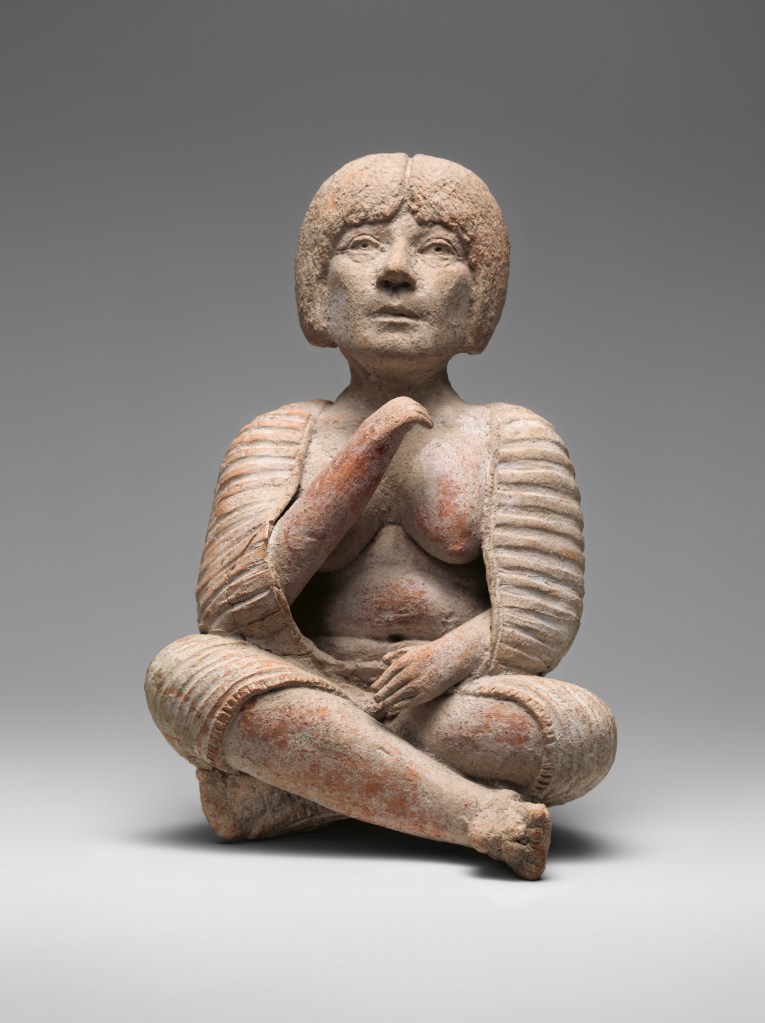
Xochipala artists were doing realism before realism was cool, and honestly I’m super impressed, showing that not all Preclassic brilliance came from the giant centers
Historical Milestones
Advancement of Teopantecuanitlan (ca. 1000-800 BC)
- El Recinto / Sunken Patio – one of the earliest civic-ceremonial complexes
- A sunken plaza about 2 m (7 ft) below ground level, built on yellow clay and faced with travertine blocks.
- Four colossal “were-jaguar” blocks – stone guardians of the underworld
- On the east and west sides of the patio sit four huge travertine monoliths (3–5 tons each), carved as anthropomorphic, jaguar-ish beings with almond eyes and down-turned mouths.
- Possibly the earliest written calendar date
- On the back of Monument 2, reads a glyph as “10 Flower”, which, if correct, would be the oldest known Mesoamerican calendar date so far.
- Engineering flex: dam, canals, and early water control
- Teopantecuanitlan has what is considered the oldest known dam in Mesoamerica, built around 1200 BCE from rough, uncut stones and using gravity-fed flow to move water to fields.
- Stone-lined canals carried water for irrigation, helped prevent erosion, reduced water loss, and even worked as an early drainage/sewer system.
The Sacred 260-Day Calendar
Long before the Aztecs or even the great cities like Teotihuacan, the peoples of Mesoamerica had already learned to measure time in a way that was spiritual, agricultural, and cosmic all at once. The result was one of the most sophisticated timekeeping systems in the ancient world: the 260-day sacred calendar, known later as the Tonalpohualli in Nahuatl and the Tzolk’in among the Maya.
- When and Where It Began
- The exact birthplace of the 260-day calendar is still debated, but most scholars agree it was developed sometime between 1200 BC and 800 BC, possibly among the Olmec or early Zapotec cultures.
- How It Worked
- The sacred calendar combined:
- 13 sacred numbers (1–13)
- 20 day-signs (each representing a god, force of nature, or symbolic concept like Jaguar, Rain, Flower, Wind, Reed, etc.)
- These rotated together to create 260 unique day combinations, repeating every 260 days. Each day had its own divine “personality” and was linked to certain rituals, gods, and fates.
- The sacred calendar combined:
- Why 260 Days?
- Roughly matches the average human gestation period, giving it deep associations with birth and life cycles.
- Corresponds to the interval between zenithal suns (the days when the sun passes directly overhead) in southern Mesoamerica, about 260 days apart.
- May also align with maize growing cycles in early farming regions.
- How It Was Used
- By 0 BC, the 260-day calendar guided almost every part of life:
- Naming children: Babies were often named after the day they were born (5 Eagle, 2 Jaguar, 9 Rain) giving each person a cosmic identity.
- Ritual timing: Priests used the calendar to know when to perform specific ceremonies, plant crops, or honor particular deities.
- Divination: Specialists known as daykeepers or calendar priests interpreted a person’s birth-sign to predict temperament, luck, and destiny.
- Community rhythm: Festivals, marriages, and initiation rituals followed its flow, weaving time, faith, and daily life into one pattern.
- By 0 BC, the 260-day calendar guided almost every part of life:
- Why It Matters
- The 260-day calendar wasn’t just a way to count days, it was a worldview. It defined how people understood their place in the cosmos and connected the cycles of the heavens to those of maize, rain, and human life.
Music & Instruments
What did it sound like?
Instruments & Uses
Key instruments
- Drums:
- The upright tubular drum called the huehuetl (wood body, skin head, often stood on three legs) was common for ceremonies.
- The slit log drum called the teponaztli, hollowed wood with carved tongues struck by mallets.
- Wind: Clay flutes, ocarinas, whistles made in animal or human-form shapes; and conch shell trumpets like the atecocolli (conch shell trumpet).
- Wind & percussion: Rattles, scrapers, turtle-shell drums.
How they were used
- Music was deeply integrated into ritual, ceremony, warfare, agriculture, feast days.
- Drums and conch trumpets announced gatherings, ritual processions, and celebrated the gods of rain/maize.
- Flutes/ocarinas: more lyrical contexts, maybe smaller rituals, children’s play, signaling.
- Instruments were often decorated with symbolic figures (animals, gods) and had specific ritual meaning, not just casual entertainment.
Media You Can Watch or Read Today
Continue your journey with these books and movies.
Adults
Movies / Documentaries
- Sentinels of Silence
Language: Spanish (original) • Dubbed/Subtitled: English available
A short Mexican documentary on ancient Mexican ruins, including centers like Teotihuacán and Monte Albán. - “Monte Albán and Zapotec Rule over Oaxaca” (The Great Courses / Apple TV episode)
Language: English (original) • Subtitles: English available
Explores the hill-top city Monte Albán and its Zapotec context, useful for your timeframe.
Books
- Monte Albán: Settlement Patterns at the Ancient Zapotec Capital (Richard E. Blanton)
Language: English
A detailed archaeological study of Monte Albán (starts around 500 BC) in the Valley of Oaxaca. - Cultural Evolution in Oaxaca: The Origins of the Zapotec and Mixtec Civilizations (Joyce Marcus & Kent V. Flannery)
Language: English
A chapter/book mapping the early Zapotec/Mixtec cultural evolution in Oaxaca. - Zapotec Civilization: A History from Beginning to End
Language: English
A more general overview of the Zapotec civilization (that begins around 500 BC).
Cookbooks / DIY / Practical Immersion
- Cocina prehispánica mexicana: la comida de los antiguos mexicanos (Heriberto García Rivas)
Language: Spanish
A guide to pre-Hispanic Mexican cooking traditions.
Kids
TV SHOWS & MOVIES
- Las Leyendas (Netflix)
Language: Spanish (original) • Dubbed/Subtitled: English available
Ages: 8–12
Think spooky fun meets Mexican folklore! This animated series dives into ghost stories and old-world monsters from Mexico’s legends, with brave kids saving the day. It’s funny, fast-paced, and sneakily educational about Indigenous myths. - Maya and the Three (Netflix)
Language: English (original) • Dubbed/Subtitled: Spanish available
Ages: 8–12
If your kids love “Moana” or “Avatar: The Last Airbender,” they’ll be obsessed. It’s a fantasy quest full of warrior gods, ancient temples, and Mesoamerican-inspired design. - Pachamama (Netflix)
Language: French (original) • Dubbed/Subtitled: English and Spanish available
Ages: 6–10
Beautiful little movie set in the Andes, not Mexico exactly, but perfect for introducing Indigenous life before Europeans arrived. It celebrates nature, community, and respect for the Earth, the same values ancient Mesoamerican kids grew up with. - Amigo and Friends (Televisa / Syndicated)
Language: Spanish (original) • Dubbed/Subtitled: English available in some versions
Ages: 6–10
A cheerful, retro cartoon where kids time-travel to different moments in Mexican history, including ancient ruins and early civilizations. It’s vintage but cute.
CHILDREN’S BOOKS
- The Princess and the Warrior: A Tale of Two Volcanoes (Duncan Tonatiuh)
Language: English (original) • Spanish edition: La princesa y el guerrero
Ages: 5–9
The love story explains how two volcanoes near Mexico City got their names. It feels magical, and it opens the door to talk about Indigenous beliefs and geography. - The Legend of the Poinsettia (Tomie dePaola)
Language: English (original) • Spanish edition available
Ages: 4–8
More colonial-era than 0 BC, but wonderful for introducing Mexican traditions and kindness as a virtue. Great for December reading when you’re connecting modern celebrations to ancient roots. - The Aztecs (Usborne Beginners Series)
Language: English
Ages: 7–11
Short, colourful nonfiction that gives a fun peek into ancient cities, markets, and gods. It technically covers later centuries, but it’s the simplest kid-friendly way to visualize pre-Columbian life, think “starter pack for ancient Mexico.” - How the Guadalupe Got Her Colors (Tonia Allen Gould)
Language: English (original) • Spanish edition available
Ages: 6–10
Mom-to-Mom: A sweet story about Mexican identity and heritage told through bright illustrations. Perfect for gently connecting spiritual and cultural traditions without getting too heavy.
COOKBOOKS & DIY / HANDS-ON FUN
- Cocina prehispánica mexicana: la comida de los antiguos mexicanos (Heriberto García Rivas)
Language: Spanish (original)
Ages: 8–12 (with adult help)
This is such a fun kitchen adventure for curious kids! You can make ancient-style corn cakes, chocolate drinks, and tamales while talking about what families ate thousands of years ago. The recipes are simple, and it’s a great bilingual learning tool. - Archaeology for Kids: Uncovering the Mysteries of Our Past (Richard Panchyk)
Language: English
Ages: 9–13
If your kid loves digging, this one’s gold. It has hands-on experiments, like making a miniature dig site or clay artifact, that mirror how archaeologists study ancient Mexico.
So what do you think — would you find peace in the rhythm of rain and maize, or lose your mind without coffee machines and Wi-Fi? Tell me below, or tag me on social, I’d love to know if you’d survive 0 BC Mexico.
 Time Traveling Table
Leave a comment