
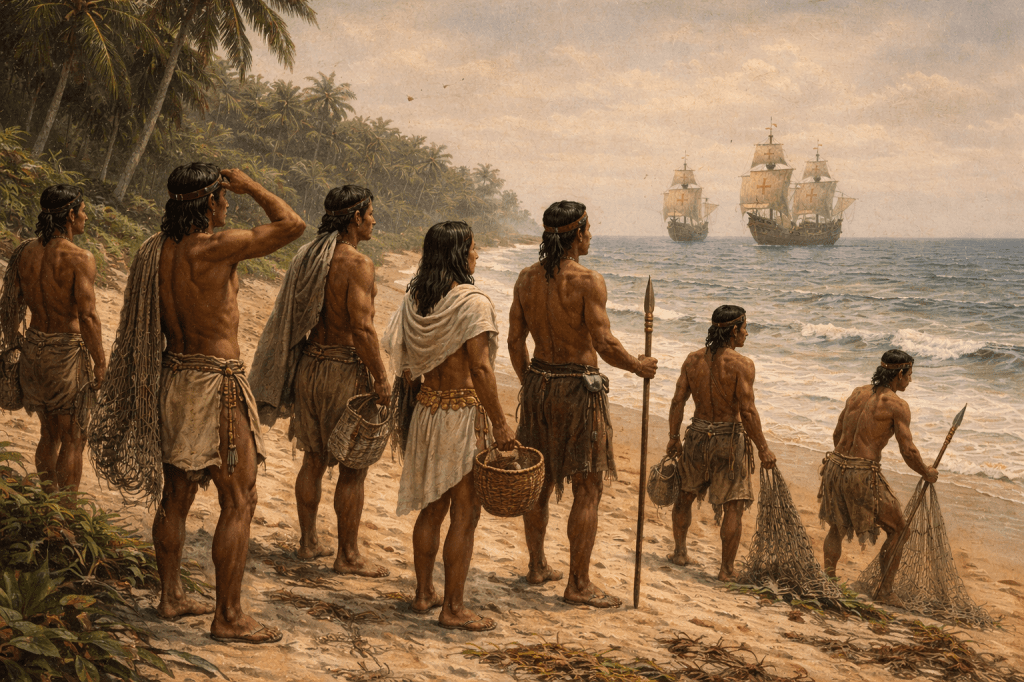
Step into a world on the edge of change. In 1519, Mexico was vibrant, ordered, and fully alive long before Europeans arrived. This post explores what daily life actually looked like in that moment, from how mornings began to what simmered over the fire, inside a society that did not yet know it was about to be disrupted forever.
Just so we’re all on the same page. Please ensure you’ve made yourself acquainted with my disclaimer
1519 and the Moment Everyone Thinks They Know
The year is famous. The story is not simple.
In 1519, a Spanish expedition led by Hernán Cortés arrived on the Gulf Coast of what is now Mexico. Cortés was not a king or a great noble. He was a military captain with about 500 men, a few horses, cannons, and steel weapons, hoping to gain land, wealth, and status under the authority of the Spanish Empire.
Why the Spaniards Came
By 1519, Spain had already established colonies in the Caribbean, especially Cuba. For years, Spanish officials collected reports of a powerful mainland filled with cities, markets, and tribute systems that sounded nothing like the islands they already controlled.
Those reports came from many directions.
- Indigenous traders along the coast describing inland cities and powerful rulers
- Earlier Spanish voyages that encountered dense populations and stone architecture
- Caribbean intermediaries who exaggerated stories as information traveled
Gold made those rumors louder. Organized societies made them believable. Cortés sailed because others had already seen enough to confirm this land was different. Empire moves fastest when curiosity meets greed.
How Cortés Knew Where to Go
Cortés did not sail blind. Spanish ships had already reached this region.
- In 1517, Francisco Hernández de Córdoba reached the Yucatán and encountered Maya cities
- In 1518, Juan de Grijalva explored the Gulf Coast and returned to Cuba with gold and detailed reports
Grijalva’s expedition confirmed wealth, political organization, and active trade networks. By the time Cortés landed, Spaniards already knew power existed here. Indigenous leaders also knew strange ships and foreign men had appeared before. First contact had already happened. Trust had not.
First Encounters on the Coast
Cortés first landed along the Tabasco coast near Potonchan, where initial encounters quickly turned violent. Spanish weapons and tactics overwhelmed local resistance. Afterward, reconciliation followed in the form of gifts, including an enslaved women.
Among them was Malintzin, also known as Marina or Malinche. She spoke both a local Maya language and Nahuatl. One of Cortés’s men spoke Maya. Together, they created a fragile bridge of translation.
This changed everything. From that moment on, negotiation, manipulation, and diplomacy became possible. Malintzin remained at Cortés’s side throughout the campaign, shaping every conversation that followed.
Moving Inland
From the coast, Cortés was directed north toward Cempoala. There, he encountered imperial tax collectors extracting tribute for the Mexica state. The tension was immediate and visible.
Word soon reached Moctezuma II that violent strangers were approaching the heartlands, moving confidently and making alliances along the way.
After consulting his council of elders, Motecuhzoma chose diplomacy. He sent gifts meant to communicate power, not submission. Ceremonial clothing. A massive gold disk representing the sun. An even larger silver disk representing the moon.
The message was meant to impress. It worked, though not in the way intended.
A Collision of Worldviews
The Mexica world was built on reciprocity, ritual, and obligation. Power came from alliances, tribute, and reputation. The Spanish worldview centered on conquest, ownership, and divine justification.
Both sides believed they were acting rationally.
Both sides misunderstood the other.
Cortés ignored orders to return to Cuba. He sent a ship carrying treasure and letters to Charles V, requesting royal backing. On the coast, he established a garrison at Veracruz. Then he destroyed his own ships. There would be no retreat. Only conquest or death.
In August of 1519, Cortés began his march inland toward Tenochtitlan.
A Persistent Myth About Cortés
For a long time, many history books repeated the idea that the Mexica believed Hernán Cortés was a returning god. According to this version, Motecuhzoma welcomed the Spaniards because he mistook Cortés for a divine figure come back from prophecy. Most scholars today do not consider this explanation accurate.
This story comes largely from Spanish accounts written after the conquest, especially those meant to justify how a small group of Europeans managed to enter the capital of a powerful empire. Framing the Mexica as confused or spiritually overwhelmed helped explain Spanish success without crediting Indigenous diplomacy, strategy, or political calculation.
When we look closely at Indigenous sources, language use, and political behavior, a different picture emerges. Motecuhzoma acted like a ruler facing uncertainty, not a believer meeting a god. He gathered intelligence, sent messengers, exchanged gifts, and tried to control events through diplomacy.
Part of why this idea persisted has to do with how Europeans later described the god Quetzalcoatl. In some colonial accounts, he was portrayed as light-skinned, bearded, and destined to return from the east. Read through that lens, Cortés conveniently fit the image.
The problem is that this version of Quetzalcoatl comes largely from post-conquest retellings shaped by Christian symbolism and Spanish expectations. Pre-contact Mesoamerican sources do not present a single, simple prophecy of a god who would return as a foreign conqueror. Quetzalcoatl existed in many forms, across regions and centuries, tied to wind, knowledge, priesthood, and creation, not to Spanish men arriving on ships.
When Motecuhzoma encountered Cortés, his behavior reflects political caution, not religious surrender. Treating the Spaniards as gods makes the conquest feel inevitable. Treating them as unpredictable outsiders makes Mexica diplomacy make sense.
When Worlds Met in Tenochtitlan
A Formal Welcome
When Cortés entered Tenochtitlan, he was received by Motecuhzoma Xocoyotzin in a setting heavy with ritual and witnesses. The rulers of Tlacopan and Tetzcoco stood beside him, representing the Triple Alliance.
The Spaniards were housed in the Palace of Axayácatl. Food and gifts arrived daily. In Mexica logic, hospitality was power. Guests were honored, watched, and measured.
This was not surrender. It was diplomacy while the rules were still unclear.
Tension Beneath the Welcome
The Spaniards did not feel secure. The palace walls that sheltered them also felt like a trap. Cortés and his officers feared ambush and worried about survival.
That fear deepened when news arrived of violence involving the Totonacs, Spanish allies on the coast. Mexica authority had not faded just because foreigners were inside the city.
Power Held Behind Walls
Soon after, Motecuhzoma was taken into Spanish custody. He was not removed from rule. From within the palace, he continued to govern, receive tribute, and judge disputes. Outwardly, the state functioned. Inwardly, tension grew.
When rumors spread of plans to free him, Motecuhzoma calmed his people. He explained the situation as divinely permitted. If he endured confinement, it was because the gods allowed it.
For the Mexica, chaos was worse than humiliation. Order mattered more than pride.
Sacred Space and Breaking Points
Peace unraveled when Spanish demands escalated. They pressed for an end to human sacrifice and demanded their Christian symbols be placed atop the sacred pyramid.
Motecuhzoma consulted his priests and the gods. He agreed to a compromise. A Christian altar could stand beside the shrine of Huitzilopochtli. Not above it. Not instead of it.
The priests reported the gods were angered. Huitzilopochtli and Tezcatlipoca demanded the strangers leave or be destroyed.
By then, the welcome was already coming apart.
Home Life
Step inside a home in 1519 and you start to see how life actually worked.
What a House Looked Like
Across much of central and southern Mexico in 1519, most homes were simple, sturdy, and built for daily use rather than display. Construction varied by region, but adobe or wattle and daub walls, packed earth floors, and thatched roofs were common, designed to stay cool during the day and hold warmth at night.
Most households centered around one main room.
- Sleeping, cooking, working, and gathering all happened in the same space
- A three stone hearth called a tenamaztli often sat directly on the floor
Living this close shaped relationships everywhere. Patience, cooperation, and awareness were learned early. Privacy was limited.
Sleeping and the Daily Rhythm
Daily life followed the sun more than a clock. People woke before dawn, worked through the cooler hours, and rested when the heat became heavy.
- Beds were woven reed mats called petates, placed on the floor at night and folded away during the day
- Blankets were cotton mantas or maguey fiber cloth, depending on region
- Naps were common, especially around midday
Children slept near their parents. Elders took the warmest or most protected spots. Personal space, as we imagine it today, was not the expectation.
Objects That Mattered
Homes were not crowded with possessions, but what existed inside mattered deeply.
- Metates and manos, heavy stone grinders worn smooth through daily use
- Clay ollas and comales, often reddish or blackened from constant fire
- A small household shrine, with incense, offerings, or simple figures
- Textiles, folded, reused, and always circulating through daily life
There was little clutter and no decoration without purpose. Everything earned its place.
Fashion & Beauty Standards
What people wore, how they moved, and what their bodies were expected to communicate.
Everyday Clothing
Across much of central and southern Mexico in 1519, clothing was practical, handmade, and shaped by climate and labor more than display. Styles varied by region and community, but silhouettes were generally straight, wrapped, and layered.
Men
Men commonly wore a maxtlatl, a wrapped loincloth tied at the waist, made from cotton or maguey fiber depending on status. A short cloak called a tilmatli was added for warmth, travel, or ceremony.
- Hair was worn medium to long and often tied back
- Facial hair was sparse and usually plucked
Women
Women typically wore long wrap skirts called cueitl and sleeveless blouses known as huipilli. These garments were woven as flat rectangles and secured by wrapping and tying rather than cutting or buttons.
- Hair was worn long and carefully arranged, often braided
- Jewelry was modest for daily life, with shells, beads, or jade reserved for elites or ritual
- Colors and designs were simple for everyday wear and more complex for ceremony
Clothing marked age, gender, and status, but comfort and movement mattered more than ornament.
Children
Children wore very little in early life, especially in warm regions. Babies were wrapped in soft cloth and carried close to the body.
- Simple wraps or tunics were added as children grew
- Adornment was minimal, sometimes limited to protective charms
- Hair was usually left natural or loosely tied
Ease and endurance mattered more than appearance.
Among Mexica communities specifically, boys around age ten received a distinctive haircut, leaving a lock of hair at the nape of the neck. This lock could only be cut after capturing a first prisoner in war, marking the expectation that male youth would grow into warriors for the state.
Materials and Making
All clothing was handmade and labor intensive.
- Materials included cotton, maguey fiber, and occasionally animal hair
- Construction relied on straight woven panels rather than tailored shapes
- Fastenings used ties, wraps, and knots
Nothing was wasted. Cloth was repaired, reused, and repurposed until it was gone.
Grooming and Cleanliness
Cleanliness was tied to balance, discipline, and social respect across Mesoamerica. People bathed frequently using water mixed with crushed plants and roots that produced a light natural lather, including soapwort-like plants and yucca.
Steam baths called temazcales were widely used for hygiene, healing, and postpartum care. A clean body signaled self control and harmony with the community.
Adornment, Ritual, and Meaning
In central Mexico, makeup, body paint, and piercings were used to mark status, ceremony, and sacred obligation rather than everyday fashion. Yellow pigments made from clay and mineral mixtures were applied during specific rites, including marriage ceremonies. Outside ritual contexts, heavy makeup and tooth staining were associated mainly with courtesans.
Men connected to ritual and instruction wore much heavier body paint. Priests and youth instructors painted their bodies black using soot from resinous wood, signaling discipline, sacrifice, and separation from ordinary life. A smear of blood placed in front of the ear marked ritual bloodletting, drawn by piercing the skin with maguey spines as an offering to the gods.
Bodies and Appearance
Based on skeletal remains, early colonial records, and nutritional studies, people in pre-contact Mesoamerica were generally shorter than modern averages.
- Men averaged about 158–162 cm (5 ft 2 in to 5 ft 4 in)
- Women averaged about 148–152 cm (4 ft 10 in to 5 ft)
Builds were compact and strong. Skin tones ranged from light to dark brown. Hair was coarse, black, and straight. Eyes were usually dark and almond-shaped.
Both men and women were accustomed to long distances and heavy work from childhood. Even women often carried tools and infants while traveling.
A sixteenth-century Spanish observer described the people as disciplined, tireless, and resolute, noting their moderation, skill, and readiness to face death.
Head Shape and Meaning
Some communities, especially among the Maya, practiced intentional head shaping during infancy. Soft bindings gently altered the skull while it was still forming, creating a sloped or elongated profile. This was not accidental, and it was not hidden.
When Spanish conquistadores questioned Maya people about this practice, they were told the shape pleased the gods, who were believed to share a similar form.
In the Popol Vuh, humans are created by the gods from maize. The human head, shaped like an ear of corn, echoed the substance of life itself. Maize was not just food. It was identity.
Teeth as Signal, Not Shock
Teeth were also intentionally altered in some communities, and again, this was about meaning, not decoration for decoration’s sake.
In several regions, people stained their teeth black, often using plant-based mixtures. Among Maya groups, blackened teeth were associated with maturity, beauty, and social stability. The color was linked to permanence and restraint, not rebellion.
Red-stained teeth carried a very different message. In central Mexico, red staining was associated mainly with courtesans. It marked erotic availability and social separation from women expected to embody modesty and restraint. The contrast was intentional and widely understood.
Diet & Daily Meals
What people grew, gathered, cooked, and depended on.
Food shaped daily life in 1519 Mexico. Most people ate what they could grow, gather, fish, or trade locally, and food work filled hours of every day. Farming, grinding maize, cooking, and trading could take 4–8 hours daily, especially for women, whose labor kept households fed.
Meals were simple but steady. Variety came from seasonality and region, not abundance. Food was not about indulgence. It was about balance, nourishment, and keeping the body strong enough to work.
Core Staples
Across central and southern Mexico, daily meals were built around a small group of dependable foods.
- Maize in tortillas, tamales, atole, and gruels
- Beans for protein and satiety
- Squash and squash seeds
- Chile peppers, so essential that fasting often meant giving up chile rather than food. A meal without chile barely counted as a meal.
- Amaranth, eaten as gruel, cakes, or drinks
Protein from Everywhere the Land Allowed
Protein came from wherever the landscape made it available.
Ants, grasshoppers, maguey worms, and jumil bugs were gathered in large quantities and eaten regularly. These were not famine foods. They were reliable, familiar, and nutritious. People knew where to find them and when they were in season.
Domesticated animals included dog and turkey (both raised for meat and eggs). The Muscovy duck was also kept. Wild game such as deer, rabbit, iguana, and birds supplemented diets when available.
Lake systems added even more variety. People harvested tequitlatl, a blue green spirulina algae skimmed from lake surfaces, dried into small cakes, and sold in markets. Spanish observers noted that these cakes tasted like cheese. Lake Texcoco was not scenery. It was a pantry.
Fish, tadpoles, frogs, axolotl, tentzonmichin, and small shrimp-like acocilin were all eaten regularly depending on season and access.
Class and Access to Food
Most commoners ate simply and consistently. Two main meals a day were typical, one in the mid morning after working and one in the mid afternoon when the sun was hottest. Portions were modest. A common meal might include two or three tortillas and beans, with an occasional nighttime amaranth gruel.
The upper classes enjoyed more variety. Rabbit, possum, deer, crane, goose, quail, and even eagle meat appear in elite diets. These foods were luxuries, not staples, and signaled status as much as nourishment.
Food reflected hierarchy long before it reflected taste.
Cacao, Vanilla, and Special Drinks
Cacao held a different place entirely. It was an elite drink and a commodity of real value. One hundred cacao beans could buy a small mantle.
To prepare cacao, beans were ground, soaked, strained, and mixed with water. A thick foam formed on top and was discarded. The resulting drink was bitter and deliberate, often flavored with flowers, honey, chile, or vanilla.
A note on vanilla: Vanilla is Indigenous to Mesoamerica and native to the Gulf Coast of Mexico. By 1519 it was cultivated, traded inland, and known in central Mexico, but it was not common. It was used almost exclusively to flavor cacao drinks or in ritual contexts. It was never a casual baking flavor or daily ingredient.
Alcohol and Discipline
The most common fermented drink was octli, made from maguey sap, with an alcohol content around 3–5 percent. Drinking itself was not forbidden. Drunkenness was.
Rules were strict.
- Elders were allowed more freedom as a reward for long life
- Commoners could be punished severely for drunkenness
- Nobles faced even harsher penalties for excess. A noble could be executed for becoming drunk, even for a first transgression
Alcohol was tolerated only within discipline. Excess was seen as a threat to social order.
Ritual Consumption
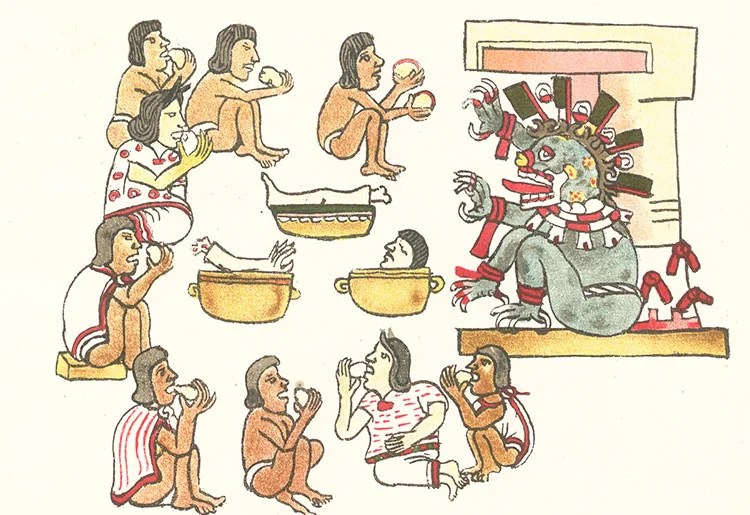
In central Mexico, ritual cannibalism occurred within a specific sacred and military context. The victims were usually war captives, and the act was tied to sacrifice rather than hunger.
After public sacrifice, bodies could be distributed among elite households and consumed in stews eaten with tortillas, typically without chile. Human flesh was understood as food belonging to the gods, not ordinary people.
A Historical Day of Eating
What this might have looked like on an ordinary day.
Morning
• Warm amaranth–maize atole: Thin, savory, nourishing
Snack
• Prickly pear fruit
• Toasted squash seeds
• Water
Main Communal Meal
• Turkey stewed in chile–tomato sauce
• Cooked chayote squash with herbs
• Beans with epazote
• Fresh maize tortillas
• Water or chia drink
Sweet Item (Rare and not daily)
• Maize cakes lightly sweetened with maguey sap
• Bitter cacao drink with chile
Modern Menu Interpretation
The same structure, translated for today.
Breakfast
• Amaranth–corn breakfast latte: Warm and lightly spiced with vanilla and cinnamon
Snack
• Prickly pear and lime cup with chili salt
• Pepita crunch clusters
• Chilled cactus water
Dinner
• Turkey chile flatbreads
• House-pressed corn flatbreads
• Shredded turkey braised in roasted chile–tomato sauce
• Charred chayote and squash
• Black beans, fresh herbs, citrus
• Optional table sauce
• Smoky chile broth for dipping or drizzling
Drink
• Chilled chia fresca, lightly sweetened and citrus-forward
• Light mezcal cocktail
Dessert
• Amaranth–corn cake with agave glaze and warm fruit compote
• Iced cacao cold brew with chile and cinnamon
Climate & Environment
Geography shaped daily life in 1519 Mexico. What people ate, how they dressed, when they worked, and even how they rested depended on heat, rain, altitude, and soil.The land decided everything long before politics ever did.
Mexico was never one climate. It was many worlds stacked side by side. People adapted to each one with precision, not guesswork.
That environmental awareness still runs deep today.
Gulf Coast Lowlands
Hot, wet, and dense, the Gulf Coast demanded constant adjustment.
- Summer temperatures hovered around 30–34 °C (86–93 °F) with humidity often 75–90%
- Winter stayed warm at 22–26 °C (72–79 °F) and remained humid
- Landscape included swamps, slow rivers, mangroves, and thick tropical growth
Clothing stayed light. Work began early. Food spoiled fast if you were careless.
Yucatán Peninsula
The Yucatán looked lush, but water was scarce.
- Summer temperatures averaged 28–33 °C (82–91 °F) with 70–85% humidity
- Winter cooled slightly to 20–25 °C (68–77 °F)
- Landscape was limestone plains and dense jungle, with cenotes instead of rivers
Life revolved around water access. Settlements clustered near cenotes.
Central Mexican Highlands
This region became the political heart of central Mexico, but its climate is what made that possible.
- Summer temperatures averaged 22–26 °C (72–79 °F) with 40–60% humidity
- Winter cooled to 15–20 °C (59–68 °F)
- Landscape included a high plateau, lakes, volcanic soil, and surrounding mountains
The climate supported intensive agriculture, dense populations, and long growing seasons. Volcanic soil fed maize fields, and lake systems fed cities.
Volcanic Mountain Regions
Higher elevations brought harsher conditions.
- Summer temperatures averaged 18–22 °C (64–72 °F)
- Winter could drop near 0 °C (32 °F) at higher elevations
- Landscape featured pine and oak forests, steep slopes, and active volcanoes
People here relied on layered clothing, seasonal movement, and deep environmental knowledge. Frost was a real threat, not an abstraction.
Pacific Coast and Western Slopes
The western regions balanced heat with seasonal rhythm.
- Summer temperatures reached 30–35 °C (86–95 °F) with 60–80% humidity
- Winter cooled to 20–25 °C (68–77 °F)
- Landscape included sandy coastlines, scrubland, and fertile river valleys
Fishing, salt gathering, and coastal trade thrived here.
Population & Top Cities
Where people lived, and how dense this world really was.
Mexico in 1519 was heavily populated by global standards. Most scholars estimate 15–30 million people lived across the region, with the greatest concentration in central Mexico.
The Basin of Mexico alone may have held 1–3 million people, depending on how its boundaries are defined. This was not a sparsely inhabited land. It was crowded, organized, and deeply urban.
Population density shaped politics, food systems, trade, and warfare.
Major Cities
Tenochtitlan
Estimated population: 200,000–250,000
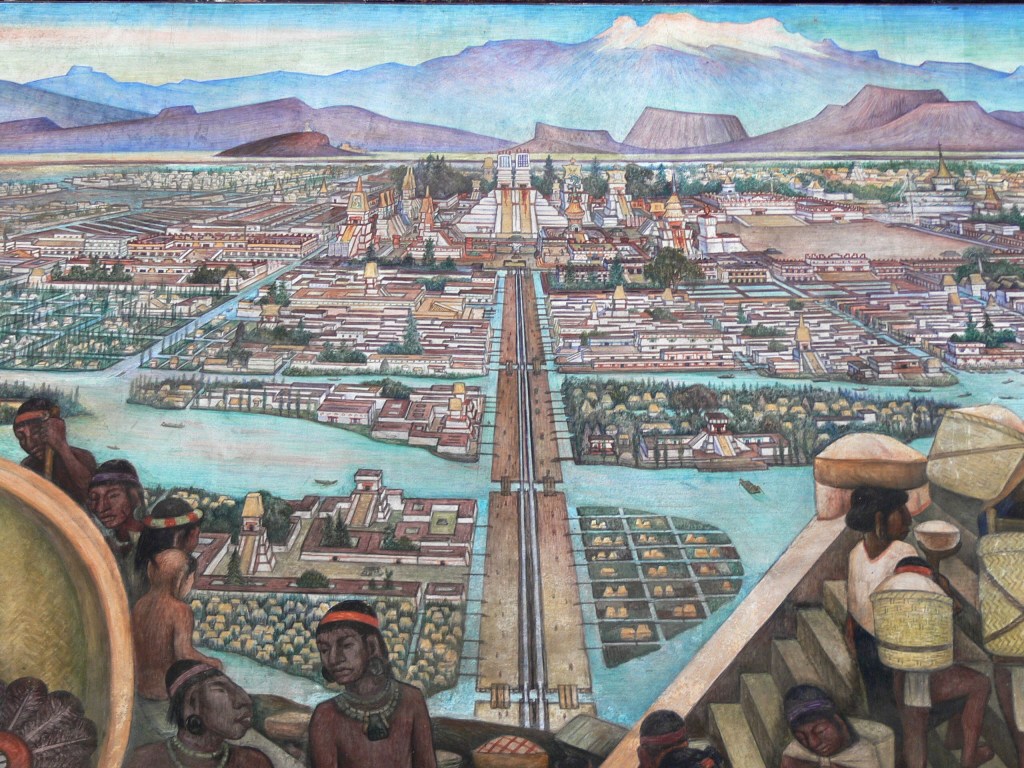
Built on an island in Lake Texcoco, Tenochtitlan was the political, religious, and economic heart of Mexica power. Canals cut through neighborhoods. Markets moved food and goods daily. Temples and public spaces dominated the skyline.
If you want to really see this city instead of just imagining it, I highly recommend exploring A Portrait of Tenochtitlan. It’s an interactive reconstruction that lets you see the city as it may have appeared in 1519, with canals, causeways, and temples laid out in space. You can explore it here if you’re curious. I also love the sider thing that lets you see the past and present in one (go look and you’ll get it)
Causeways connected the city to the mainland. These were wide stone roads, not narrow paths, and they were interrupted by removable wooden bridges.
- Canoes and trade traffic passed beneath them
- Bridges could be lifted or removed quickly
- At night or during danger, the city could cut itself off completely
Tenochtitlan was open and defensible at the same time.
This mattered deeply. In Europe, bridges were fixed. Once crossed, they stayed crossed. In Tenochtitlan, access was regulated every day. Movement, trade, and defense were part of a living system. To Spanish soldiers, the city felt unreal. Streets became water. Water became streets. Bridges vanished. From their point of view, this was not primitive engineering. It was strategic design.
Texcoco
Estimated population: 25,000–50,000
Texcoco was a major intellectual and legal center. It was known for scholars, poets, and engineers, and it helped shape law, philosophy, and infrastructure across central Mexico.
Power here looked quieter, but its influence was deep.
Tlacopan
Estimated population: 20,000–30,000
Tlacopan was one of the three cities of the Triple Alliance. Smaller than Tenochtitlan or Texcoco, it was still politically crucial, helping support and legitimize Mexica rule.
Not all power needed scale. Some power came from position.
Cholula
Estimated population: 40,000–60,000
Cholula was a sacred city, famous for its massive pyramid and religious importance. It functioned as a pilgrimage center and was respected across cultural and political boundaries.
Its influence came from belief as much as force.
Tlatelolco
Estimated population: 30,000–40,000
Tlatelolco was best known for its enormous marketplace. Tens of thousands of people traded there daily. Food, tools, cloth, animals, and luxury goods flowed through this space with tight regulation.
This was urban life at full speed.
Seeing It Through European Eyes
To understand the shock of first contact, we have to zoom out.
In 1519, Europeans did not expect to find cities of this scale outside Europe, North Africa, or parts of Asia. When Spaniards entered Tenochtitlan, they compared it to the greatest cities they knew.
Estimated Populations Around 1500
- Tenochtitlan
200,000–250,000
Island city with canals, aqueducts, massive markets, and monumental temples - Paris
200,000–225,000
Densely packed, narrow streets, limited sanitation - Venice
110,000–150,000
A maritime power with canals, but far smaller - London
50,000–75,000
Growing quickly, but still compact and polluted - Seville
60,000–80,000
Spain’s Atlantic gateway to the Americas
Tenochtitlan was not just large. It was planned.
- Wide causeways with removable bridges
- Canals for daily transport
- Fresh water aqueducts feeding the city
- Markets hosting tens of thousands of people
For many Europeans, this was the first time seeing a non-European city that matched or exceeded their own in scale and organization.
Imagine arriving from Castile and seeing this. A city on water. Clean streets. Order without familiar kings or churches. A population rivaling Paris, built without Roman roads or medieval stone castles. The Spaniards were not walking into a primitive world. They were walking into a city that forced them to rethink what they knew.
Peoples of Mexico
Mexico in 1519 was not one culture, one belief system, or one political body. It was a mosaic of powerful societies with shared roots, deep histories, and active rivalries. Before belief or ritual can make sense, we need to know who was actually here. Below are some of the most prominent cultures in Mexico at the time, but they were far from the only ones.
The Mexica (Aztecs)
The Mexica were the dominant political and military power in central Mexico. Their capital, Tenochtitlan, stood at the center of a vast tribute empire.
They ruled through alliances, warfare, and ritual authority rather than mass settlement. Conquered cities kept their own rulers but owed tribute in food, cloth, labor, and captives.
The Mexica did not see themselves as conquerors in the European sense. They understood their role as caretakers of cosmic order. Power meant responsibility, and failure to rule correctly risked imbalance that could affect gods, land, and people alike.
They were powerful, but not universally loved. Tribute demands created resentment, which mattered later.
The Tlaxcalans
The Tlaxcalans were an independent Nahua people and the most persistent enemies of the Mexica.
They lived east of the Valley of Mexico in a fortified highland region centered around Tlaxcala. Despite repeated wars, they were never conquered.
They shared many religious beliefs and cultural traditions with the Mexica, but fiercely guarded their independence.
When Spaniards arrived, the Tlaxcalans did not see them as saviors. They saw them as tools.
Without Tlaxcalan alliance and manpower, Spanish conquest in central Mexico almost certainly fails.
The Maya
The Maya were not a single empire in 1519. They were a network of powerful city states spread across the Yucatán Peninsula and southern regions.
They possessed long standing traditions of astronomy, writing, architecture, and ritual knowledge. Some major cities had declined from earlier peaks, but Maya societies remained politically and culturally strong.
Spanish conquest in Maya regions took decades longer than in central Mexico.
Economy & Jobs
How people worked, traded, and kept life moving.
People in 1519 did not “earn a living” the way we think of jobs today. Work was about obligation, skill, and contribution to the household, the community, and the city. Identity mattered more than income. Money existed, yes. But daily life ran on exchange, tribute, and labor rather than wages.
What you did was who you were.
Was Money Used?
Yes, but not coins in pockets.
Across central Mexico, standardized exchange items helped set value, especially in larger markets.
- Cacao beans, counted out for small purchases
- Cotton cloth pieces called quachtli, used for higher value transactions
- Copper tools or bells, used in some regions
Most daily exchanges were still barter-based. Food, labor, tools, or cloth moved directly between people. These items helped standardize value, but they were not universal cash.
Money existed to support the system, not replace it.
How People Got What They Needed
Households did not stand alone. They were part of a wider economic web.
- Families farmed, gathered, fished, or produced goods
- Tribute flowed upward to city leaders and rulers
- Markets redistributed food, tools, cloth, and luxury items
The market at Tlatelolco was the largest in the region. Tens of thousands of people traded there daily. Prices were regulated. Judges monitored fairness. Theft and cheating were punished. Markets were not chaotic. They were orderly, watched, and trusted.
Class Structure and Work
This was not a simple divide between rich and poor. Society was layered and interconnected.
- Commoners worked as farmers, laborers, artisans, and porters
- Skilled specialists included builders, scribes, healers, and craftspeople
- Elites included nobles, high-ranking warriors, and priests
- Rulers came from royal lineages and city leadership
Most people lived modest but stable lives. They were not wealthy, but they were not destitute. Food security came from land access, tribute systems, and communal responsibility.
Could People Move Up or Down?
Yes, more than many people expect.
- Warriors could rise dramatically through battlefield success
- Merchants gained wealth and influence through long-distance trade
- Families could lose status through political shifts or failure
Status was inherited, but it was not frozen. Achievement mattered. So did loyalty and timing.
Health
Life expectancy, healing, and the risks people lived with every day.
Health in 1519 Mexico was a mix of deep knowledge and real danger. People understood the body through balance, heat, movement, and spiritual forces. Care was observational, routine, and woven into daily life.
If you survived childhood, you had a strong chance at a long, active life. Getting there was the hardest part.
Life Expectancy and Survival
- If someone reached adulthood, living into their 50s or early 60s was common
- Child survival hovered around 60–70% reaching adulthood
Healthcare and Medicine
Medicine was organized, respected, and practical. Healers were trained specialists, not amateurs guessing with herbs.
- Physicians treated wounds, illness, and chronic conditions
- Midwives handled childbirth, fertility care, and women’s health
- Herbal specialists prepared remedies from plants, roots, resins, and minerals
Diagnosis focused on balance. Too much heat, too much cold, blocked movement, or spiritual disruption all mattered. Treatment aimed to restore flow, not isolate symptoms.
Common Remedies and Treatments
People worked with what the land provided.
- Willow bark for pain and inflammation
- Maguey sap for wound cleaning and infection control
- Chili and salt for circulation and cleansing
- Temazcales, steam baths used for illness recovery and postpartum care
Basic surgical practices existed. Bone setting, wound stitching, and dental filing are all documented. Care was hands-on and direct.
Hygiene and Body Care
Cleanliness mattered and was routine, especially in urban areas.
- Frequent bathing using water and plant-based cleansers
- Steam baths used weekly or more
- Teeth cleaned with fibers, powders, and chewing sticks
- Menstrual care using absorbent plant fibers and cloth, washed and reused
- Organized waste removal and latrines in cities
A clean body signaled discipline and self-respect, not vanity.
Common Dangers Before Contact
Before European diseases arrived, the greatest risks were ordinary ones.
- Childhood infections
- Accidents related to labor and travel
- Complications from childbirth
- Malnutrition during drought or famine years
Health and Belief
The body as a vessel of sacred forces.
Mexica thought treated the human body as more than flesh. The body was a container of sacred energies, a small reflection of the wider cosmos. Health depended on keeping those forces in balance.
Most sources agree on one core idea. A person did not have a single soul. They carried multiple spiritual forces that worked together.
When one weakened, the others suffered too.
The Tonalli
The tonalli lived in the head and was tied to the Sun. It governed will, intelligence, and personal destiny. Its name comes from a word meaning to radiate or warm.
The tonalli entered the body at conception and shaped character from the beginning. Because the Sun fed it, infants were often placed near fire or sunlight to strengthen it.
Tonalli was fragile. Fear, shock, or strong emotion could weaken it. Hair and fingernails were believed to protect and store this energy.
In war, seizing an enemy by the hair was believed to capture their tonalli. A severed head held concentrated destiny. This idea appears repeatedly in Mexica art.
The Teyolia
The teyolia resided in the heart and animated emotion, vitality, and social presence. It shaped affection, courage, leadership, and creativity.
This force did not leave the body during life. After death, it lingered near the body for four days, then began its journey either toward Mictlan or the sky of the Sun, sometimes transforming into a bird.
Places could also hold teyolia. Cities, mountains, lakes, and homes had heart centers. When a household head fell gravely ill, grain seeds were sometimes removed so they would not perish alongside him.
This belief shaped ritual heart sacrifice. Offering hearts strengthened the Sun by returning sacred energy to it. The heart was not metaphor. It was fuel for the universe.
The Ihiyotl
The ihiyotl occupied the liver or stomach region and governed breath, passion, aggression, and emotional intensity. It lived in inhaled and exhaled air.
This force was volatile. It could spill outward and harm others if uncontrolled. Rage, desire, and inner fire came from here.
Social & Family Structure
Who lived together, and how order was maintained.
Family in 1519 was not small or private. It was the core unit of survival, identity, and authority. Who you lived with, who raised you, and who you answered to shaped your entire place in society.
In a world without police stations and hospitals, community is the safety net. Community wasn’t optional. It was survival infrastructure.
Birth, Gender, and Early Training
From birth, children in Nahua society were trained for specific social roles. This training was not symbolic. It was practical preparation for a life where every person had to contribute.
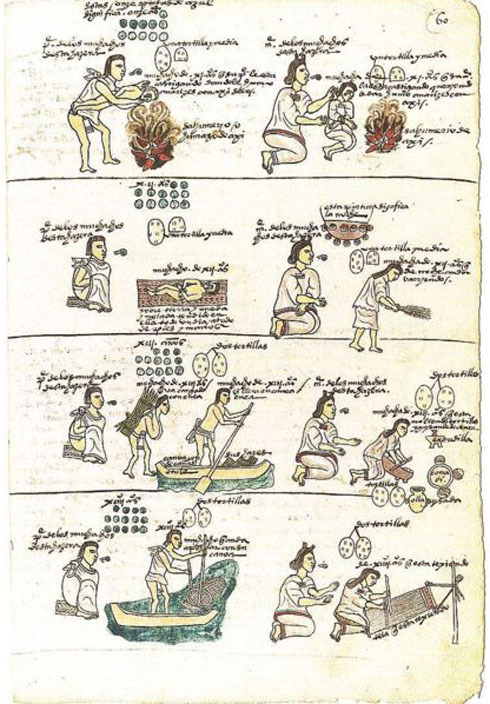
Here’s what you’re seeing, panel by panel:
• Purification through fire
Children undergo the izcalli ritual every four years. Boys are held briefly over the fire. Girls are held near it. This was believed to strengthen the body and spirit and prepare children for hardship.
• Early childhood punishment and restraint (boys)
A young boy is shown bound and forced to lie on the cold ground, a disciplinary measure meant to teach endurance. This was not accidental hardship. It was intentional conditioning. Boys were expected to tolerate discomfort, cold, and restraint without complaint, preparing them for future military service.
• Early childhood purification and labor training (girls)
A young girl is shown sweeping the house, an act tied to both cleanliness and ritual purification. Sweeping was not just a chore. It was a moral duty connected to order, discipline, and maintaining harmony within the home.
• Gendered labor training
Boys carry firewood, learn fishing, and work outdoors. Girls grind maize and weave on a back-strap loom. These were not chores. These were life skills tied to survival.
The takeaway is simple: childhood was not sheltered. It was structured. Every stage prepared a person to hold up their part of the community.
Households and Daily Life
Most people lived in extended households.
Parents, children, grandparents, and sometimes married siblings shared space, food preparation, childcare, and labor. Homes clustered into neighborhoods tied by kinship and obligation.
Privacy mattered less than cooperation. Survival depended on shared effort.
Marriage and Adulthood
Marriage was expected and taken seriously. It linked families, labor, and responsibility.
• Commoners practiced monogamy
• Elite men could take multiple wives for political alliances
• Marriages were arranged through family negotiation
Women usually married between 15–18 years.
Men between 18–22 years.
Marriage marked full adulthood. Children often followed soon after.
Social Hierarchy and Power
Ordered from least to most powerful.
This society was not chaotic. Roles were ranked, expected, and enforced. Below is a bottom-to-top structure, not to diminish those at the bottom, but to show how authority accumulated.
1. Tlacotin
Enslaved individuals, usually due to debt or crime. Slavery was not hereditary. People could buy back freedom. Children of enslaved parents were born free.
They were protected by law from abuse. Even here, community limits applied.
2. Mayeque
Landless workers tied to noble estates. They paid heavy tribute but were not owned. Their status was harsh but not permanent.
3. Macehualtin
Free commoners. Farmers, laborers, artisans, and soldiers. This was the largest group and the backbone of society.
They owed tribute, labor, and military service, but had land access through their community.
4. Pochteca
Long-distance merchants. Technically commoners, but wealthy and influential. They traded luxury goods, acted as spies, and operated their own courts.
Power through information and movement.
5. Pipiltin
Nobility by birth. Landowners who received tribute. They held political and religious offices.
Exceptional commoners could rise into this class through military achievement.
6. Tecuhtli
Local lords governing districts or towns. They acted as judges, military leaders, and land stewards.
They represented their people upward and defended them downward.
7. Cihuacoatl
Second-in-command to the ruler. Managed daily governance, tribute, courts, and war leadership.
This was the engine of the state.
8. Tlatoani / Huey Tlatoani
The ruler of a city-state. In Tenochtitlan, the imperial ruler.
Responsible for war, justice, markets, religion, famine response, and rebuilding after disaster.
A good ruler was described as carrying his people in his cloak.
Childhood & Parenthood
What it meant to raise a child, and what it meant to be one.
Childhood in 1519 was not treated as a protected bubble. It was a training ground. Parenthood was serious work, shaped by risk, responsibility, and the knowledge that survival depended on preparation.
What Parenting Looked Like
Parenting was intentional and hands-on. Raising a child was not a private project. It was a shared responsibility across family and neighborhood.
Every adult in the community was expected to correct, instruct, and model proper behavior. No one was like “not my kid.”
Being a Parent
Pros
- Children contributed meaningfully to household labor
- Elders helped with childcare and instruction
- Clear social expectations reduced uncertainty
- Parenting was supported by shared community norms
- Children learned resilience early
Cons
- High infant and child mortality
- Discipline was strict and sometimes harsh
- Parenthood began young
- Constant labor left little rest
- Fear of illness or famine was always present
Being a Child
Pros
- Strong sense of belonging
- Constant interaction with family and community
- Clear expectations and routines
- Learning through doing rather than abstraction
- Daily life filled with movement and social connection
Cons
- Little personal freedom
- Early labor responsibilities
- Physical punishment was normal
- Childhood ended quickly
- High exposure to illness and danger
The Calmecac
The calmecac was the elite school attended primarily by children of nobles, though exceptionally gifted commoner boys could also be admitted.
Children typically entered the calmecac around 10 to 12 years old.
Students lived at the school, not at home. This was full immersion, not day education.
The calmecac taught:
- Religion and ritual practice
- Law and governance
- Calendar knowledge
- Formal speech and oratory
- Writing and record keeping
- Military leadership
Students were trained to lead, not to be comfortable.
Discipline in the Calmecac
Discipline in the calmecac was severe and uncompromising. This was intentional. More was expected of these children, especially sons of nobles, and punishment reflected that expectation.
For minor disobedience, students could be:
- Forced to inhale the smoke of burning chili peppers
- Beaten with nettle switches
For more serious infractions, punishments escalated:
- Burning of the body
- Cutting and bloodletting at the ears, chest, thighs, or calves
- Beatings severe enough to draw blood
For major moral violations, including drinking alcohol or engaging in premarital sex, punishments could be fatal.Students could be strangled, thrown into a fire, or shot with arrows
Sons of noble families faced harsher punishment than others, not leniency. Their status increased expectations, not protection.
The calmecac did not exist to nurture individuality. It existed to produce disciplined leaders capable of bearing responsibility without breaking.
Animals In The Home
Animals were part of daily life, but not emotional companions in the modern sense.
- Dogs were common and served multiple roles
- Turkeys were raised near homes
- Birds were kept for feathers
Leisure, Festivals, and Daily Joy
How did people have fun?
Life in 1519 was demanding, but it was not joyless. Rest, play, and celebration were built into the rhythm of daily life and the ritual calendar. Leisure was not an escape from responsibility. It was part of staying balanced.
Fun was social by default. People relaxed together, played together, and celebrated together, usually in public or shared spaces.
Adults
Everyday Joys
Small pleasures filled the spaces between work.
- Sharing meals in the day
- Talking and joking while grinding maize or weaving
- Conversation, gossip, and storytelling in the evenings
- Visiting the market just to see what was new
Life was noisy, communal, and rarely solitary.
Games and Gambling
Games were entertainment, training, and risk all at once.
- Patolli: a popular racing and gambling board game. Patolli mixed strategy, chance, and superstition.
- Played with painted beans used like dice and small stone counters
- Cross-shaped board divided into 52 squares, reflecting the calendar cycle
- Four players often sat on mats while the game was watched by others
- The god Macuilxochitl, associated with gambling and pleasure, was believed to preside over games
- A rare upright bean throw could instantly end the game and award all winnings
- Players bet cloaks, jewelry, cacao beans, food, and sometimes theirs or their children’s personal freedom
Men and women, nobles and commoners all played. It crossed social boundaries in a way few activities did.
Games taught patience, emotional control, and how to handle loss.
Ballgames as Spectacle
Ullamaliztli was watched far more often than it was played.
- Played on stone courts called tlachtli
- Used a heavy solid rubber ball
- Players struck the ball with hips, thighs, shoulders, or upper arms
- Protective padding was required due to the ball’s weight
The game carried layered meaning.
- The ball symbolized celestial movement
- The court reflected cosmic order
- Sending the ball through a stone ring was rare and awe-inspiring
Matches were physically brutal and socially significant.
- Elite warriors and nobles often played
- Large wagers were common
- Some ceremonial games ended in players being sacrifice, though not all
The ballgame sat at the crossroads of sport, religion, and power.
Music and Performance
Music was constant and communal.
- Drums, flutes, rattles, and shell instruments
- Group singing and rhythmic chanting
- Dance tied to storytelling, ritual, and memory
Music was learned young and shared often. Silence was rare.
Festivals and the Calendar
The ritual calendar structured joy throughout the year.
- Monthly festivals tied to agriculture and weather
- Public feasting, music, and dance
- Costumes, body paint, and performance
Festivals were participatory, not spectator events.
Markets as Social Space
Markets doubled as gathering places.
- Friends met while shopping
- News and gossip spread quickly
- Street food and small treats added pleasure to errands
A market day was as much about connection as commerce.
Children & Families
Children’s Play
Children played constantly and socially.
- Running and chasing games
- Ball games using rubber balls
- Dolls made from cloth, clay, or wood
- Miniature tools for imitation play
- Riddles and word games taught by elders
Children played in mixed-age groups, usually close to home. Solitary play was rare.
Family Leisure
Joy was shared across generations.
- Shared meals as the main daily gathering
- Watching festivals and dances together
- Visiting markets as a household
- Teaching songs, games, and stories
Children learned joy by watching adults enjoy themselves.
Culture, Language & Worldview
Religion in 1519 was not something practiced once a week. It was how the world made sense. Gods, land, bodies, and time were woven together, and daily life unfolded inside that fabric without separating sacred from ordinary.
How the Universe Was Understood
The Mexica understood the universe as alive, unstable, and relational.
Time moved in cycles, not straight lines
Creation required ongoing nourishment
Humans were participants, not observers
The universe did not run automatically. It had to be sustained.
Language, Writing, and Thought
Nahuatl dominated central Mexico alongside many regional languages.
Writing was pictographic and glyph based
Codices recorded history, tribute, ritual, and time
Texts were meant to be read aloud and explained
Religion & Sacred Order
Faith in 1519 was practical, not abstract. Gods were present in weather, crops, illness, birth, and war. Religion structured time, behavior, and responsibility.
Ritual, Reciprocity, and Obligation
The universe did not run automatically. It had to be sustained.
Human sacrifice was understood as repayment of a debt owed to the gods. The gods had sacrificed themselves to bring the world and humanity into existence. In return, humans were required to sustain them with the most precious substance they possessed: blood and life energy.
The Mexica believed that without this exchange, the universe would collapse. The sun would cease to move, crops would fail, and life itself would end.
Sacrifice was therefore purposeful, structured, and deeply ritualized.
Sacred Time, Taboos, and Coordination
Sacred time required discipline so that rain would fall, crops would grow, and the sun would rise again.
One person acting wrongly could, in their understanding, tip that balance. When we say a misstep could ripple outward, we are not talking about superstition or control. We are talking about a culture that believed survival depended on coordination.
When everyone moved together, the world held. When they did not, it trembled.
Concrete Examples of Taboos
- During major rain or maize festivals
- You did not have sex
- Because sexual activity was considered heat and excess. During moments when rain or crop growth was being ritually stabilized, excess heat could dry the land or anger rain deities. Restraint helped cool the world so rain would come.
- If rain failed afterward, people believed this restraint had been broken somewhere.
- During fasting days
- You ate less or avoided certain foods
- Because overconsumption pulled energy toward the body instead of toward sustaining the gods and the world. Fasting redirected strength outward.
- Eating heavily during a fast was not sinful. It was irresponsible.
- During specific ritual weeks
- You did not drink pulque
- Because intoxication loosened control. Sacred time required clarity so rituals stayed precise. A drunk mistake could ruin a carefully timed ceremony.
- Pulque itself was sacred, just not during moments that demanded restraint.
- When entering temples or sacred spaces
- You washed your body and wore clean clothing
- Because dirt and disorder symbolized imbalance. Entering sacred space incorrectly was like bringing mud into a mechanism that had to run smoothly.
- This was not about moral purity. It was about not contaminating ritual work.
- During certain ceremonies
- You did not argue, fight, or shout
- Because conflict disrupted harmony. Loud emotional disorder fractured cooperation between humans and gods.
- Even justified anger was postponed.
Children and Religious Knowledge
Children in Mexica society were not systematically shielded from knowledge of human sacrifice, but neither was it an everyday sight.
Sacrifice occurred during specific ritual moments and in designated sacred spaces. Children were taught from an early age that these acts were necessary to sustain the world and were framed as solemn obligations rather than frightening or celebratory violence.
By the time children encountered sacrifice directly, it was already contextualized within religious meaning, discipline, and community responsibility.
This was a culture teaching children how to live in a fragile universe, where difficult acts were sometimes required to keep life going.
Priests and Sacred Discipline
Priests were trained professionals, not distant mystics.
They managed calendars and ceremonies
Interpreted signs, dreams, and omens
Oversaw education and ritual discipline
Bernal Díaz described priests wearing black cloaks and long gowns that reached their feet. Some wore hoods. Others let their hair grow long, sometimes to the waist, sometimes to the ankles.
Their hair was matted with dried blood and could not be separated. Their ears were cut as part of penance. Their fingernails were long. Díaz wrote that they smelled of sulfur and decay. Yet even he admitted they were deeply pious and lived disciplined lives.
Autosacrifice
Autosacrifice was also common.
Priests and laypeople pierced their ears, tongues, thighs, or genitals with maguey spines to offer their own blood. Some performed this daily.
This was not self harm for guilt. It was participation in cosmic maintenance.
Sacrifice & Cosmic Responsibility
Human sacrifice is the most visible and misunderstood aspect of Mexica civilization. Within their worldview, it was not random violence. It was obligation.
Who Was Sacrificed
Most victims were warriors captured in battle, and many believed their souls would be welcomed by the Sun after death.
Others were selected for physical beauty or symbolic qualities. To be chosen was often understood as an honor.
Captives also included slaves, criminals, noblewomen, and children, particularly in rites dedicated to Tlaloc.
Methods of Ritual Death
Methods of ritual death varied and included:
- Heart extraction
- Decapitation
- Death by arrows
- Drowning
- Gladiatorial combat
- Burial alive
- Burning
- Flaying
These methods were chosen based on deity, season, and symbolic meaning.
Sacred Spaces and Aftermath
Sacrifices took place at temple platforms, mountain sites, and ball courts.
Afterward, further rituals followed.
- Heads were placed on skull racks
- Bodies could be prepared under strict rules for communal consumption during sacred banquets
- Sometimes the body was buried.
- In sacrifices dedicated to Xipe Totec, the skin of the victim was flayed and worn by a young man who represented the god in ceremonies that followed.
How Europeans reacted
In the early months after contact, the Mexica did perform public sacrifices in the presence of the Spaniards, and in at least a few documented cases, the rituals were explicitly framed as protective or diplomatic acts that included the newcomers. Spanish eyewitness accounts make their reactions very clear.
Many Spaniards were horrified, physically sick, or emotionally shaken by what they saw. Some reportedly wept, others prayed aloud, and several described the rituals as more disturbing than anything they had witnessed in war.
Bernal Díaz del Castillo, who was present during the conquest, wrote in graphic detail about:
- The smell of blood and burning flesh
- The sound of drums and chants
- The visibility of beating hearts
He described priests with blood-matted hair and temples slick with gore, and he did not hide his revulsion. For Christian Europeans, sacrifice was associated with demonic imagery, not sacred duty. Seeing it performed openly, calmly, and reverently was deeply unsettling.
To the Spaniards, this was evidence of barbarity.
To the Mexica, it was evidence of responsibility.
Major Advancements & Trials Since 1300
By 1519, Mexico was not standing at the beginning of its story. It stood at the edge of a long arc of consolidation, innovation, strain, and rising tension. The century and a half before European arrival shaped everything the Spaniards would encounter.
1375: Establishing kingship
By the mid-1300s, the Mexica were under pressure. Their growing settlement around Lake Texcoco drew the attention of powerful neighbors, especially Azcapotzalco, whose ruler Tezozomoc imposed heavy taxes on them. Military resistance was not an option, so the Mexica chose legitimacy. Elders and priests sought a ruler who could anchor political unity, embody Huitzilopochtli (the Mexica patron god of the sun and war), and connect the Mexica to prestigious noble lineages. They chose Acamapichtli, of Mexica and Colhua noble descent, whose Toltec ancestry carried weight. Around 1375 AD, he was crowned the first tlatoani, marking the shift from marginal settlers to dynastic rulers.
1428: Formation of the Triple Alliance
In 1428, the Mexica allied with Texcoco and Tlacopan, overthrowing a dominant regional rival. This alliance created the imperial structure later called the “Aztec Empire.” Tribute extraction replaced land occupation, expansion accelerated, and legitimacy was reinforced through shared rule.
1473: Absorption of Tlatelolco
Tenochtitlan defeated and absorbed its neighboring city, Tlatelolco, securing control over the largest market system in central Mexico. Markets governed food, tools, luxury goods, and information. Whoever controlled the market controlled the city’s pulse.
1487: Dedication of the expanded Templo Mayor
In 1487, under the ruler Ahuitzotl, a major expansion of the Templo Mayor was completed and ritually activated. This was a multi-day imperial spectacle involving delegations from across the empire, tribute displays, public feasting, music, and ritual sacrifice.
1502: Motecuhzoma II takes the throne
In 1502, Motecuhzoma Xocoyotzin became tlatoani. He was experienced, deeply religious, and politically ambitious. Under his rule, the empire reached its greatest territorial extent, but internal tension also peaked. He restructured leadership, emphasized loyalty training among noble youth, and enforced obedience with harsh consequences.
Late in his reign, Motecuhzoma was warned of a celestial sign that was interpreted as the approach of a force destined to overthrow him. A comet appeared in the sky, and the court astrologers and seers were unable to explain it within the established Mexica cosmological system. This failure was treated as a serious breach of responsibility. These specialists existed to interpret the will of the gods and anticipate threats to cosmic and political order. When they failed to foresee or properly interpret the sign, Motecuhzoma ordered their execution. The comet was understood not as a vague omen, but as a direct indication that a hostile power was moving toward him and that the balance sustaining his rule was breaking down.
The individual who brought this warning believed the sign meant that Motecuhzoma’s authority was coming to an end and that an external force, sanctioned by the gods, would soon overturn the existing order. After receiving this interpretation, Motecuhzoma is described as becoming increasingly fearful and severe. His anxiety deepened as he struggled to respond to what he believed was an unavoidable destiny rather than a preventable threat. Within Mexica belief, such signs indicated not merely political danger, but cosmic judgment: if the gods had withdrawn their support, resistance was futile, and the fall of a ruler was already set in motion.
1507: The last New Fire Ceremony
In 1507, the Mexica completed the New Fire Ceremony, a ritual held at the end of a 52-year calendar cycle, when all sacred calendars realigned. This was not a regular festival. It was an existential one. The Mexica believed that at the end of each cycle, the universe might simply stop. The sun might not rise. Time itself could fail. So on this night, every fire across the Basin of Mexico was extinguished. Homes went dark. Hearths went cold. People waited in silence while priests climbed Cerro de la Estrella to see whether the cosmos would continue.
At the appointed moment, a new fire was drilled into the chest cavity of a sacrificial victim, and from that single flame, fire was relit and carried outward to temples, neighborhoods, and homes. Life resumed. The world had been renewed for another 52 years.
1517: Hernández de Córdoba reaches the Yucatán
This first Spanish expedition encountered Maya cities and organized societies. Córdoba was badly wounded and later died, but reports of wealth and urban life returned to Cuba.
1518: Juan de Grijalva surveys the Gulf Coast
Grijalva gathered intelligence, traded, and confirmed that powerful inland societies existed.
1519: Cortés arrives
The collision phase begins.
Music & Instruments
Instruments you would actually hear
Music in 1519 was physical and communal, built to carry across plazas, temples, and neighborhoods.
- Huehuetl
A tall vertical drum carved from wood and topped with animal skin. Its sound was deep and steady, like a heartbeat anchoring ceremonies. - Teponaztli
A horizontal slit drum struck with rubber-tipped mallets. Tuned and rhythmic, it created layered patterns rather than melody. - Tlapitzalli
Clay flutes and whistles, often animal-shaped, producing sharp, piercing tones that cut through crowds. - Ayacachtli
Rattles made from gourds or seed pods, shaken during dance and procession. - Atecocolli
Conch shell trumpets, loud and commanding, used to announce ritual moments and summon attention.
These were not casual objects. Many instruments were restricted to trained musicians and ritual specialists. Playing incorrectly was not a harmless mistake. It mattered.
Sacred music vs. everyday sound
Sacred and formal music
- Performed on temple instruments like the huehuetl and teponaztli
- Played by trained specialists
- Used during ceremonies, festivals, and state events
- Required precision in timing and rhythm
Mistakes were not aesthetic failures. They were ritual failures.
Everyday and personal music
- Singing while grinding maize
- Songs during weaving, walking, or field work
- Lullabies sung to children
- Rhythmic clapping or tool tapping during chores
Singing was the most common form of music in daily life, especially in households. Music existed from cradle to old age, even when instruments were absent.
Could musicians play at home for fun?
Yes, with limits.
A trained musician could:
- Practice rhythms and songs
- Teach apprentices
- Play informal versions of melodies
What they could not do casually was:
- Use sacred instruments incorrectly
- Perform ritual music outside proper context
What would it sound like today?
We don’t have recordings, obviously. What we do have are careful modern reconstructions based on surviving instruments, codices, and archaeological evidence.
Reconstruction playlist (modern recordings, ancient sound):
- Huehuetl y Teponaztli – Jorge Reyes
- Prehispanic Music of Mexico – Tlapitzalli Ensemble
- Conch Shell Calls and Drums – Xavier Quijas Yxayotl
Media You Can Watch or Read Today
If you want to feel 1519 instead of just reading about it, these are my go-to picks. Some are strict history, some are poetic, some are spicy with myth, but all of them help you step into the world where Mexico and Europe first collided. Café de olla recommended while consuming.
Adults
Movies
- Apocalypto (Film, 2006)
Language: English (original); Dubbed/Subtitled: Spanish available
A brutal, fast-paced story set in a Maya world just before Spanish arrival. It’s fictional, but the jungle life, fear, and ritual atmosphere feel real in your bones. - Retorno a Aztlán (Film, 1989)
Language: Nahuatl & Spanish (original); Subtitles vary
A mythic film about origins and destiny, told largely in Indigenous language. It feels like stepping into a codex that learned how to move. - La otra conquista (Film, 1998)
Language: Spanish (original); Subtitled: English available
Tells the conquest from an Indigenous perspective, focused on spiritual collision rather than just swords and horses. Heavy, emotional, and worth the quiet after. - Cabeza de Vaca (Film, 1991)
Language: Spanish (original); Subtitled: English available
About a Spaniard who survives by living among Indigenous peoples. It’s less about conquest and more about culture shock, humility, and transformation.
TV
- Hernán (TV Series, Amazon, 2019)
Language: Spanish (original); Subtitled: English available
Political drama about Cortés and Moctezuma. Big budget, big emotions, and a reminder that this was a human story, not just a timeline.
Books & Manuscripts
- The Fifth Sun: A New History of the Aztecs (Book, Camilla Townsend)
Language: English (original); Translated: Spanish edition available
This one lets Nahua voices lead. It reads like history but feels like people talking back through time. - Historia verdadera de la conquista de la Nueva España (Book, Bernal Díaz del Castillo)
Language: Spanish (original); Translated: English available
Written by a soldier who was there. Messy, biased, vivid. You don’t read it for truth alone, you read it to hear how Spaniards made sense of what they saw. - Visión de los vencidos (Book, Miguel León-Portilla)
Language: Spanish (original); Translated: English available as The Broken Spears
Indigenous accounts of conquest, compiled from Nahuatl sources. Quietly devastating. This is how the story sounds from inside the fire. - The Florentine Codex (Book, Bernardino de Sahagún)
Language: Nahuatl & Spanish (original); Translated: English available
An encyclopedia of Mexica life. Gods, food, family, fears, jokes. It’s like a time capsule disguised as a manuscript. - Aztec (Novel, Gary Jennings)
Language: English (original); Translated: Spanish available
Historical fiction that follows a Mexica man through markets, war, sexuality, travel, and conquest. Long, chaotic, and wildly immersive. - Codex Mendoza (Manuscript, 1540s)
Language: Nahuatl pictographs & Spanish glosses
A visual guide to tribute, daily life, and rulers. Not a “book” in the modern sense, but absolutely a window into how this world explained itself. - Tenochtitlan: Capital of the Aztecs (Book, Eduardo Matos Moctezuma)
Language: Spanish (original); Translated: English available
Archaeology plus storytelling. Shows how the city actually worked, not just how it fell.
Children
TV & Movies
- Dora the Explorer (Nickelodeon, 2000)
Language: English & Spanish (bilingual); Dubbed/Subtitled: Spanish available
Ages: 2–5
Yes. Dora is still a win. She introduces Spanish naturally, celebrates problem-solving, and treats Latin America as a place of adventure and intelligence. It’s not historical, but it builds comfort and curiosity, which is exactly what you want at this age. - Go, Diego, Go! (Nickelodeon, 2005)
Language: English & Spanish (bilingual); Dubbed/Subtitled: Spanish available
Ages: 3–5
Dora’s cousin, more animals, more nature. Great if your kid loves creatures and rescuing things. It quietly introduces geography and ecosystems connected to Mexico and Central America. - Niño Santo
Language: Spanish (some English subs available)
Ages: 4–6
Short, calm animated clips rooted in Mexican storytelling. These are nice if you want something quieter than Dora. - Coco (Disney, 2017)
Language: English (original); Dubbed/Subtitled: Spanish available
Ages: 4–6 (with a parent nearby)
I always tell parents this one is emotionally gentle but big-feelings rich. Most preschoolers love the colors, music, and family warmth. If your child is sensitive about death, just cuddle through it and keep explanations simple. - El Camino de Xico (Netflix, 2020)
Language: Spanish (original); Dubbed/Subtitled: English available
Ages: 6–10
A sweet animated movie inspired by Mexican myth and landscape. Strong girl lead, magical journey, gentle stakes. Great “Saturday afternoon with popcorn” energy. - Legend Quest (Netflix, 2017)
Language: Spanish (original); Dubbed/Subtitled: English available
Ages: 7–11
Same universe as Las Leyendas, but a little lighter. It’s silly, energetic, and full of cultural references that spark great follow-up conversations. Perfect for kids who like action with humor. - Las Leyendas (Netflix, 2017)
Language: Spanish (original); Dubbed/Subtitled: English available
Ages: 8–12
A supernatural adventure series rooted in Mexican folklore. Think spooky but not nightmare-fuel. It introduces Indigenous monsters and legends in a fun, fast-paced way. My kind of “they’re learning without realizing it” show.
Books
- ¡Vamos! Let’s Go to the Market
Language: English & Spanish
Ages: 2–5
Bright, loud, joyful book about a Mexican market day. You can almost smell the fruit. This is one of those books kids ask for again and again. - My Colors, My World
Language: English (with Spanish words)
Ages: 2–5
Soft, poetic, and calm. It connects colors to nature and daily life. Perfect bedtime energy. - Round Is a Tortilla
Language: English (Spanish concepts throughout)
Ages: 2–5
Shapes through Mexican culture and food. Simple, sturdy, and very “sit-on-the-floor-and-read-together.” - The Cempasúchil Flower
Language: English (Spanish editions available)
Ages: 3–6
A very gentle introduction to Día de los Muertos themes. No fear, no death talk beyond remembrance and love. This one lands especially well if you’ve already watched Coco. - The Magic of Mexico
Language: English (original)
Ages: 6–9
More culture than history, but it builds context beautifully. Food, festivals, art, daily life. This one pairs really well with cooking or craft nights. - Ancient Mexico
Language: English (original)
Ages: 7–11
National Geographic style. Clear, colorful, and calm. Perfect if you want facts without fear or hype. - Myths and Legends of Mexico
Language: English (original); Some Spanish editions available
Ages: 8–12
Short stories you can read aloud. Great bedtime option if your kids like myth but don’t want something too spooky before sleep. - The Aztecs (DK Children’s Book)
Language: English (original)
Ages: 8–12
Big pictures, short text, zero overwhelm. This is the book you leave on the coffee table and suddenly your kid is asking why Tenochtitlan was built on water. - You Wouldn’t Want to Be an Aztec Sacrifice
Language: English (original)
Ages: 9–12
Dramatic title, surprisingly respectful content. It doesn’t glorify violence, but it does satisfy curious kids who want real answers. Good for kids who ask “but WHY” a lot.
Would you have thrived in a world built on shared responsibility, ritual discipline, and community survival… or struggled without privacy, plumbing, and personal freedom? Leave your thoughts below or tag me on social.
 Time Traveling Table
Leave a comment