
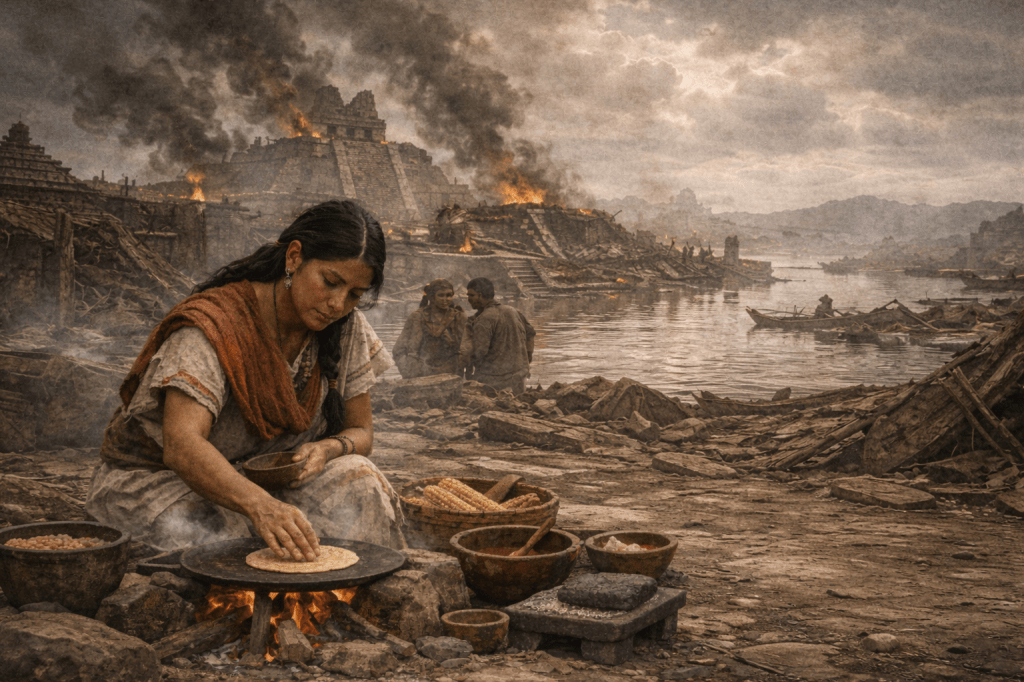
This is not the beginning of contact. It is the breaking point. In this post, we move past battles and headlines and look at what daily life actually felt like in the year Tenochtitlan fell. From what people wore and ate to how families reorganized, how music changed, and how faith bent without fully breaking. Not just what happened politically, but how ordinary life adjusted in real time.
Just so we’re all on the same page. Please ensure you’ve made yourself acquainted with my disclaimer
How the Mexica world cracked from 1519 to 1521
If you read my 1519 post, you already know the vibe. Cortés enters the Valley of Mexico as a guest, and the Mexica respond with diplomacy, gifting, and ritual timing. Not because one side was blind or evil, but because two highly developed civilizations met without a shared understanding of consequence.
To the Mexica, the arrival of foreigners was a political and cosmic problem, not an immediate moral one. New people meant new relationships to manage. Gifts, messengers, ritual timing, and observation were tools for figuring out intent. No one assumed this was the end of the world. It was a situation to stabilize.
The warning at Cholula
Before Tenochtitlan fractures, another city is shattered.
In October 1519, Hernán Cortés and his forces entered Cholula, one of the most important religious cities in Central Mexico and a major pilgrimage site dedicated to Quetzalcoatl. He arrived with several hundred Spaniards and thousands of Indigenous allies, primarily Tlaxcalans. Tension rose quickly. Spanish sources later claimed they uncovered a planned ambush, alleging trenches had been dug, women and children removed, and Mexica forces prepared to assist in an attack. Cortés framed what followed as a preemptive strike to prevent destruction.
Indigenous accounts recorded later in Nahuatl sources describe a different sequence. They present Cholula as having received the Spaniards as guests amid confusion and unease, but not open warfare. According to these accounts, Spanish and Tlaxcalan forces gathered leaders in a courtyard, blocked the exits, and attacked unarmed nobles and ritual participants without warning.
Estimates of the dead range between 3,000 and 6,000 people. Many victims were nobles, priests, and civilians. Tlaxcalan allies participated heavily, continuing long-standing regional rivalries. Parts of the city were burned, looting occurred, and Cholula’s political leadership was destabilized.
The hostage moment that broke legitimacy
By late 1519, Cortés and his men are housed in the Palace of Axayácatl in Tenochtitlan, and the relationship starts to sour fast. Spanish chroniclers describe fear of being trapped. Mexica sources describe foreigners who keep pushing deeper, demanding more, and refusing to act like a guest.
A turning point comes when Cortés takes Motecuhzoma II hostage and uses him as a lever to control the city. Motecuhzoma is still made to “rule,” but now under guard, inside the palace.
From a Spanish point of view, this was stability through control.
From a Mexica point of view, this was catastrophic. The tlatoani’s authority depended on legitimacy, ritual standing, and public trust. A ruler under guard is a ruler already broken.
What “imbalance” meant, and why it escalated everything
For the Mexica, the universe was not stable by default. It stayed in balance only because humans, gods, seasons, and rituals were all doing their part. Think of reality less like a machine and more like a system that constantly needs tuning.
So when strangers arrived who did not follow protocol, who ignored reciprocity, who disrupted sacred space, that signaled imbalance. Not “evil.” Not “punishment.” Imbalance.
And when the Mexica increased rituals, offerings, and caution after contact, they were not panicking. They were trying to correct the system.
Once Spaniards attacked, seized leaders, or destroyed temples, the imbalance was no longer subtle. It was severe.
Sacred space becomes a battlefield
The Spaniards insisted that Mexica human sacrifice must stop and demanded permission to place Christian symbols inside the sacred precinct of the Templo Mayor. Cortés warned that if this request was denied, he would tear down the idols himself. Under pressure, Motecuhzoma allowed a cross and an image of the Virgin Mary to be placed within the temple complex. To the Spaniards, this was the removal of false gods and the beginning of proper order. To many Mexica, it was desecration inside the center of the world.
From the Mexica view, this was not just war. It was cosmic disorder entering daily life. Sacred space had been altered. The balance between gods and humans felt unstable. The response was not panic but correction. More ritual. More caution. More effort to restore equilibrium. Those actions made sense inside their worldview, but appeared incomprehensible or threatening to the Spaniards.
At this point, you can feel the trap closing. Each side is acting “logically.” Each side is also escalating in a way the other cannot interpret correctly.
1520, the year everything accelerates
Now we add a factor people forget. Spain was fighting with itself.
Cortés did not have direct approval from the Spanish crown to conquer anything. He was originally authorized by Diego Velázquez de Cuéllar, governor of Cuba, to lead a limited expedition.
That permission was supposed to mean:
- Explore the coast
- Trade
- Gather information
- Come back
Not invade, not found cities, not overthrow empires.
When Velázquez realized Cortés had gone rogue, a Spanish force under Pánfilo de Narváez was sent to arrest him. Cortés then leaves Tenochtitlan to handle that threat, and he leaves the city under Pedro de Alvarado.
This decision sets up the disaster.
At the same time, Cortés was already writing to the Spanish crown. In his letters, he described the land as wealthy, the cities as organized, and his actions as necessary. Even while the situation in Tenochtitlan grew unstable, he framed himself as a loyal servant expanding royal power.
The Festival Massacre, the moment peace became impossible
During the festival of Tóxcatl in 1520, Mexica nobles and priests gathered in the temple precinct for a scheduled public ceremony. It was not a military gathering. It was ritual. While Cortés was away confronting a rival Spanish force, Pedro de Alvarado remained in command. At the height of the ceremony, Spanish soldiers blocked the exits of the courtyard and attacked. The participants were unarmed. Swords and spears were used against dancers and priests. Estimates vary, but historians believe several hundred, and possibly up to a thousand, people were killed within hours.
From the Mexica perspective, this was not simply violence. A sacred ceremony had been violated. Nobles and priests were slaughtered inside ritual space. The gods had been dishonored publicly. Whatever uncertainty had existed before now hardened. The strangers were not just politically dangerous. They were dismantling the structure that kept the world ordered.
News spread rapidly through the city. Residents armed themselves. The Spaniards were attacked. Motecuhzoma’s already fragile authority collapsed entirely. When Cortés returned, he did not find tension waiting to be managed. He found open revolt.
The festival massacre was the moment when peace became impossible. Not because violence had never happened before, but because this violence destroyed trust, legitimacy, and sacred space all at once. That is why historians point to 1520, not 1519, as the moment everything truly broke.
Motecuhzoma dies, leadership turns over fast
Soon after, Motecuhzoma dies in the chaos. Spanish accounts often say he was struck by stones thrown by his own people. Some Indigenous accounts say the Spaniards killed him. Either way, the result is the same. The old political framework collapses in public.
Cuitláhuac rules for only 80 days, then dies during the first major smallpox wave in late 1520. The war is now stacked with crisis on crisis.
Next Cuauhtémoc becomes tlatoani.
La Noche Triste, the retreat
In June 1520, Cortés and his forces attempted to flee Tenochtitlan under cover of darkness. The city had turned against them, and staying there was no longer possible. They tried to escape along the western causeway toward Tlacopan. Mexica warriors attacked from rooftops and from canoes in the lake. Bridges were removed, sections of the causeway gave way, and chaos spread quickly. An estimated 400 to 600 Spaniards were killed during the retreat, along with roughly 4,000 to 8,000 Indigenous allies, most of them Tlaxcalans. Many drowned in Lake Texcoco, weighed down by armor, weapons, and looted gold. The survivors eventually reached Tlaxcala, battered and diminished. For a brief moment, it appeared the invasion might collapse entirely.
1521, the siege and the fall of Tenochtitlan
After the retreat, Cortés regrouped in Tlaxcala. He rebuilt his forces, strengthened alliances, and constructed brigantines to control Lake Texcoco. While he prepared to return, smallpox spread through the Basin of Mexico. It killed leaders, priests, children, and warriors. It destabilized communities before the next campaign even began. By the time Cortés moved again in 1521, Tenochtitlan was already weakened.
In May 1521, he returned with a coalition. Tens of thousands of Indigenous warriors fought alongside the Spaniards. Spain did not conquer alone. This was also a Mesoamerican power struggle shaped by long rivalries, strategic alliances, and towns making survival decisions under pressure. Cortés shifted strategy and committed to a full siege. For three months the city was systematically cut off. Causeways were contested, movement on the lake was controlled, food access collapsed, and fresh water became a battlefield. Starvation and disease compounded daily.
Cuauhtémoc led the final defense and refused surrender terms until there was nothing left to hold. On August 13, 1521, he was captured, and Tenochtitlan fell.
Spain locks the story down, fast
After this, withdrawal is no longer an option for Spain. Spaniards had killed nobles and priests. They had taken losses. They had invested prestige and treasure. So Cortés goes into damage control.
In letters to the Spanish crown, Cortés frames himself not as someone who lost control, but as someone holding back chaos. He positions the violence as necessary, the land as too valuable to abandon, and the conquest as already in motion.
Mexico, 1521. How the land is doing overall
When the Spaniards arrived, they believed the stakes were obvious. Land was to be claimed. Souls were to be converted. Authority came from a single god, a single king, and written law. To them, this encounter was the beginning of incorporation into their world.
By 1521, Mexico is not “post conquest” everywhere. It is fractured, wounded, and wildly uneven. Some regions are already collapsing. Others are still living almost exactly as they did before any European ever set foot here. This matters, because Spain did not hit Mexico all at once. It crept, clawed, and negotiated its way in.
Central Mexico
This is ground zero. The Basin of Mexico has taken the hardest blow.
The fall of Tenochtitlan in 1521 breaks the political spine of the Mexica world. Cities burn. Leadership is executed or co opted. Entire neighborhoods empty out fast.
Disease has already begun moving through the population, especially smallpox. People die in days. Elders, priests, warriors, children. Whole families disappear. Social memory fractures with them. This region is destabilized, and grieving.
Western Mexico
Places like Michoacán are shaken but not flattened.
The Purépecha state is watching closely, adapting fast, and choosing when to submit rather than be annihilated. Their political structures still stand in 1521, though the pressure is real.
Life continues with tension rather than collapse.
Southern Mexico
Oaxaca and Chiapas remain culturally dense and locally governed.
Zapotec and Mixtec communities still farm, trade, marry, and worship much as they did in 1519. Spaniards are present but not dominant yet.
There is fear. There is rumor. But daily life still feels familiar.
The Maya regions
The Maya world is largely untouched in 1521.
No sweeping conquest yet. No mass restructuring. City states continue their rhythms of farming, ritual, and warfare. Europeans are distant stories carried by traders and coastal sightings.
For most Maya people, nothing has changed yet.
Northern Mexico
Nomadic and semi nomadic groups barely register European presence at this point.
There is no conquest here yet because Spain does not know how to conquer people who do not build cities.
Life continues on ancestral patterns.
Home Life
Step inside a house in 1521. What did it look like, and what has changed since 1519?
What the Average House Looked Like
Most Indigenous families still lived in:
- Single-room homes
- Built from adobe, wattle and daub, wood poles, and thatch
- About 20–40 square meters (215-430 square feet) in size
- Packed earth floors
- One shared communal space
Urban homes in the Basin of Mexico often had:
- Smoother plaster walls
- Better drainage
- More refined finishing
Rural homes remained simple, practical, and climate-adapted.
Bedrooms?
No separate rooms. Families unrolled petates at night and stored them during the day.
Bathrooms?
None inside the home. Waste systems remained communal or external.
Sleeping & Cleanliness
- Families slept side by side on woven reed mats
- Blankets and cloaks doubled as bedding
- Bathing remained common
- Steam baths and river bathing continued
- Cleanliness was cultural, not cosmetic
Nothing European has reshaped daily hygiene yet.
What Has Changed Since 1519
- Some homes in Central Mexico stand abandoned due to death or displacement
- Other homes are overcrowded as families merge for survival
- Trade disruption makes replacing broken tools harder
- A few elite homes display European objects as curiosities
These are stress fractures, not redesigns.
What Has Not Changed
- Layout and construction methods
- Communal living patterns
- Food preparation techniques
- Core household technology
- Object placement and daily rhythms
The metate is still the metate. The comal is still the comal.
Culturally Important Objects
Inside the home you would still find:
- Small ritual spaces
- Bundles of herbs
- Ancestor-linked objects
- Protective items tied to lineage
What has changed is visibility.
In occupied areas:
- Ritual practice becomes quieter
- Some sacred objects move further indoors
What has not changed:
- Belief systems
- The sacred relationship between home, body, and earth
Fashion & Beauty Standards
What did people wear and what did society expect them to look like in 1521?
Most clothing in 1521 is still Indigenous in form, material, and meaning. The Spanish presence has created pressure, not transformation.
Men
Clothing & Accessories
Most men continue wearing:
- Maxtlatl (wrapped loincloth)
- Tilmatli (cloak, tied at the shoulder)
- Sandals made from leather or woven fiber
- Ear spools, necklaces, and status jewelry (depending on rank)
Clothing is wrapped and tied. There are no buttons. No stitched European tailoring. Silhouettes remain unchanged.
What has changed since 1519
- Elite men in occupied zones may hide or remove visible status markers
- Jewelry becomes more situational, worn carefully rather than openly
- Stress and disease are visibly thinning bodies in Central Mexico
Clothing still signals identity. It just carries more risk now.
Women
Clothing & Adornment
Women continue wearing:
- Huipil (woven tunic)
- Cueitl (wrapped skirt)
- Sandals or barefoot
- Beaded necklaces and ear ornaments
Textiles remain cotton or maguey fiber. Embroidery continues to mark region and identity. Silhouettes stay rectangular and structured.
What has changed since 1519
- Some women in occupied areas simplify adornment
- Pregnancy loss and illness increase in Central Mexico
- Public display of wealth becomes more cautious
Clothing remains Indigenous in structure and symbolism.
Children & Babies
Children still dress lightly:
- Simple tunics or skirts
- Infants often wrapped in cloth
- Amulets or small protective cords
What has changed:
- Fewer children visible in some regions due to disease
- Extended households mean more shared caregiving
Childhood clothing remains culturally consistent.
Cranial Shaping & Body Ideals
Intentional head shaping in infants continues in 1521. It is tied to identity, lineage, and beauty. Three years of European presence does not erase centuries of practice.
What has changed
- In Central Mexico, some families reduce or hide the practice near Spanish-controlled zones
- This is not ideological abandonment. It is caution.
There is no formal ban yet.
What has not changed
- In southern Mexico and Maya regions, the practice continues openly
- No internal Indigenous movement exists against it
For most families, this remains normal child-rearing.
Grooming & Hygiene
Cleanliness remains culturally important:
- Frequent bathing
- Herbal cleansers
- Hair grooming and body care routines
What has changed:
- In besieged or damaged cities, water access is disrupted
- Hygiene declines where infrastructure collapses
This is situational, not cultural decline.
Diet & Daily Meals
What did they grow, hunt, cook, and crave in 1521?
First thing to understand. Food is still sacred in 1521. It has not become scarce everywhere yet, and it has not become European yet. What has changed is the emotional weight around eating in places touched by war and disease. Food is still life, but now it’s also survival.
What has changed since 1519
- In Central Mexico, more time spent securing food due to disruption
- Market rhythms become less predictable
What has changed
- Central markets shrink or relocate
- Some tribute goods disappear temporarily
Even during siege, people still thought about food. Because survival is always agricultural first.
Before the war disrupted everything, the Valley of Mexico thrived through:
- Chinampas: raised agricultural beds built in shallow lakes
- Milpa system: maize, beans, squash growing together in ecological balance
- Amaranth, chiles, tomatoes, cacao, maguey
- Turkey and ducks
- Freshwater fish and insects
Maize was nixtamalized with cal. That process unlocked nutrients and made masa possible. Without that chemistry trick, Mesoamerican civilizations would not have flourished. Science, but make it Indigenous.
During the siege, famine hit hard. Spanish accounts describe people eating weeds, leather, whatever they could boil. That detail hurts.
Still, maize survived. Chinampa agriculture survived. And today, when you eat a tortilla in Mexico City, you are eating something older than Spain as a unified nation.
Population & Top Cities
Where were people living in 1521, and how many were left?
Before Spanish contact, scholars estimate the population of what is now Mexico somewhere between 15 and 30 million people. The range is wide because estimates rely on archaeology, tribute records, and later colonial data.
By 1521, the population has already begun to decline, especially in Central Mexico. Smallpox spreads faster than armies, and the Basin of Mexico absorbs the heaviest early losses. The national total is still debated, but the demographic shock is already visible in the heart of the former Mexica empire.
This is the first population break. The larger collapse unfolds over the following decades.
Tenochtitlan
Estimated population before contact
200,000 to 250,000
Estimated population after the siege in late 1521
40,000 to 60,000
Some estimates go lower.
Once one of the largest cities in the world and the capital of the Mexica empire. Tenochtitlan experiences catastrophic loss from smallpox, starvation, violence, and flight into surrounding communities. This is rapid urban collapse.
Tenochtitlan does not slowly decline. It empties.
Tlaxcala
Estimated population
35,000 to 50,000
Tlaxcala is not conquered in 1521. It is allied with the Spaniards. As a long-time rival of the Mexica, it supplies warriors, logistics, and political legitimacy to the campaign. Its population remains comparatively stable at this moment.
Cholula
Estimated population
30,000 to 40,000
Cholula is one of the oldest continuously inhabited cities in Mesoamerica and a major religious center associated with Quetzalcoatl. The 1519 massacre destabilizes leadership but does not empty the city.
Texcoco
Estimated population
25,000 to 30,000
Texcoco was a powerful altepetl. An altepetl was a Nahua city-state, a political and territorial unit with its own ruler, land, and ritual identity, and a long-standing rival of the Mexica. Texcoco was known for legal codes, engineering, and intellectual life. It aligns early with Cortés and becomes the military backbone of the siege.
Coyoacan
Estimated population
15,000 to 20,000
Coyoacan was also an altepetl. After the fall of Tenochtitlan, Spaniards use it as an administrative base. Its importance grows not because it was the largest, but because power relocates there.
Economy & Jobs
How did people earn a living in 1521, and was money even used?
The economy in 1521 does not disappear. Mexico was not a barter-only society. Markets were structured and regulated. Currency existed alongside trust-based exchange.
Markets used:
- Cacao beans for small transactions
- Cotton cloth for higher-value exchange
- Barter for bulk goods
- Tribute systems between city-states
Since 1519 in Central Mexico:
- Trade routes are disrupted
- Market days become less predictable
- Some currencies temporarily disappear during siege
- Scarcity increases in urban zones
This creates price instability and uncertainty, especially in Tenochtitlan during the siege.
Class Structure Before the Fall
Mexica society operated within defined categories:
- Tlatoani: Ruler of an altepetl, a Nahua city-state with its own territory and identity
- Pipiltin: Nobles, priests, military leaders
- Macehualtin: Farmers, artisans, laborers
- Tlacotin: Enslaved individuals
This hierarchy shaped land access, tribute obligations, and economic opportunity.
What Changes After 1521
- Elites tied directly to Mexica imperial power lose status quickly
- Tribute networks destabilize
- Political power shifts to allied Indigenous cities and Spanish administrators
- Urban labor becomes more precarious in Central Mexico
What Does Not Change
- Rural stability remains comparatively stronger
- Subsistence farming continues as the economic backbone
- Milpa agriculture does not collapse overnight
- Most people still produce their own food
Health
Life expectancy, medicine, and everyday dangers in 1521
Health in 1521 is uneven and fragile. Not because Indigenous medicine fails. But because new diseases arrive that no healer could have prepared for.
Life Expectancy
If a person survives childhood, they can live into their 50s or early 60s.
Childhood is the hardest gate.
Roughly 60 percent of children survive to adulthood in many regions before epidemic waves
Common Health Issues Before Epidemic Shock
- Gastrointestinal illness
- Parasites
- Respiratory infections
- Injuries from labor or warfare
- Dental wear from stone-ground maize
Common causes of death include:
- Infection
- Childbirth complications
- Injury
Then something new appears.
Smallpox
The epidemic that reshapes everything
Smallpox, explained from zero
Okay. Let’s strip this down and walk it slowly, like we’re sitting at the table and you’ve never heard the word before. Smallpox is a virus.
It spreads through breath, close contact, shared fabrics, blankets, and mats.
In 1521, no one in Mexico has ever encountered it before.
Stage 1: The Beginning (Days 1–4)
At first, it looks like something else.
People feel:
- Sudden fever
- Chills
- Deep exhaustion
- Head and back pain
- Nausea
- Body aches
This is the most dangerous stage because they are already contagious.
Stage 2: The Turn (Days 4–7)
The fever spikes higher.
A rash appears:
- First in the mouth and throat
- Then on the face
- Then arms, torso, legs
These are not blisters yet. They are flat red spots.
Stage 3: The Eruption (Days 7–14)
The spots become:
- Raised
- Filled with thick fluid
- Painful
- Tight
- Burning
They cover:
- Face
- Hands
- Feet
- Inside the mouth
- Sometimes eyes
People cannot eat. Cannot sleep. Cannot be touched.
The fever stays high.
Stage 4: The Worst Outcomes
At this point, two things can happen.
1. Death
Many die from:
- Fever overwhelming the body
- Secondary infections
- Dehydration
- Organ failure
In Central Mexico within the first epidemic waves:
- Estimated mortality reaches between 30 and 50 percent in some regions
- Children and elders die most
Adults die in numbers that feel unnatural and terrifying.
2. Survival, Scars, and Immunity
If someone survives smallpox, the sores eventually dry, scab, and fall away over weeks. But they do not leave quietly.
They often leave:
- Deep facial scarring
- Pitted skin
- Missing patches of hair
- Sometimes blindness
- Joint pain
Survivors are visibly marked for life.
And here is the cruel twist. If you survive smallpox, you cannot get it again. Your body learns the virus permanently. Immunity becomes lifelong.
But that immunity is bought with pain, loss, and a body that carries the memory forever.But that immunity comes at enormous cost.
Many survivors live with:
- Chronic pain
- Vision loss
- Reduced mobility
- Social stigma due to scarring
- Psychological trauma
In a society where the face carries identity, scars matter.
Why It Devastates Mexico
Smallpox had circulated in Europe, Africa, and Asia for centuries.
Those populations had partial immunity.
In Mexico:
- Zero exposure
- Zero inherited resistance
- No medical knowledge of this virus
What People Think It Is
People interpret it through the only framework they have.
Some believe:
- The gods are angry
- The balance is broken
- The world is ending
- The gods have turned away
The Social Fabric Is Ripped
The social fabric weakens when elders die. Knowledge transmission breaks.
By 1521, grief is constant in Central Mexico. Loss piles up without pause. There is no time to recover between funerals. Entire households fall sick at once. This is not one child in a bed with adults taking turns. This is entire families collapsing together.
Imagine a mother with fever so high she can barely sit up, trying to cool a child whose skin is burning. A father whose eyes are swelling shut, still trying to bring water to a mouth full of sores. Grandparents who should be the steady ones dying first. No healthy caregiver to rotate in.
Care becomes dangerous. Love does not stop. Parents stay. Smallpox does what swords alone could not.
Social & Family Structure
Who lived together, and who held power in 1521?
Mexica society was built on extended family networks. Not isolated nuclear homes. Not individuals.
Household Structure
Most people lived in extended family compounds.
- Parents
- Grandparents
- Married children
- Siblings
- In-laws
Daily life required interdependence.
Food production, childcare, ritual practice, and craft labor were shared responsibilities.
What Has Changed Since 1519
Population loss reshapes households.
- Families absorb orphans and widows
- Surviving households grow denser
- Labor gaps must be filled internally
Marriage patterns shift.
- War and death delay some marriages
- Widowhood becomes more common
Gender Roles and Power
This society is not matriarchal or patriarchal in the modern sense. It is complementary. Men and women hold distinct responsibilities.
Men often handle:
- Warfare
- Heavy agriculture
- Long-distance trade
Women anchor:
- Household economy
- Food systems
- Textile production
- Childcare
- Market exchange
What Changes After 1521
Male roles tied to warfare collapse faster as imperial military structures fall.
Women’s household authority often becomes more central, not through ideology, but through necessity.
Elders and Authority
Old age is not marginal here. Elders are living archives.
They carry:
- Genealogy
- Ritual knowledge
- Agricultural timing
- Oral history
What changes in 1521 is devastating.
Loss of elders due to disease fractures knowledge transmission. When elders die, memory gaps form.
Childhood & Parenthood
What was it like to be a child, or to raise one, in 1521?
Children in Mexica society were not passive. They were trained early, watched closely, and prepared for adult responsibility.
Education & Training
Boys were trained in:
- Farming
- Warfare
- Craft production
Girls were trained in:
- Weaving
- Food preparation
- Household management
- Ritual practice
Education could be formal.
- Calmecac trained noble youth in religion, leadership, and scholarship
- Telpochcalli trained commoner boys in warfare and civic duty
Discipline was strict. Responsibility came early. Children were prepared, not sheltered.
Daily Life for Children
Even during crisis, children:
- Carried water
- Helped grind maize
- Assisted in food preparation
- Learned songs and origin stories
- Listened to elders
Childhood was productive, communal, and embedded in family life.
What Has Changed by 1521
1. Fewer Children
This is the largest shift.
- Smallpox hits children hard
- Infant and child mortality spike in Central Mexico
- Entire age groups thin out
Homes grow quieter. The absence is the change.
2. More Communal Parenting
Loss forces adaptation.
- Orphans are absorbed into extended families
- Grandparents, aunts, and older siblings take on heavier caregiving roles
- Households grow denser
Childhood becomes more collective, not less. When parents fall, kin step forward.
3. Earlier Responsibility
Not earlier in ideology. Earlier in reality.
- Labor shortages push children into adult tasks sooner
- Boys assist in farming earlier
- Girls take on food and caregiving roles younger
This is necessity, not new philosophy. Labor gaps do not wait.
4. Interrupted Education
Formal systems weaken in Central Mexico.
- Calmecac and telpochcalli structures fracture
- Apprenticeship shifts closer to home
- Institutional learning becomes uneven
Children still learn. But more inside households than schools.
5. New Fear
Children notice shifts adults try to hide.
- War visible on the lake
- Ritual tone changes
- Adults whisper more
- Ceremony feels different
An eight-year-old watching brigantines surround their city does not need explanation to understand danger.
Leisure & Recreation
How did people have fun in 1521?
Even in crisis, people make time for rhythm, play, and story. Leisure is not luxury. It is cultural glue. Celebration does not vanish in 1521. It becomes quieter in some places and stronger in others.
Adults
Common Recreational Activities
- Ritual dances tied to the ceremonial calendar
- Poetry and song performances
- Storytelling in communal spaces
- Ballgame participation or spectating
- Market gatherings as social hubs
The Mesoamerican ballgame continues in many regions. It is sport, ritual, and politics woven together.
Feasting still accompanies ritual cycles where possible.
What Has Changed
In occupied areas of the Basin:
- Some dances soften or move indoors
- Public spectacle becomes more cautious
- Large ceremonial gatherings feel riskier
In regions outside direct Spanish control:
- Performance traditions remain strong
- Ritual cycles continue more openly
Celebration adapts to surveillance.
Children & Families
Children play even in uncertain times.
Common games include:
- Tag-like chasing games
- Simple ball games
- Dolls made of cloth or clay
- Riddles and verbal games
Family evenings include:
- Storytelling
- Song
- Oral history
- Moral instruction through narrative
Play does not require stability. It requires imagination.
Holidays & Gatherings
- Agricultural festivals continue where possible
- Local ritual feasts still occur
- Market days remain social events
- Private and local celebrations continue
What Has Changed
- Public spectacle reduces in occupied zones
- Large imperial-scale festivals become uneven or disrupted
Ceremony shrinks in scale, not in meaning.
Cultural Landscape in 1521
Mexico is not one culture. It never was.
If we’re talking influence and population in 1521, three major cultural blocs stand out.
1. Mexica (Aztecs)
Dominant in Central Mexico until 1521.
- Political and military power
- Religious influence across regions
- Urban and highly organized
Status in 1521:
Politically broken. Culturally alive. Empire falls. Identity remains.
2. Maya
Spread across southern Mexico and into Central America.
- Independent city-states, not a single empire
- Strong astronomical and calendrical systems
- Deep cultural continuity
Status in 1521:
Largely intact. Watching events in Central Mexico from a distance.
As a side note: Why does Spanish conquest take so much longer in Maya regions?
- No Single Capital
- Tenochtitlan functioned as a central node. Seize it, and destabilize the system. Maya regions had:
- Decentralized city-states
- No single ruler controlling the whole region
- So taking one city did not collapse the rest.
- Tenochtitlan functioned as a central node. Seize it, and destabilize the system. Maya regions had:
- Geography Limits Spanish Warfare
- Spanish warfare relied on:
- Horses, cannons, road-based supply lines
- Maya territory offered:
- Dense jungle, swamp, heavy rain, heat, fewer usable roads
- Spanish warfare relied on:
- Fewer Large-Scale Alliances
- In Central Mexico, Spain gained tens of thousands of Indigenous allies.
- In Maya regions:
- Rivalries were local, with no unified enemy
- Many communities chose avoidance over alliance
- No massive Indigenous coalition meant slower conquest.
- Political Culture of Endurance
- Maya societies were used to:
- Cycles of collapse and reorganization
- Abandoning cities and resettling
- Long conflict without surrender
- Maya societies were used to:
Some Maya groups remain autonomous into the late 1600s. Spain conquered central Mexico quickly because the Mexica Empire was centralized, accessible, and already under internal strain. Spain struggled in Maya regions because power was decentralized, geography was hostile, and societies were structured to survive disruption.
3. Zapotec & Mixtec
Located primarily in Oaxaca.
- Sophisticated writing systems
- Strong regional governance
- Long artistic traditions
Status in 1521:
Functioning societies. Aware. Watching carefully. Survival sometimes looks like staying quiet.
Culture, Language & Religion
Worldview, art, and sacred structure in 1521
What Has Changed Since 1519
- Public ritual decreases in occupied areas
- Priests are killed or silenced
- Some ceremonies move into private spaces
- Monumental art slows in Central Mexico
- Some codices are destroyed in conquered areas
Knowledge holders are targeted.
What Has Not Changed
- Cosmology
- Reciprocity between humans and gods
- Moral obligation to maintain balance
- Oral tradition remains strong
- Featherwork remains prized
- Portable art continues
Language & Memory
Nahua languages continue across Central Mexico.
Maya languages remain vibrant in the south.
Zapotec and Mixtec languages persist regionally.
Literacy in pictorial codices continues where possible. Oral memory remains primary.
When Balance Breaks
The theological crisis of 1521
This is the quiet crisis. Not just political collapse. Cosmic doubt. The Mexica worldview is built on reciprocity. Humans give ritual, blood, discipline. The gods give rain, sun, continuity.
If Ritual Sustains the Cosmos, Why Is It Failing?
People do not assume the gods are fake.
People say:
- The gods are testing us
- We misunderstood the signs
- The time has changed
- The gods have turned their faces
Confidence weakens. Belief mutates. When the world no longer behaves as promised, people do not stop believing. They ask hard questions, and those questions echo for generations.
Do Other Indigenous Groups Feel Vindicated?
Many do. Some interpret events as:
- Mexica overreach corrected
- Cosmic justice
- Strategic opportunity
Very few see Spaniards as holy deliverers, they see them as useful chaos. When empires fall, enemies call it destiny.
Where Do Mexica People Go?
They do not vanish. They move. Common destinations:
- Culhuacan
- Iztapalapa
- Xochimilco
- Rural chinampa zones
- Marriage-linked communities
Some remain among ruins. Some relocate temporarily. Some blend into neighboring Nahua communities.
Music & Instruments
What did 1521 sound like?
In 1519, music in Central Mexico was large and public. Drums echoed across plazas and temple platforms, marking ritual time and political authority. By late 1521, especially in the Basin of Mexico, that scale shrinks. Imperial ceremonies decline with the fall of the state, and large public performances become less common. Music moves into homes, courtyards, and smaller neighborhood gatherings.
The instruments themselves do not change. Drums, flutes, and rattles are still used, and ritual songs continue where possible. What changes is their political role. Drums no longer function as tools of imperial coordination but as community instruments. Musicians lose centralized patronage as temple systems weaken, and training becomes more household based.
Music is not outlawed in 1521. But in occupied zones, loud public ritual draws attention, and attention feels dangerous. Communities become more cautious about when and where music is played. The rhythms remain Indigenous. The structure survives. The sound simply grows smaller.
Some people call it “the fall.”
Some call it “the birth of New Spain.”
Some say it is trauma. Others say it is fusion.
Honestly, it is all of that.
1521 marks the violent end of the Mexica imperial state. But it also begins the long, complicated process that creates mestizo identity, colonial systems, Catholic syncretism, racial caste hierarchies, and eventually the Mexico we know.
It is not a simple story of disappearance.
It is transformation.
When you walk through Mexico City today, beneath the cathedral are Mexica foundations. Literally. Stones of Tenochtitlan reused in colonial buildings.
That is the metaphor.
They did not vanish. We layered.
And that layered identity, with pain and pride together, is what makes Mexican history so intense, so beautiful, so complicated.
And we are still unpacking it.
 Time Traveling Table
Leave a comment