
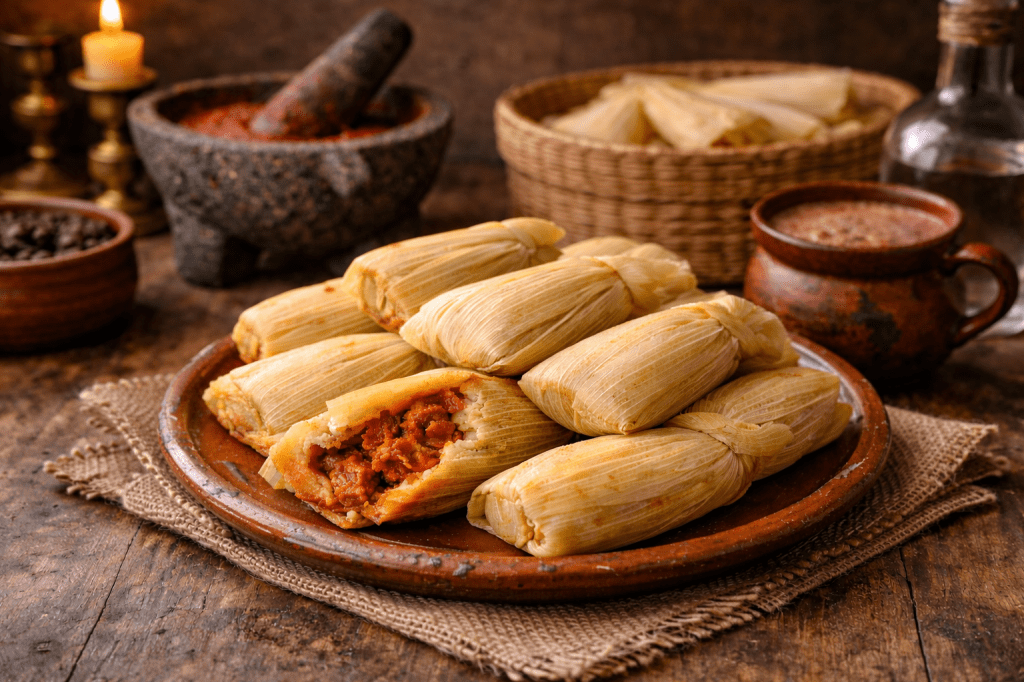
Tamales have been part of life in Mexico for thousands of years. Long before Spanish contact, Indigenous communities across Mesoamerica were already steaming masa filled with beans, chiles, vegetables, and meat. They were practical, portable, and nourishing. They worked perfectly for travelers, workers in the fields, and large communal gatherings. By the early 1600s in New Spain, tamales were still a staple food, but the ingredients had begun to reflect a changing world. Indigenous staples like maize, chiles, and epazote were now sometimes joined by newly introduced foods such as pork fat and domesticated poultry raised in colonial settlements. The result was a cuisine that still felt deeply Indigenous while slowly absorbing outside influences.
Tamales also tell us something important about how people cooked and ate together. These were not quick solo meals. Making tamales was, and still is, a group effort. Preparing the filling, mixing the masa, spreading the dough, and folding the husks takes time. Historically, families and neighbors would gather to make large batches together, turning the work into a social event. The rhythm of assembling tamales lends itself to conversation, storytelling, and simply enjoying time together.
And honestly… now that I have made them the real way, I completely understand why.
This was the first time I have really really made tamales from scratch. I have made them before, but I will admit I cheated a little and used kits and shortcuts. This time though everything was from scratch. Grinding the chiles, mixing the masa, wrapping the tamales myself. I am not going to lie, by the end I was pretty impressed with myself. It was a lot of work, but it was also kind of fun.
I could easily see how making hundreds of these with family would become one of those tasks where your hands stay busy but your mind gets to relax. It is repetitive in the best way. Spread, fill, fold, repeat. I enlisted my mom to help with this batch, and it turned into exactly the kind of experience tamales are famous for. Trying something new together, laughing at our mistakes, and slowly building a big pot of food.
We ended up hosting a small gathering of seven people that evening, and let’s just say the tamales disappeared quickly. Everyone kept going back for more again and again and again, so I am going to take that as a sign we must have done something right.
Time Estimate
Total time: about 3½–4 hours
Tamales are a labor of love, but once they’re steaming, the hard work is done.
Servings: About 7 people (approximately 20 tamales, 2–3 per person)
Ingredients
A Quick Note on the Ingredients: If there’s an ingredient below that doesn’t appeal to you or isn’t available at your store, don’t stress, just skip it, find a similar substitute, or let this recipe inspire you to add your own twist. Back in this time period, recipes didn’t exist in the structured way we know them today. People used whatever they had on hand, and measurements were more of a “feel it out” situation. So embrace the spirit of the age and make it yours!
Turkey & Broth
- 1 3–3½ lb bone-in turkey breast
- 6 cups water
- 1½ tsp salt
Chile Molli
- 3 dried ancho chiles
- 2 dried chile de árbol
- 1 small handful epazote
- 1–1½ cups turkey broth (from the cooked turkey)
- 2 Tbsp ground pumpkin seeds (pepitas)
Masa
- 4 cups masa harina
- 3¼–3½ cups warm turkey broth
- 2–3 Tbsp pork fat (lard)
- 1 tsp salt
Wrapping
- 20–24 corn husks
Instructions
Soak the Corn Husks
Place the corn husks in a large bowl or pot and cover them with warm water. Soak about 2 hours, or until they are soft and flexible. If they float, place a small plate on top to keep them submerged.
Cook the Turkey
Place the turkey breast in a large pot with:
- 5 cups water
- 1½ tsp salt
Bring to a gentle simmer and cook 45–60 minutes, until the meat is tender. Remove the turkey from the pot and reserve the broth. Once cool enough to handle, remove the meat from the bones and shred into small pieces.
Prepare the Chiles
Remove stems and most seeds from the chiles. Toast them briefly on a dry skillet or comal:
- ancho: about 10–15 seconds per side
- árbol: about 5 seconds per side
Do not burn them. Place the toasted chiles in hot water and let them soften about 15 minutes.
Grind the Molli
Molcajete Method (Traditional)
Place the pumpkin seeds in the molcajete first and grind them until they form a coarse paste. Add the softened chiles and a small splash of turkey broth. Continue grinding, gradually adding a little more broth as needed. Work the mixture against the stone until it becomes smooth and cohesive.
Blender or Food Processor Method (Modern Shortcut)
If you prefer a faster method, place the softened chiles and pumpkin seeds into a blender or food processor. Add about 1 cup of turkey broth and blend until completely smooth.
Cook the Sauce
Pour the chile paste into a pot.
Add:
- ½–1 cup turkey broth
- epazote
Simmer 10–15 minutes, stirring occasionally. The sauce should thicken and deepen in color.
Add the Turkey
Add the chopped turkey to the sauce. Simmer about 10 minutes so the meat absorbs the flavor. The finished filling should be thick and spoonable not watery. Let it cool slightly before assembling tamales.
Prepare the Masa
In a large bowl combine:
- 4 cups masa harina
- 1 tsp salt
Gradually mix in 3¼ cups warm turkey broth. Add the pork fat and knead until smooth.The dough should feel soft and spreadable, about the consistency of hummus.
If it feels stiff, add a little more broth.
If it feels sticky, add a little more masa harina.
Let the dough rest 10–15 minutes so the corn fully hydrates.
Assemble the Tamales
Lay a soaked corn husk flat on your work surface.
Spread 15–45 g (1–3 tablespoons) of masa across the center of the husk, depending on the size of the husk. Spread the dough so it forms a layer about 3–6 mm (⅛–¼ inch thick).
Add 15–30 g ( 1–2 tablespoons) of turkey molli filling down the center of the masa.
Fold the two sides of the husk inward so the masa surrounds the filling. Then fold the bottom of the husk upward to seal the tamal, leaving the top end open.
Repeat until all tamales are assembled.
Steam the Tamales
Traditional Pot Method
Before specialized steamers were common, tamales were often steamed in a large pot. Place a a large bundle of empty corn husks, trivet, rack, or even a small heatproof plate at the bottom of a large pot to keep the tamales elevated above the water.
Add a few inches of water to the pot. The water should sit below the trivet so it does not touch the tamales. Arrange the tamales in the pot either standing upright with the open ends facing up or laid gently on their sides in snug layers.
Cover the tamales with a few extra corn husks or a clean cloth to help trap steam, then place the lid on the pot. Bring the water to a gentle boil and steam the tamales 60–75 minutes, checking occasionally to make sure the pot does not run out of water.
Modern Steamer Method
If using a steamer basket or tamale steamer, place the tamales in the basket either upright with the open ends facing upward or laid on their sides in snug layers.
Add water to the bottom of the pot below the steamer basket. Cover and steam 60–75 minutes, checking occasionally to ensure the water does not evaporate.
Rest
Turn off the heat and leave the tamales covered for 10–15 minutes.
This allows the masa to firm up and improves the texture.
 Time Traveling Table
Leave a comment