
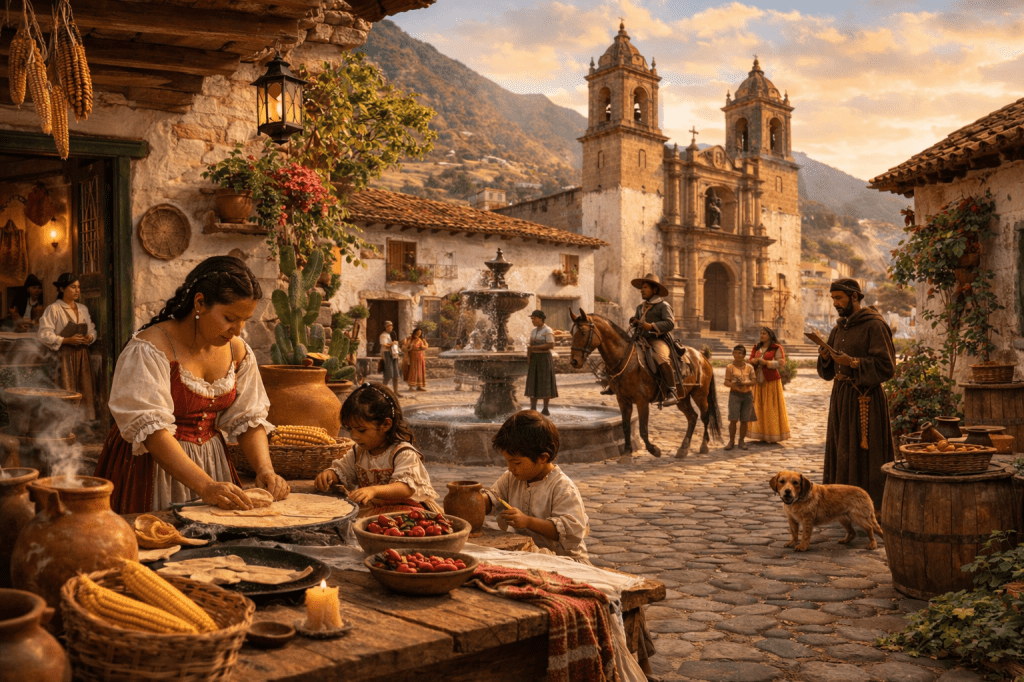
Step into a different time.
In this post, we explore what everyday life looked like in Mexico around the year 1700. Not just the big historical events, but the rhythms of ordinary life. What people wore, what they ate, how families lived together, and what might have been simmering on the stove.
If you joined me in the 1600 Mexico post, you already saw a world in transition, where Indigenous traditions and Spanish influence were beginning to blend. Now, about a century later, that blending has taken root. Cities are larger, trade stretches across oceans, and daily life reflects a more fully formed colonial society.
So grab something warm to drink, and let’s step into the world of New Spain at the dawn of the 18th century.
Just so we’re all on the same page. Please ensure you’ve made yourself acquainted with my disclaimer
Home Life
Step into a home in 1700 New Spain and see how daily life actually felt inside those walls.
Homes changed depending on region and wealth, but most people lived in small, practical spaces built from whatever was nearby. Adobe, wood, palm, stone. Nothing wasted. Everything used.
Size and Layout of the Average Home
For most Indigenous and mestizo families, home was simple and compact. Usually one or two rooms, built by hand, shaped by climate more than style.
A typical home measured around 30 to 60 square meters (320 to 650 sq ft).
Typical layout
- One main room for sleeping, cooking, and daily work
- Sometimes a second small room for storage or extra sleeping space
- No indoor bathroom
- A cooking area either inside or just outside
- A patio or yard used for animals, grinding maize, washing clothes, and daily chores
Bathrooms like we think of them today did not exist. People used latrines or simple outdoor pits, set a little away from the house. Water was not on demand either. You carried it from wells, rivers, springs, or a shared fountain.
Even with limited space, these homes were full of life. Kids running in and out, abuelos nearby, maybe a chicken wandering through like it owns the place. Privacy was not the goal. Living together was.
Sleep, Beds, and Nighttime Life
Night came and things slowed down fast. Without electricity, once the sun went down, your options were candles or oil lamps. So people followed a natural rhythm tied to daylight.
Daily rhythm looked something like
- Wake around sunrise
- Work through the day with short breaks and pauses during peak heat
- Wind down after sunset and sleep not long after
What you slept on depended on what you had.
Common sleeping setups
- Petates: Woven palm mats laid directly on the floor. This was the most common by far.
- Simple wooden beds: Found in wealthier homes.
- Hammocks: Especially in warmer regions like Yucatán where airflow mattered.
Blankets were usually wool, cotton, or woven maguey fiber. No real pajamas either. Most people slept in what they wore during the day or a loose cotton garment.
And yes, families slept together.
- Babies stayed close to their mother
- Kids slept nearby on their own mats
- Extended family often shared the same room
Privacy was not a cultural expectation the way it is now. Nighttime was quiet, dark, and shared.
What About Naps?
Midday rest was very real, especially in hotter regions.
People did not always call it a siesta, but the pattern was there. When the heat peaked, work slowed down.
Midday rhythm often included
- A meal
- A short rest on a petate
- Then back to work
Important Household Objects
Homes were small, but they were not empty. Every object had a purpose, and most had deep roots going back thousands of years.
Essential household tools
- Metate and mano: A flat stone and hand roller used to grind maize into masa
- Comal: A flat clay griddle for tortillas and other foods
- Ollas de barro: Clay pots for beans, stews, and sauces
- Molcajete: Volcanic stone mortar for grinding chile and spices
- Petates: Used for sleeping, sitting, and even carrying goods
- Clay water jars: Designed to keep water cool through evaporation
What Was New or Changing Around 1700?
By 1700, colonial influence had started to show up inside the home, but it depended a lot on where you lived.
In cities or wealthier households, you might see new materials and objects.
Newer additions included
- Glass windows instead of only wooden shutters
- Metal cookware from Europe
- Wooden furniture like chairs and tables
- Iron locks and keys
But for most families, daily life still followed deeply Indigenous patterns. Same tools, same layout, same rhythms.
Mexico at this point was not about one culture replacing another. It was layers building on top of each other. And you can still feel that layering today if you know where to look.
Fashion & Beauty Standards
What people wore in 1700 New Spain and what it quietly said about them.
Walk through a town in Mexico around 1700 and you are not just seeing clothes. You are reading people.
In New Spain, clothing signaled social class, ancestry, and sometimes even legal status inside the caste system. An outfit could tell you if someone was Spanish, Indigenous, African, mestizo, or somewhere in between, even before they spoke.
At the same time, people were not just passive. They worked within those limits. Color, embroidery, jewelry, and styling still gave space for identity. What you see is not one clean style but a mix of Indigenous continuity and Spanish influence, layered in everyday ways.
Women’s Clothing
For most women, clothing was practical, modest, and made from natural fibers. Indigenous and mestiza women especially held onto styles that had been around long before Spanish rule.
Typical garments
- Huipil: A loose cotton tunic, usually square, with openings for the head and arms. Often embroidered with geometric patterns or flowers.
- Enagua or skirt: A long wrap skirt that reached the ankles.
- Rebozo: A woven shawl used for warmth, modesty, carrying babies, or hauling goods.
- Apron: Common for cooking and daily work.
Accessories
- Silver earrings
- Coral or glass bead necklaces
- Hair ribbons
- Occasionally rings or small bracelets
Shoes were not guaranteed. Many rural women went barefoot or wore simple leather sandals.
In wealthier Spanish households, clothing followed more European styles.
Upper class elements
- Layered skirts
- Fitted bodices
- Lace collars
- Silk shawls
These fabrics were softer and more decorative. Silk, velvet, and fine wool showed up here. Even then, clothing still adjusted to the climate. Many regions stayed around 25 to 30 °C (77 to 86 °F), so lighter fabrics made sense.
Men’s Clothing
Men’s clothing shifted more clearly based on work and status.
Indigenous farmers and laborers wore simple, functional pieces that allowed movement and handled heat.
Typical clothing
- Cotton loincloth or short trousers
- Loose cotton shirt or tunic
- Simple woven cloak or tilma
Footwear again depended on resources.
- Many went barefoot
- Others wore simple leather sandals, similar to what we now call huaraches
Spanish and elite men dressed with more structure.
Upper class clothing
- Knee length breeches
- Long coats or jackets
- Buttoned waistcoats
- Leather boots
Hats were everywhere and crossed class lines.
Common headwear
- Straw hats for field work
- Felt hats in towns
- Wide brim hats for sun protection
Children and Babies
Children did not have a separate fashion world. They dressed like smaller versions of adults.
Young kids often wore simple cotton tunics or long shirts that could last as they grew. Babies were wrapped in cloth or blankets and often carried in a rebozo.
As children got older, their clothing gradually matched adult styles. Shoes were rare for younger kids, especially in rural areas.
Clothing needed to work because children were part of daily labor early on.
Hair, Grooming, and Personal Appearance
Hair was not just aesthetic. It carried meaning, especially in Indigenous communities.
Earlier Mesoamerican cultures sometimes shaped infants’ heads using boards or bindings as a sign of beauty or identity. By 1700, that practice had mostly disappeared under colonial pressure, though traces of it may have lingered in more isolated communities.
Women’s hairstyles
- Long braids
- Hair tied with ribbons
- Center part with hair pulled back
Hair was usually long, dark, and well cared for with oils or plant based rinses. Loose hair in public could be seen as improper for adult women.
Men’s hair and facial hair
- Shoulder length or tied back among Indigenous men
- Even cuts around the head
- Generally clean shaven due to genetically lighter facial hair
Spanish men often followed different grooming habits.
- Trimmed mustaches
- Short beards
- Styled hair
These differences could signal background without a word being spoken.
Cosmetics and Beauty Care
Beauty care existed, but it was subtle and tied to natural materials.
Common practices
- Herbal hair rinses from local plants
- Scented oils or flower extracts
- Light use of natural pigments
Bathing habits were actually strong in many Indigenous communities.
People bathed in:
- Rivers
- Lakes
- Wooden tubs
Soap was simple.
Typical cleansers
- Plant ash mixed with water
- Early animal fat soaps
- Crushed herbs or clay
Cleanliness was part of daily life, not a luxury.
Jewelry, Piercings, and Body Decoration
Adornment mattered, but it stayed relatively simple in everyday life.
Common items
- Silver earrings
- Bead necklaces
- Bone or shell pieces
Pierced ears were common, especially for women.
Older traditions like tattooing or ritual body paint had declined in many areas due to colonial pressure, though some communities kept elements of them quietly.
Beauty Standards and Body Ideals
Beauty standards leaned toward health and capability, not extremes.
For women
- Strong and capable
- Healthy skin
- Long dark hair
- Balanced body shape
A bit of softness could signal stability and access to food.
For men
- Strength
- Endurance
- Ability to work
Daily labor shaped bodies more than intentional fitness.
In cities, especially among elites, appearance and presentation carried more weight, tied to status and reputation.
Average Body Size in 1700 Mexico
People were generally shorter and leaner than today, shaped by diet, disease, and physical work.
Estimated averages
- Men: about 160 to 165 cm (5 ft 3 in to 5 ft 5 in)
- Women: about 150 to 155 cm (4 ft 11 in to 5 ft 1 in)
Estimated weight ranges
- Men: about 60 to 68 kg (132 to 150 lb)
- Women: about 50 to 57 kg (110 to 125 lb)
Bodies were typically wiry and strong. Not large, but built for constant movement and work.
Diet & Daily Meals
What people grew, cooked, and ate day to day in 1700 New Spain.
If you want to understand life in 1700, you start in the kitchen. Not a formal one, a real one. Smoke in the air, a comal heating up, someone already working through a pile of maize.
Food was part of the structure of the day. It dictated when you woke up, how you worked, and when you paused.
Most families relied on the milpa system, a long standing Indigenous farming method where maize, beans, and squash grow together and support each other. It is efficient, reliable, and shaped what people ate without much variation.
Spanish ingredients had entered the picture by this point, but for most households, the core diet still looked very familiar.
Views on Food
For many Indigenous and mestizo families, food followed routine and season.
Maize was central. Not just because it was practical, but because it carried meaning. In several traditions, people understood themselves as being formed from maize, so eating it daily was expected, not repetitive.
Meals shifted with the agricultural cycle.
- Fresh foods during harvest
- Stored or dried foods in leaner months
- Ingredients rotating based on what was available
Food took time. That was built into the day.
Staple Foods
Most households relied on a small group of ingredients that showed up again and again.
Daily staples
- Maize: Used for tortillas, tamales, atole, and more
- Beans: Usually black or pinto, cooked slowly in clay ollas
- Squash and pumpkin: Roasted, stewed, or added to soups
- Chiles: Fresh or dried for flavor
- Tomatoes and tomatillos
- Amaranth and chia
- Nopales
Animal protein was present, but not in large portions.
Common meats:
- Turkey
- Chicken
- Pork
- Wild game like deer or rabbit
- Fish in coastal or lake regions
For most families, meat was occasional rather than central.
Drinks and Alcohol
Drinks were often filling and part of daily intake, not just something on the side.
Common beverages
- Atole: Warm, thick drink made from maize, sometimes sweetened with piloncillo
- Chocolate drinks: Ground cacao mixed with water and spices
- Fresh fruit waters
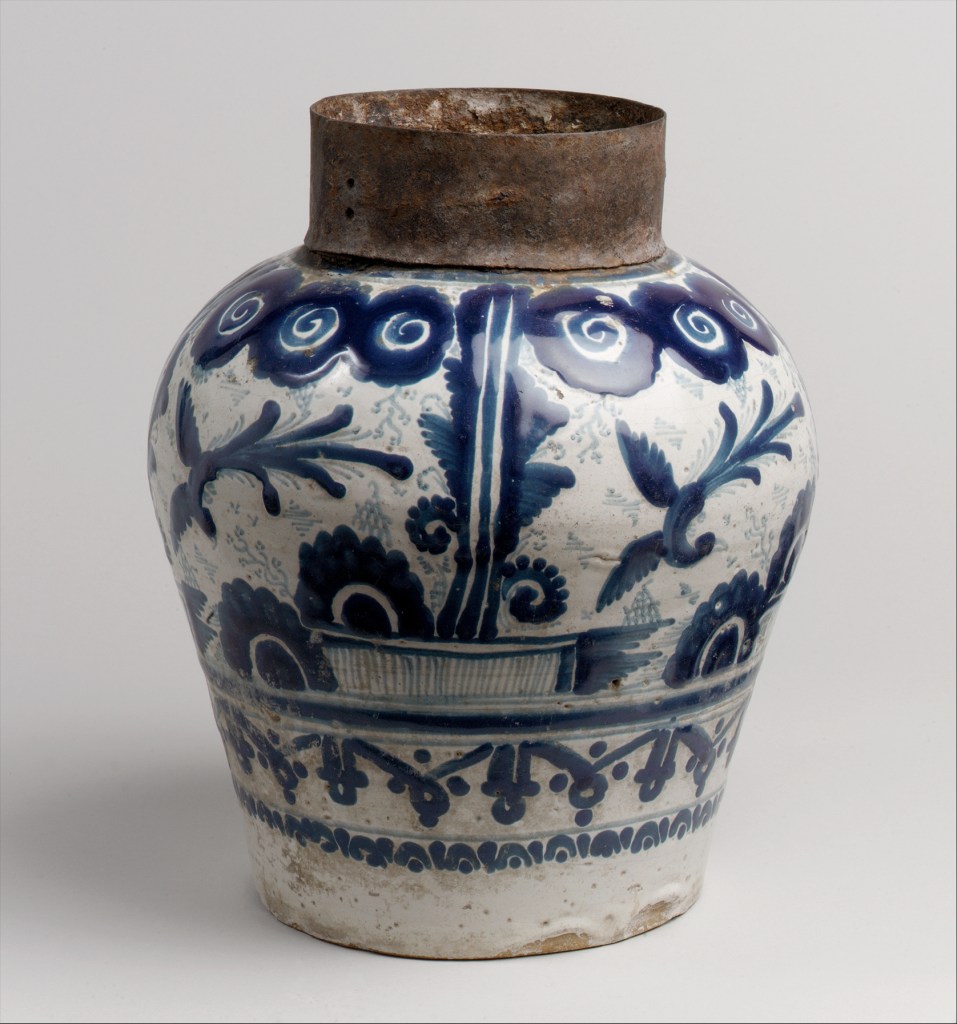
The blue and white design shows birds that look like a mix between a Chinese phoenix and a Mesoamerican quetzal. That overlap is not random. It reflects how global trade and local symbolism were already blending by 1700.
You can see the original piece in the The Metropolitan Museum of Art collection
Alcohol existed, but it was not constant for most people.
Alcoholic drinks
- Pulque
Fermented maguey sap, widely consumed in moderate amounts - Mezcal
Distilled maguey liquor becoming more common by this time
How Much Time Food Took
Food required steady, daily labor.
This was not something you handled quickly and moved on from. It was built into the rhythm of the day.
Daily tasks often included
- Working milpa fields
- Grinding maize on a metate
- Making tortillas multiple times a day
- Gathering firewood
- Caring for animals
- Visiting markets to trade
Grinding maize alone could take one to two hours. That came before cooking even started.
Eating Style and Tools
How people ate depended on space and habit.
Many households did not use tall tables.
Common setups
- Sitting on stools
- Sitting on petates
- Eating around a low shared surface
Utensils were minimal.
Typical tools
- Tortillas used to pick up food
- Clay bowls for soups and stews
- Wooden spoons
Metal forks and knives existed, but mostly in wealthier homes.
For most meals, the tortilla handled it.
Children and Meals
Meals were shared across the household.
Children ate with everyone else and learned by watching.
- Sitting with family
- Sharing food
- Adjusting portions based on age
There was no separate meal or separate space.
Courses and Portion Size
Meals were not divided into courses.
Food was set out and people ate what they needed. Waste was minimal because food took time to produce.
The combination of maize and beans provided steady energy and supported long days of physical work.
It was simple, but it covered what people needed.
Daily Meal Plan
A full day of eating in 1700 New Spain, built from the rhythms of work, season, and what was available.
This is not a feast day or a special occasion. This is a realistic look at what a mestizo household in the Valley of Mexico might eat on a normal day. Simple, filling, and built around maize, beans, and whatever else could be grown, raised, or traded.
OG Version
What this day likely looked like using period ingredients, tools, and cooking methods.
- Morning: Breakfast was simple and quick before work began.
- Eggs scrambled with tomatoes, onion, and chile on the comal
Served with fresh maize tortillas, and a small portion of beans cooked with epazote - Drink: Warm atole made from maize. Flavored with piloncillo and cinnamon
- Eggs scrambled with tomatoes, onion, and chile on the comal
- Snack: Portable food that could be eaten while working or moving through markets.
- Roasted maize and pumpkin seeds. Toasted on the comal and carried in a small pouch
- Drink: Agua fresca made from jamaica or seasonal fruit
- Main Communal Meal (Largest meal of the day)
- Pork stewed with beans, chiles, tomato, garlic, and onion in a clay pot. Served with a stacks of fresh tortillas, roasted squash, and chile–tomatillo salsa. A small portion of rice cooked with tomato and herbs might also appear.
- Drink: Fresh guava agua fresca, lightly sweetened
- Sweet Item: Usually something purchased rather than made daily.
- Piloncillo-anise raisin sweet rolls
- Drink: Foamy cacao drink with cinnamon, whisked with a molinillo
Modern Version
This version keeps the spirit of the original meals but presents them in a way that fits a modern kitchen and how we tend to plate and serve food today.
- Breakfast
- Corn tortillas with scrambled eggs, blistered tomato, onion, and roasted chile
- Served with with, refried beans, fresh cilantro, queso fresco
- Drink: Piloncillo-cinnamon atole latte
- Snack
- Smoky corn and pepita snack mix: Roasted corn nuts and toasted pumpkin seeds with chile-lime seasoning
- Drink: Iced hibiscus agua fresca
- Main Meal:
- Slow braised pork and heirloom bean tacos
Served with:- Roasted squash
- Charred tomatillo salsa
- Handmade tortillas
- Cilantro and onion
- Drink
Fresh guava agua fresca
- Slow braised pork and heirloom bean tacos
- Dessert
- Warm piloncillo-anise raisin sweet roll. Served with whipped cinnamon butter
- Drink: Mexican hot chocolate with cinnamon
Population & Top Cities
Where people lived, how many there were, and how colonial society was structured.
If you zoom out and look at New Spain around 1700, what stands out is not just how many people were here, but how they were sorted. By this point, the total population is estimated at around 4 to 5 million people, though exact numbers are hard to pin down.
Colonial society grouped people into broad identity categories often called castas. These were tied to ancestry and shaped social status, types of work, and legal rights. Exact numbers are hard to pin down, but historians agree on the general proportions.
Estimated population makeup
- Indigenous peoples
About 60 to 65 percent - Mestizo
Mixed Indigenous and Spanish ancestry
About 20 to 25 percent - Spanish and Criollo
Spanish ancestry, born in Spain or the Americas
About 8 to 10 percent - African and Afro mixed communities
Enslaved Africans and free Afro Mexicans
About 3 to 5 percent - Other mixed caste groups
Including mulatto, castizo, and others
About 3 to 5 percent
Even under Spanish rule, Indigenous communities still made up the majority. Their agricultural systems, languages, and food traditions continued shaping daily life across the colony.
The Five Largest Cities Around 1700
1. Mexico City
Estimated population: 100,000 to 110,000
Built on the remains of Tenochtitlan, this was the political and economic center of New Spain.
Why it mattered
- Capital of New Spain
- Seat of the viceroy
- Major trade and administrative center
- One of the largest cities in the Americas
2. Puebla de los Ángeles
Estimated population: 50,000 to 60,000
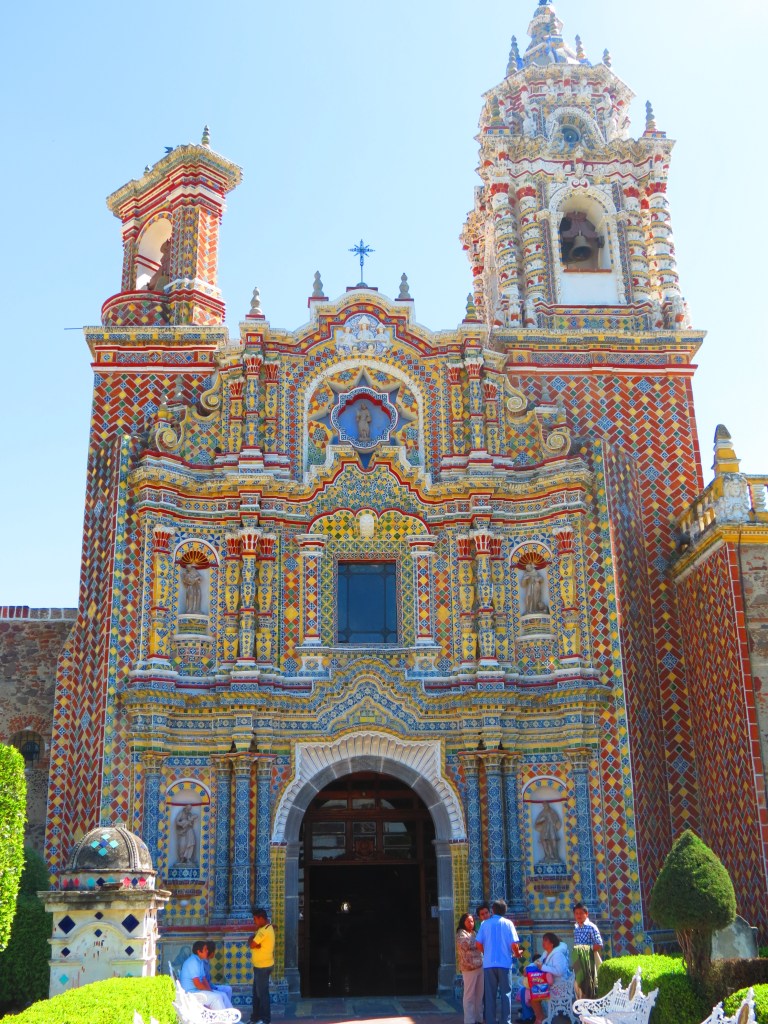
The entire facade is covered in Talavera tile. It is dense, detailed, and very intentional. This is not minimal. This is craftsmanship on full display.
Vista de la Fachada del Templo de San Francisco Acatepec by Luisalvaz (Wikimedia Commons, CC BY-SA 4.0)
Located between Mexico City and Veracruz, Puebla became a major economic center. The city became known for its built environment. White stone buildings and blue Talavera tiles gave it a distinct look that still stands out.
Why it mattered
- Textile production hub
- Key stop on the route to the Gulf Coast
- Strong regional trade activity
3. Guadalajara
Estimated population: 30,000 to 35,000
In western New Spain, Guadalajara served as the center of Nueva Galicia.
Why it mattered
- Administrative capital for the region
- Ranching and agricultural production
- Growing commercial activity
4. Zacatecas
Estimated population: 25,000 to 30,000
Zacatecas existed because of silver. Everything there pointed back to it.
Why it mattered
- One of the richest silver mining regions in the world
- Major source of wealth for the Spanish Empire
- Drew workers, merchants, and investors
5. Veracruz
Estimated population: 15,000 to 20,000
Smaller than the others, but essential.
Why it mattered
- Main Atlantic port of New Spain
- Entry point for ships from Spain
- Movement of goods, people, and information
Urban Life vs Rural Life
Even with these cities, most people did not live in them.
The majority of the population lived in:
- Farming villages
- Indigenous towns
- Ranching communities
- Mining settlements
Cities held power, but they did not represent everyday life for most people.
Life happened in smaller communities spread across valleys, mountains, and plains. Families worked the land, spoke local languages, and maintained traditions that had been in place for generations.
Economy & Jobs
How people earned a living and how money actually worked in 1700 New Spain.
Money existed. But daily life did not revolve around it the way it does now.
The economy of New Spain ran on a mix of silver coins, barter, and local exchange. Markets were everywhere. People traded food, cloth, animals, labor, tools. Sometimes with coins, sometimes with goods. Most people were not sitting on piles of money. Wealth usually meant land, livestock, or control over labor, not coins in your pocket.
What Currency Looked Like
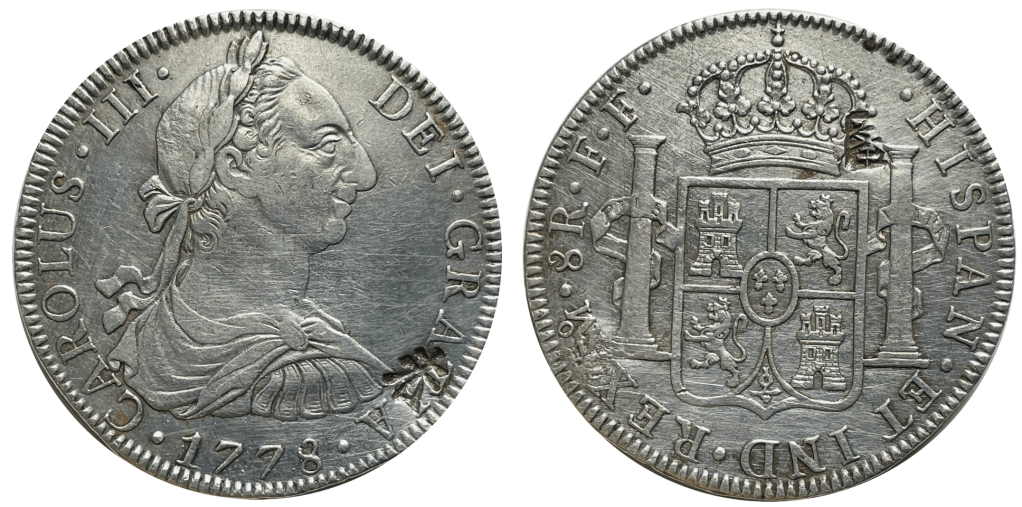
The main currency was the Spanish silver real, minted from silver mined in places like Zacatecas and Guanajuato.
Common coins
- 1 real
- 2 reales
- 4 reales
- 8 reales, also called the peso or piece of eight
These coins were trusted far beyond New Spain. They moved through trade networks across Europe, the Americas, and even Asia.
The peso was not just local money. It was global.
A Quick Note on the Dollar Sign
Small detour, but worth it.
The modern $ symbol most likely traces back to the Spanish peso. In handwritten records, merchants often abbreviated pesos as Ps. Over time, the letters overlapped and simplified into the symbol we recognize today.
So that little symbol on your screen has roots in the silver economy of colonial Mexico.
Converting 1700 Money to Today
This part is tricky because the systems are so different.
A rough estimate:
- 1 peso (8 reales)
≈ about 1,400 to 2,100 MXN (2026)
≈ about 80 to 120 USD (2026)
It is not exact, but it gives a general sense of scale.
Common Jobs and Typical Earnings
Below is a simplified look at common occupations and what they might earn. These are rough daily or yearly estimates.
1. Unskilled Farm Laborer
- Daily wage: 1 real
- Modern equivalent
≈ 175 to 260 MXN per day (2026)
≈ 10 to 15 USD per day (2026)
Work included planting, harvesting, hauling water, and general field labor. Physically demanding with very low pay.
2. Domestic Servant
- Daily wage: 1 to 2 reales
- Modern equivalent
≈ 175 to 520 MXN per day (2026)
≈ 15 to 30 USD per day (2026)
Tasks included cleaning, cooking, childcare, and errands. Many lived in the household where they worked.
3. Indigenous Community Farmer
- Income: varied by harvest
- Estimated yearly: 50 to 80 pesos
- Modern equivalent
≈ 70,000 to 168,000 MXN per year (2026)
≈ 4,000 to 8,000 USD per year (2026)
Many relied more on what they grew than on wages.
4. Skilled Artisan
- Daily wage: 3 to 4 reales
- Modern equivalent
≈ 600 to 1,050 MXN per day (2026)
≈ 35 to 50 USD per day (2026)
Common trades included blacksmithing, carpentry, pottery, and weaving. A small but important urban group.
5. Merchant or Shopkeeper
- Income: varied widely
- Estimated yearly: 200 to 500 pesos
- Modern equivalent
≈ 280,000 to 1,050,000 MXN per year (2026)
≈ 16,000 to 50,000 USD per year (2026)
They sold textiles, tools, food, and imported goods. Markets and shops were central to city life.
6. Silver Miner
- Daily wage: 4 to 5 reales
- Modern equivalent
≈ 800 to 1,300 MXN per day (2026)
≈ 45 to 65 USD per day (2026)
Better pay than farming, but dangerous work. Mining accidents and long term health risks were common.
7. Hacienda Owner
- Income: 2,000 to 10,000 pesos yearly
- Modern equivalent
≈ 2.8 to 21 million MXN per year (2026)
≈ 160,000 to 1,000,000 USD per year (2026)
Wealth came from land and labor. These estates produced crops or livestock on a large scale.
8. Major Silver Mine Owner
- Income: could exceed 50,000 pesos yearly
- Modern equivalent
≈ 70 million MXN or more per year (2026)
≈ 4 million USD or more per year (2026)
Silver drove the entire colonial economy. The wealth at this level could be enormous.
Could People Change Their Status
Social mobility existed, but it was limited. It was easier to move up through trade or skilled work than through farming.
Possible paths upward
- Building a successful trade business
- Acquiring land
- Entering the clergy
- Marrying into wealth
Colonial racial categories still placed real limits on opportunity. For many Indigenous and African descended communities, upward movement was much harder.
Cost of Living
What everyday things cost and what people could actually afford in 1700 New Spain.
This is where things get real.
Most families were not relying heavily on cash because they did not have much of it. Daily life depended more on what you could grow, raise, or make yourself.
So cost of living was less about prices and more about trade-offs.
Do you buy wheat bread or make tortillas
Do you eat meat today or stretch the beans one more day
Reminder
1 peso = 8 reales
A low wage worker earned about 1 real per day
Typical Costs
1. Small Adobe House
- Cost: 80 to 120 pesos
- Modern equivalent:
≈ 112,000 to 252,000 MXN (2026)
≈ 7,000 to 12,000 USD (2026)
For a laborer earning around 45 pesos per year, this could represent years of income. Most homes were built gradually using adobe, wood, and local materials.
2. Cow
- Cost: 20 to 30 pesos
- Modern equivalent:
≈ 28,000 to 63,000 MXN (2026)
≈ 1,600 to 3,000 USD (2026)
A cow meant long-term value. Milk, calves, and sometimes labor. Not common for poorer households.
3. Pig
- Cost: 4 to 6 pesos
- Modern equivalent:
≈ 5,600 to 12,600 MXN (2026)
≈ 320 to 600 USD (2026)
Pigs were practical and widely kept. They reproduced quickly and could be fed scraps.
4. Chicken
- Cost: 1 to 2 pesos
- Modern equivalent:
≈ 1,400 to 4,200 MXN (2026)
≈ 80 to 200 USD (2026)
One of the most common animals. Eggs made them especially useful.
5. One Fanega of Maize
About 40-50 kg (88-110 lb)
- Cost: 1 to 1.5 pesos
- Modern equivalent:
≈ 1,400 to 3,150 MXN (2026)
≈ 80 to 150 USD (2026)
Maize was the foundation. A quantity like this could feed a family for weeks.
6. Dozen Eggs
- Cost: 1 to 2 reales
- Modern equivalent:
≈ 175 to 520 MXN (2026)
≈ 10 to 25 USD (2026)
Common, but still something families used carefully.
7. Milk
About 3.8 liters (1 gallon)
- Cost: 1 real
- Modern equivalent:
≈ 175 to 260 MXN (2026)
≈ 10 to 15 USD (2026)
More common in ranching regions. Many people relied more on atole or cacao drinks.
8. Bread or Masa for Tortillas
- Cost: ½ real
- Modern equivalent:
≈ 85 to 130 MXN (2026)
≈ 5 to 7 USD (2026)
Wheat bread showed up more in cities. Tortillas were made fresh daily in most homes.
What People Had to Give Up
This is where the numbers start to land.
A laborer earning 1 real per day might spend
- 1 day’s wages on milk
- 2 days’ wages on eggs
- Over a week’s wages on a chicken
Meat was expensive relative to income. That is why many meals relied on
- Beans
- Maize
- Squash
- Chile
Animal protein showed up less often.
The Hidden Economy
A lot of survival never showed up in money at all.
Families reduced costs by producing things themselves.
- Growing maize in milpas
- Raising chickens
- Making tortillas at home
- Weaving clothing
- Building tools or furniture
This kind of household production made the difference between getting by and falling short.
What “Comfortable” Meant
A household with
- A small house
- A few chickens
- Maybe a pig
- Reliable access to maize
was doing okay.
Real wealth looked different.
- Owning land
- Owning cattle
- Hiring labor
- Eating meat regularly
That level was not common.
Cost of living was not about bills or monthly expenses. It came down to a few basic questions.
- Is there enough maize?
- Are the animals producing?
- Is there fuel to cook?
If those held steady, a family could manage. If not, things got difficult fast.
Health
Life expectancy, medicine, and the everyday risks of living in 1700 New Spain.
Life in 1700 Mexico could be vibrant, but it was also fragile in ways that are hard to imagine now. No antibiotics. No vaccines. No modern hospitals. If someone got sick, survival depended on the body, local knowledge, and sometimes luck.
That said, people were not helpless. Communities had deep medical traditions, especially herbal knowledge passed down over generations.
Still, the numbers tell you how risky life could be.
Life Expectancy
If someone made it past childhood, they likely got to roughly 45 to 55 years old. Some people reached their 60s or 70s, but that was less common. Years of physical labor and repeated illness took a toll.
Childhood Survival
Childhood was the most dangerous stage of life.
- Estimated survival to adulthood: about 50 to 60 percent
That means a large portion of children did not reach age 15.
Healthcare and Medicine
Medical care was not centralized. It came from multiple traditions working at the same time.
- Indigenous healers
- European trained physicians
- Midwives
- Herbalists
- Religious caregivers
Each played a different role depending on access, location, and cost.
Common Health Issues
- Respiratory infections
- Dysentery
- Smallpox outbreaks
- Measles
- Tuberculosis type illnesses
Epidemics could hit entire communities. Even minor infections could become serious.
Common Causes of Death
Most deaths came from everyday conditions, not rare events.
- Infectious disease
- Childbirth complications
- Malnutrition
- Work related injuries
- Epidemics
Mining regions were especially dangerous due to accidents and long term lung damage.
Hygiene and Cleanliness
This part surprises people.
Bathing was common in many Indigenous communities, and water had both practical and cultural importance.
Bathing methods
- Rivers and lakes
- Wooden tubs
- Temazcal steam baths
Soap existed, but it was basic.
Common cleansers
- Plant ash mixed with water
- Animal fat soaps
- Crushed herbs
Cleanliness was part of routine life, not a luxury.
Dental Care
Dental care was simple but present.
Methods included
- Chewing sticks from certain plants
- Cloth cleaning
- Herbal rinses
Stone ground maize often introduced small bits of grit into food. Over time, this wore down teeth. This is something archaeologists see clearly in skeletal remains.
Social & Family Structure
Who lived together and how families actually functioned in 1700 New Spain.
If you want to understand Mexico around 1700, look at the household. Not just parents and children. The whole network.
Life in New Spain revolved around kinship, shared labor, and community ties. People depended on each other for childcare, farming, food, and survival.
A household was rarely just a small nuclear family. It usually included multiple generations and sometimes non relatives living under the same roof or nearby.
Household Structure
Most families lived in extended households or close clusters of relatives.
In many towns, you would see small groups of homes belonging to the same family. Parents in one space, married children nearby, grandparents close enough to be part of daily life.
A typical household might include:
- Parents
- Several children
- One or two grandparents
- A widowed relative
- Occasionally a servant or apprentice
Homes were small, so space was shared. Sleeping areas overlapped. Daily life happened together.
Children grew up surrounded by adults who all played a role in raising them.
The Role of Elders
Elders held real authority in many communities.
Grandparents and older relatives were central to:
- Teaching traditions
- Passing down stories and knowledge
- Helping raise children
- Advising on family decisions
In many Indigenous communities, elders also acted as community advisors. Age carried weight. Experience mattered.
Marriage Customs
Marriage was shaped by both Catholic expectations and local practice. The official standard was monogamous marriage recognized by the Church. A formal ceremony made it legal.
Arranged vs Personal Choice
Marriage looked different depending on class. Among Spanish and elite families, marriages were often arranged or heavily guided. They were tied to:
- Land
- Alliances
- Reputation
Among Indigenous and mestizo communities, there was usually more personal choice, though families still had influence. Parents were looking for someone dependable, not just romantic.
What a Marriage Ceremony Looked Like
Most formal weddings took place in a Catholic church.
Typical elements included:
- Vows before a priest
- Witnesses from both families
- A blessing
- A celebration afterward
Wealthy families might host large gatherings with music and food. For others, the celebration was smaller but still meaningful.
Average Age of Marriage
People married younger than today.
- Women: about 16 to 20 years
- Men: about 20 to 25 years
Men often married later because they needed some form of income or stability first. Marriage was closely tied to starting a household.
Age of First Children
Children often arrived soon after marriage.
- First births typically between 17 and 22 years
Social Expectations
People were expected to contribute based on age and role.
- Men worked in labor or trade
- Women managed the household
- Children learned skills early
- Elders guided decisions
These expectations were not identical everywhere, but they provided structure.
Social Identity and Status
Family shaped identity in a very real way.
Status was influenced by:
- Ancestry
- Reputation
- Occupation
- Land ownership
Marriage could sometimes shift a family’s position, but movement was limited for many.
Childhood & Parenthood
What it was like to grow up and raise children in 1700 New Spain.
Childhood in 1700 Mexico looked very different from today. Children were valued and welcomed into strong family networks. But childhood moved faster. Kids began learning responsibility early because family survival depended on it.
Children were not treated like full adults, but they were expected to become capable members of the household.
Parenting Style
Parenting was structured but not cold. Children were raised to understand respect, responsibility, and religious life from an early age. But parents were not doing this alone.
A child grew up surrounded by people who all had a role. Parents, grandparents, godparents, aunts, uncles, older siblings. Skills and behavior were reinforced from every direction.
Parenting Roles
Roles existed, but they were practical more than rigid.
Mothers handled most of the daily care. They fed infants, taught household skills, and passed down knowledge like cooking, herbal remedies, and textile work. If a child was sick, mamá was usually the first line of care.
Fathers focused more on preparing children for work and life outside the home. They taught farming, trades, animal care, and how to move through the community. They also represented the household in legal or public matters.
Grandparents were active members of the household. They helped raise children, passed down stories, and taught language and traditions. They often anchored the family.
Godparents added another layer of support. Their role was tied to religion, but it often extended into practical help if a family needed it.
Pets and Animals
Animals were part of everyday life, mostly for practical reasons.
Dogs guarded the home and sometimes helped with hunting. Cats kept rodents out of food storage. Chickens, pigs, and turkeys were part of the household economy.
Kids still formed attachments to them. You can imagine a child chasing chickens in the courtyard, even if that chicken might eventually become dinner.
Cultural Expectations of Children
Children were expected to grow into useful members of the household.
They learned how to behave, how to work, and how to participate in religious life. Some children, especially in cities, attended church schools where they learned reading and writing.
For many others, learning happened through observation and repetition at home.
Girls often learned domestic skills. Boys often learned farming or trades. Not as a strict rule every time, but a common pattern.
Work and Responsibilities
By around age 6 or 7, most children were already helping in small ways.
They might carry water, gather firewood, feed animals, help grind maize, or assist in markets and workshops.
Work was part of growing up, not something separate from it.
Pros & Cons of Childhood & Parenthood in 1700
Pros of Being a Child
- Strong support from extended family and community
- Close relationships with siblings and cousins
- Daily life outdoors with freedom to explore
- Early development of practical, real world skills
- Participation in festivals, traditions, and religious life
Cons of Being a Child
- High risk of illness and disease
- Limited access to medical care
- Expectation to work from a young age
- Uneven access to formal education
- Higher likelihood of losing siblings
Pros of Being a Parent
- Strong family and community support systems
- Children contributing to household labor
- Clear cultural and religious structure around family life
- Shared responsibility across extended family networks
- Deep sense of purpose tied to raising children
Cons of Being a Parent
- High risk of losing children to illness
- Limited medical knowledge for treatment
- Economic pressure to provide food and stability
- Frequent pregnancies over a lifetime
- Constant physical labor required to sustain the household
Leisure & Recreation
How people relaxed, socialized, and found moments of fun in 1700 New Spain.
Leisure was usually shared. It happened in plazas, courtyards, markets, and festivals. Most entertainment was not private. It was something you did with other people.
Adults
For adults, free time centered around conversation, music, and gathering. Sometimes that meant something simple. Sitting in the plaza, talking, watching people pass by. That alone was a break from the day.
Card games were one of the most popular forms of entertainment. Spanish games like primero, triunfo, and ombre spread quickly and were played in homes, taverns, and public spaces. Dice games showed up too, sometimes casually, sometimes with small stakes.
Music and dance were everywhere.
- Guitars, violins, drums, and flutes were common
- Fandangos brought groups together for lively dancing
- In elite settings, dances followed more formal Spanish styles
A dance did not need planning. It could start in a courtyard or spill into the plaza.
Adults also gathered in pulquerías and taverns. People drank pulque, mezcal, or imported wine while talking, playing games, and sharing news.
In larger cities, there were performances.
- Religious plays
- Comedy acts
- Traveling theater groups
- Musical performances
These added a more structured form of entertainment, especially in places like Mexico City and Puebla.
Festivals often included competitions like horseback riding, strength contests, and bull related events. These drew crowds and added energy to celebrations.
Children
Children spent most of their free time outdoors, playing in groups and using what they had around them.
Many of their games would still feel familiar.
- Tag and hide and seek
- Stick and ball games
- Riddles and word games
- Pretend play
One of the most common activities was hoop rolling. Kids would push a wooden hoop with a stick and race each other through streets or open spaces.
Toys were simple and often handmade.
- Cloth dolls
- Carved wooden animals
- Spinning tops
- Clay or stone marbles
Some were made by family members, others by local artisans, and many were improvised.
Children were also part of family life, not separate from it. Evenings could include storytelling in the courtyard, shared meals, and music. Kids were right there in the middle of it.
The biggest moments of excitement came during festivals.
- Religious feast days
- Market fairs
- Seasonal celebrations
Towns filled with music, food, dancing, and games. These events could last several days.
Birthdays were not usually the main celebration. Families focused more on baptisms or saints’ days. A child’s birthday might still be acknowledged quietly, but not with large parties.
Culture, Language & Religion
The beliefs, languages, and artistic world shaping daily life in 1700 New Spain.
If you want to understand how people in 1700 Mexico saw the world, look at three things working together. Faith, language, and art.
Religion shaped daily life. Language carried culture across generations. Art filled churches, homes, and public spaces with meaning.
Mexico in 1700 was not one culture replacing another. Indigenous traditions, Spanish Catholic beliefs, and African influences all existed at the same time, shaping each other in everyday life.
Religion and Spiritual Life
By 1700, Roman Catholicism was the dominant public religion.
Churches sat at the center of towns. Bells marked the day. The calendar followed religious events as much as anything else.
Daily life included:
- Morning and evening prayers
- Sunday Mass
- Saints’ day celebrations
- Baptisms, weddings, and funerals through the church
Religion was not just personal belief. It structured community life.
Blending of Beliefs
Older Indigenous traditions did not disappear. They adapted.
In many communities, you would see:
- Catholic saints linked to older sacred places
- Traditional healing alongside Christian prayer
- Festivals that mixed Indigenous and Catholic practices
This blending is often called syncretism, but in practice it just looked like people carrying multiple traditions at once.
Devotion to Our Lady of Guadalupe is one of the clearest examples of this layered belief system.
Art and Aesthetic Style
The visual world of colonial Mexico was detailed and expressive.
The dominant style was Baroque, brought from Europe but adapted locally. It favored movement, contrast, and heavy decoration.
Churches and public buildings often included:
- Carved stone facades
- Gold covered altars
- Large painted scenes
- Intricate woodwork
The goal was not simplicity. It was impact.
Everyday Art Forms
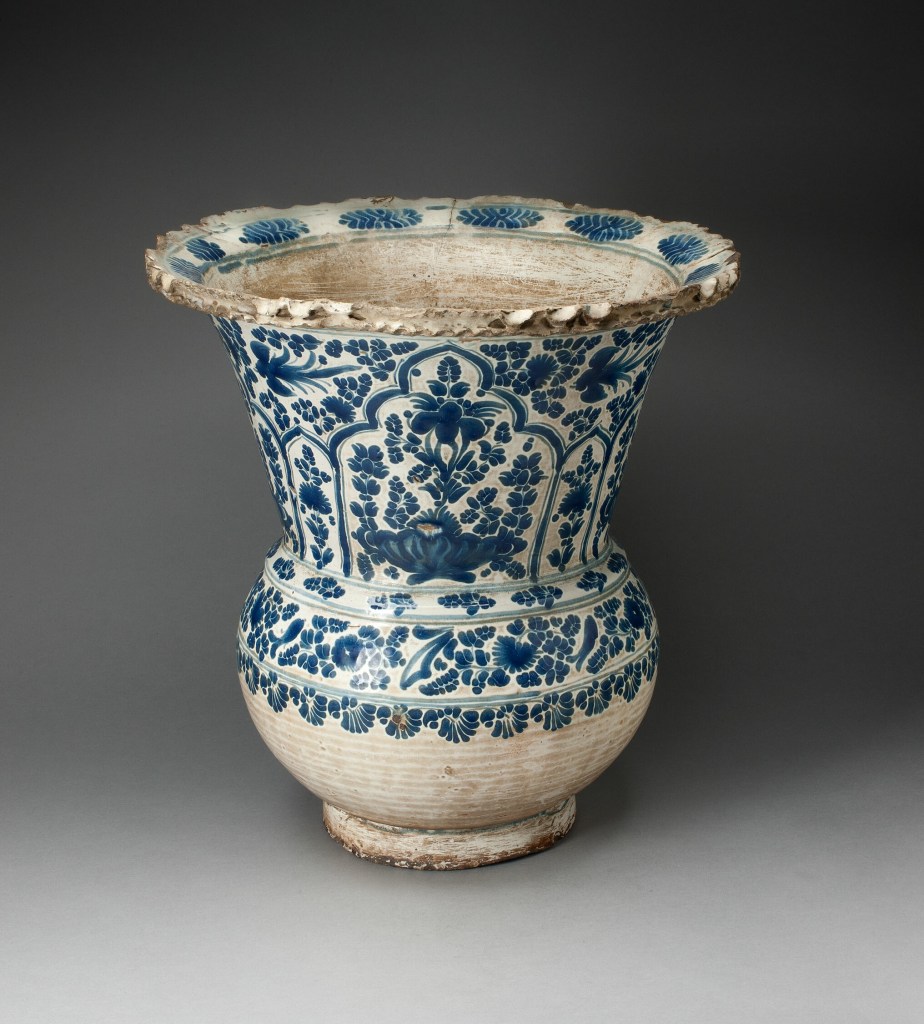
Tin-glazed ceramic with hand-painted blue designs
Art was not limited to churches.
People interacted with it through:
- Religious paintings and sculptures
- Pottery and ceramics
- Woven textiles
- Silverwork
Talavera pottery from Puebla became especially recognizable for its blue and white glazing.
Silver objects reflected the mining wealth of the region and showed up in both religious and everyday items.
Notable Artists
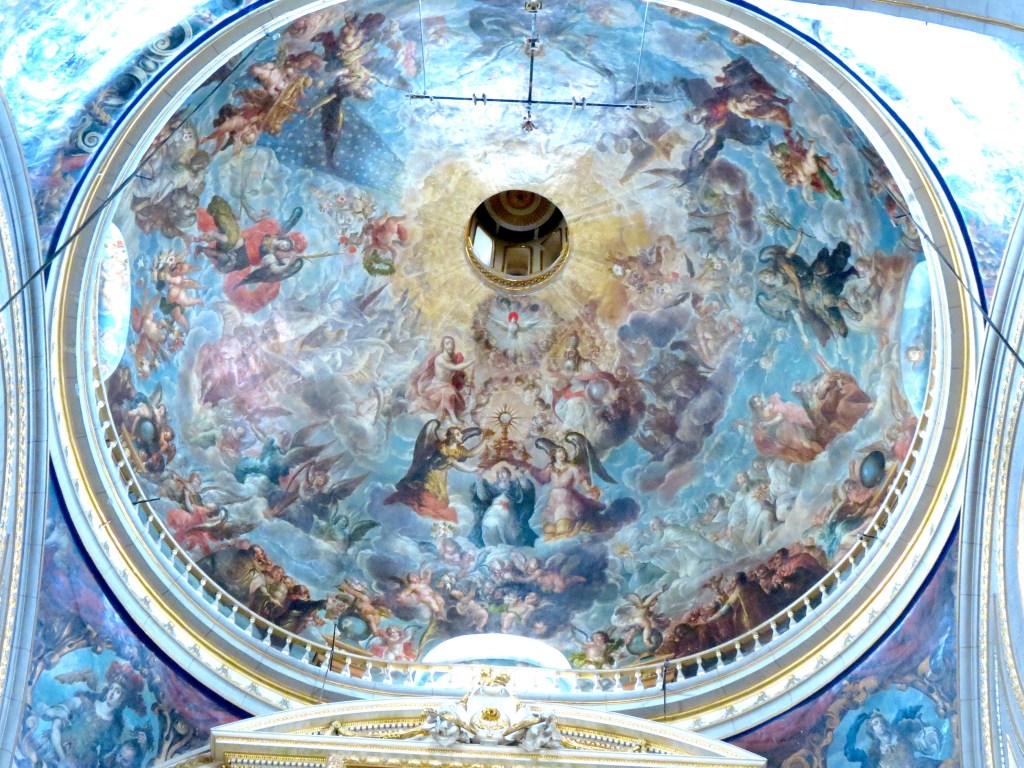
By Luisalvaz, via Wikimedia Commons. Licensed under CC BY-SA 4.0
Some artists became widely known for their work.
- Cristóbal de Villalpando, known for large scale religious scenes
- Juan Correa, recognized for detailed church paintings
- Miguel Cabrera, later in the 18th century, known for portraits and religious works
Their work helped shape the visual identity of the period.
Languages Spoken and Written
Mexico in 1700 was multilingual.
Spanish was the language of government and official business, but many people spoke Indigenous languages in daily life.
Common languages included:
- Spanish for administration and trade
- Nahuatl in central Mexico
- Maya languages in the Yucatán
- Mixtec and Zapotec in Oaxaca
- Purépecha in western regions
It was common for people to move between languages depending on the setting.
Literacy varied widely. Clergy, officials, and merchants were more likely to read and write in Spanish. Many others relied on oral tradition.
At the same time, Indigenous scribes continued writing in their own languages using the Latin alphabet introduced during colonization.
Printed Materials
Mexico City had one of the earliest printing presses in the Americas.
Printed materials included:
- Religious texts
- Legal documents
- Educational materials
- Sermons
Books were expensive and not widely owned. Most people experienced knowledge through hearing, not reading.
What Was Changing in Mexico Between 1600 and 1700
By 1700, Mexico had lived under Spanish colonial rule for nearly two centuries. The initial shock of conquest had passed, but the world people lived in was still evolving.
The 1600s were not quiet years. They were a century of expansion, adaptation, and tension. Cities grew. Trade networks stretched across oceans. Wealth increased in some places, while inequality deepened in others.
At the same time, Indigenous communities continued preserving traditions that reached back thousands of years.
To understand daily life in 1700, we need to walk through the major forces that shaped the century.
Early 1600s: Expansion, Conflict, and Environmental Challenges
At the start of the century, colonial systems were still solidifying across New Spain.
Indigenous resistance remained active, especially on the northern frontiers. One major conflict was the Tepehuán Revolt of 1616 in present-day Durango. Indigenous groups pushed back against forced labor and missionary control. The rebellion disrupted the region before Spanish forces regained control, but conflict in frontier areas continued throughout the century.
At the same time, Mexico City faced a very different kind of threat.
In 1629, heavy rains caused catastrophic flooding. Because the city sat on the former lakebed of Lake Texcoco, water had nowhere to go. Large parts of the city remained underwater for years. Canoes moved through streets that once held markets and foot traffic. At one point, there were even serious discussions about abandoning Mexico City entirely and relocating the capital to higher ground.
In response, colonial authorities made a major decision. Instead of rebuilding around the lake system, colonial authorities chose to drain it. They dug canals, expanded drainage tunnels, and redirected water out of the valley. Over time, the lakes shrank and the city shifted from a water-based landscape to dry land. This permanently altered the environment, leading to long-term issues like flooding and ground sinking that Mexico City still faces today.
Mid-1600s: Silver, Trade, and a Global Economy
By the middle of the century, New Spain had become one of the most economically important regions in the world.
Silver mining drove everything.
Major mining centers like Zacatecas, Guanajuato, San Luis Potosí produced enormous amounts of silver. This wealth fueled the Spanish Empire and connected Mexico to global markets.
Mining towns grew quickly as workers, merchants, and investors arrived. Life in these places could be dangerous, but the potential for profit pulled people in.
At the same time, Mexico became part of a global trade network through the Manila Galleon trade.
Ships traveled between Acapulco (New Spain) to Manila (Philippines) carrying goods across the Pacific.
Items arriving in Mexico included
• silk from China
• porcelain
• spices
• ivory
Social Structure
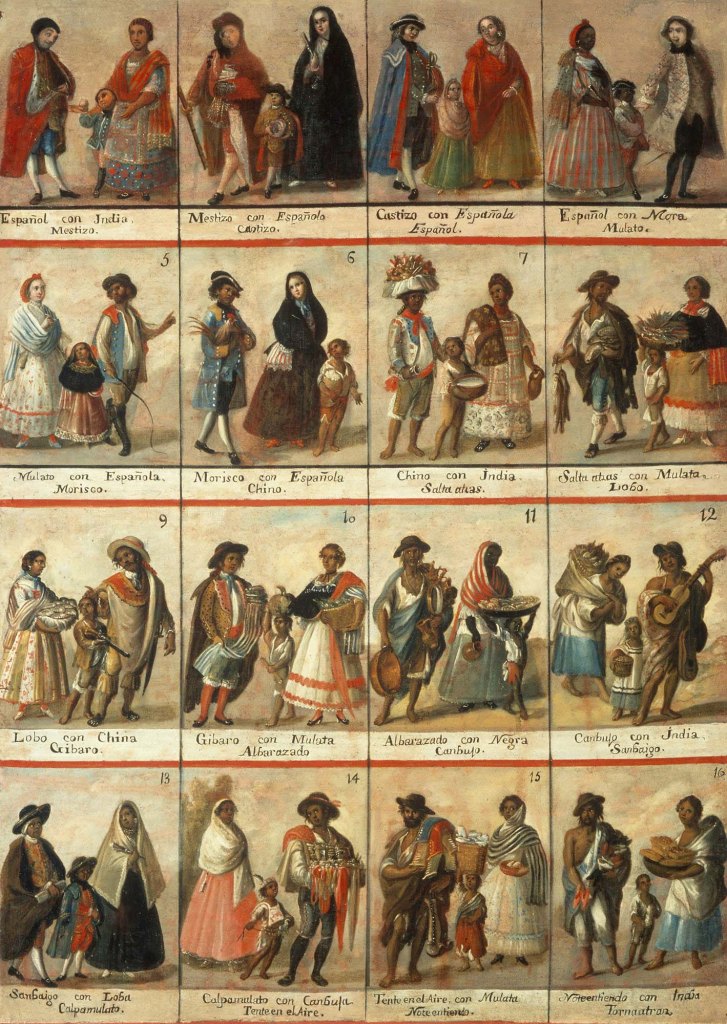
Colonial authorities tried to organize society through the casta system, a classification system based on ancestry.
People of Indigenous, Spanish, and African ancestry formed a wide range of identities. Some commonly described combinations included
• Spanish + Indigenous = mestizo
• Spanish + mestizo = castizo
• Spanish + African = mulatto
Over time, dozens of named categories appeared, attempting to define every possible mixture. But the system never fully worked. People moved between categories. Some passed into higher status through appearance, wealth, or cultural assimilation. Social identity was not fixed. It was negotiated.
Late 1600s: Culture, Art, and Intellectual Life
By the late 1600s, New Spain was not just economically powerful. It was culturally vibrant.
As the Baroque style spread across Mexico, especially in cities like Puebla and Mexico City. Art became a way to express both religious devotion and social power.
One of the most important intellectual figures of this period was Sor Juana Inés de la Cruz (1651–1695).
She was a nun, writer, and scholar who explored
• philosophy
• science
• theology
• women’s education
Her work challenged expectations and showed the intellectual depth possible in colonial Mexico. Today, she is considered one of the greatest writers in the Spanish-speaking world.
1697: The Final Conquest
Even by the late 1600s, not all regions were fully under Spanish control.
In 1697, the Itza Maya kingdom, centered at Nojpetén in the Petén region, was defeated. This is often considered the final major Indigenous kingdom to fall to Spanish rule.
But control did not mean complete cultural erasure. In many regions, especially more remote ones, Indigenous communities continued maintaining language, traditions, and memory.
It is very possible that by the late 1600s or early 1700s, elders were still passing down stories from people who had lived closer to the pre-contact world. After this point, those memories shifted from lived experience into history and story.
Music & Instruments
What Mexico Sounded Like Around 1700
Alright compa, if you walked through a town in Mexico around 1700, you would hear music everywhere. In the plaza. In the church. In someone’s courtyard during a celebration.
Music was not just for professionals. People sang while working, played during gatherings, and danced during festivals. It was part of daily life.
And the sound itself was layered. Indigenous rhythms, Spanish melodies, and African percussion traditions were all blending together. That fusion is one of the roots of modern Mexican music.
Musical Instruments
Music in New Spain pulled from multiple traditions, and instruments reflected that mix.
String Instruments (melody and harmony)
These became the backbone of most everyday music because they were portable and adaptable.
• Guitar: widely used in homes, plazas, and celebrations
• Vihuela: a smaller guitar-like instrument used in early folk traditions
• Harp: common in both rural and urban settings, especially in central Mexico
• Violin: brought from Europe but quickly adopted into local music
Wind Instruments (ceremonial and folk use)
Used in both church and community settings.
• Wooden or bone flutes
• Recorders in religious music
• Shawms, early reed instruments similar to oboes
Percussion (rhythm and movement)
These often carried strong Indigenous and African influence.
• Hand drums
• Rattles made from gourds or seeds
• Tambourines
Indigenous Instruments (continuity of older traditions)
These had existed for centuries and continued shaping local sound.
• Huehuetl: large standing drum
• Teponaztli: hollow slit drum with a sharp, rhythmic tone
• Clay flutes and whistles
Musical Styles Taking Shape
By the late 1600s, distinct regional styles were beginning to form.
Son (early folk tradition)
One of the most important musical developments.
• Combined string instruments with rhythmic dancing
• Often included call-and-response singing
• Regional styles began emerging, including early forms of Son Jarocho and Son Huasteco
Fandango (community music gatherings)
Not just music, but a full social event.
• Live string music
• Rhythmic footwork and clapping
• Improvised singing
These gatherings brought entire communities together.
Sacred Church Music
Churches were major musical centers, especially in cities.
• Choral singing
• Pipe organs
• Orchestral compositions during Mass
Cathedrals in Mexico City and Puebla supported highly trained musicians, and the music could be complex and dramatic.
Media You Can Watch or Read Today
Continue Your Journey into Colonial Mexico
Alright, if you want to really feel this era, sometimes the best thing is to watch it or read it through stories. Some of these are historical dramas, others are historical fiction inspired by real people and events.
None of them are perfect documentaries. But they help bring the world of colonial Mexico, New Spain, missions, mining towns, and colonial society to life.
Here are some good ones that capture pieces of the time period or the cultural world around it.
Adults
Historical Drama & Film
- Juana Inés (TV Series)
Language: Spanish (original); Dubbed/Subtitled: English available
This historical drama tells the story of Sor Juana Inés de la Cruz, one of the most brilliant minds of colonial Mexico. The series dives into convent life, intellectual debates, and the rigid social rules of New Spain. Think candlelit libraries, poetic rivalries, and a woman trying to outthink an entire patriarchal system. If you want to understand colonial culture, this one is gold. - Alatriste (2006)
Language: Spanish (original); Dubbed/Subtitled: English available
Set in the Spanish Empire during the 1600s, this epic follows a hardened soldier navigating war, politics, and honor across the empire. While most of the story takes place in Spain, it captures the broader world that shaped colonial Mexico. Sword fights, royal intrigue, and dusty battlefields. It gives you a feel for the mindset of the empire that ruled New Spain. - Cabeza de Vaca (1991)
Language: Spanish (original); Dubbed/Subtitled: English available
This visually stunning film follows Spanish explorer Álvar Núñez Cabeza de Vaca after he becomes stranded in the Americas. As he travels across Indigenous lands, the story explores cultural encounters, survival, and spiritual transformation. It is not strictly set in 1700, but it gives a powerful look at the cultural worlds that still influenced Mexico centuries later. - The Mission (1986)
Language: English (original); Dubbed/Subtitled: Spanish available
A sweeping historical drama about Jesuit missionaries working among Indigenous communities in colonial South America. While it takes place slightly outside Mexico, it captures the larger religious and colonial dynamics of the Spanish world during this era. Gorgeous cinematography, unforgettable music, and some serious emotional weight. - Conquistadors: Adventum (Series)
Language: Spanish (original); Dubbed/Subtitled: English available
This historical docu drama series explores the Spanish conquest and early colonial expansion. It blends dramatic reenactments with historical storytelling. While it focuses on earlier events, it helps explain how the colonial world that existed in 1700 first came into being. - Mexico: The Royal Tour (Documentary)
Language: English (original); Subtitled Spanish available
This documentary travels across Mexico exploring history, culture, and landscapes with a focus on how past civilizations shaped the modern country. It jumps across time periods, including colonial history, and helps connect historical Mexico with the country you see today.
Books & Literature
- Sor Juana: Or, The Traps of Faith – Octavio Paz (Book)
Language: Spanish (original); English translation available
This famous biography dives into the life and ideas of Sor Juana Inés de la Cruz. Paz explores the politics, religion, and intellectual world of colonial Mexico through the lens of one extraordinary woman. It reads part like history and part like philosophical detective work. If you want to understand the mind of colonial Mexico, this book is a fantastic guide.
Kids & Teens
Alright, finding kid friendly media specifically set in colonial Mexico around the 1600–1700s is a little tricky. But there are some really great options that either happen during the colonial era or pull heavily from Mexican folklore, Indigenous traditions, and early New Spain culture.
Preschool – Early Elementary (Ages 3–7)
- Canticos (Nick Jr / YouTube / Netflix)
Language: English & Spanish bilingual; Subtitled: English and Spanish available
Ages: 2–6
This one is technically modern animation, but it pulls heavily from traditional Spanish and Mexican nursery songs that families have been singing for generations. It is colorful, musical, and bilingual, which makes it great for little kids. If you want something gentle that introduces cultural roots without being complicated, this is a really easy win. - Dora the Explorer (Nickelodeon / Paramount+)
Language: English (original); Spanish words integrated; Spanish dub available
Ages: 3–7
Okay, yes, Dora is modern. But the reason many parents like it is because it introduces kids to Spanish language, Latin American geography, and cultural elements in a fun way. Think bright adventures, puzzles, and music. It is a nice starting place for little kids before they get into deeper cultural stories. - Abuela (Picture Book by Arthur Dorros)
Language: English (original); Spanish words included; Spanish edition available
Ages: 4–8
This sweet picture book follows a little girl and her grandmother as they imagine flying across New York while speaking Spanish together. It is not colonial history exactly, but it beautifully captures Latino family culture, language, and storytelling traditions that stretch back generations. A great read aloud for younger kids.
Elementary Age (Ages 7–10)
- Las Leyendas (Netflix)
Language: Spanish (original); Dubbed/Subtitled: English available
Ages: 8–12
This animated series pulls from Mexican colonial era legends and folklore, including ghosts and monsters said to haunt old towns and churches. It is spooky in a playful way, not nightmare fuel. If your kid likes mystery, adventure, and a little bit of humor, this one can be really fun. - The Princess and the Warrior: A Tale of Two Volcanoes (Book by Duncan Tonatiuh)
Language: English (original); Spanish edition available
Ages: 7–11
This book tells the legendary love story connected to the volcanoes Popocatépetl and Iztaccíhuatl. The art style is inspired by Indigenous codices, which makes it visually really cool. If your kid likes mythology and dramatic love stories, this is a beautiful introduction to Mexican legend. - The Chocolate Tree: A Mayan Folktale (Book by Linda Lowery)
Language: English (original); Spanish edition available
Ages: 7–10
This story explains the origins of cacao through a traditional folktale. It is not exactly set in 1700, but cacao culture absolutely carried into colonial Mexico. Kids who like mythology and origin stories tend to love this one.
Upper Elementary – Middle School (Ages 10–13)
- The Smoking Mirror (Book by David Bowles)
Language: English (original); Spanish translation available
Ages: 10–14
This is the first book in a fantasy series inspired by Mexican mythology and colonial era legends. It follows a young boy discovering he is connected to ancient gods. Adventure, monsters, and a lot of cultural history mixed into the story. Great for kids who like Percy Jackson style adventures but want something rooted in Mesoamerican culture. - The Girl Who Could Silence the Wind (Book by Meg Medina)
Language: English (original); Spanish translation available
Ages: 10–14
This story takes place in a Latin American village with strong echoes of older colonial community life. It explores family expectations, community traditions, and faith. If your kid likes thoughtful stories about growing up and finding their place in the world, this one is really beautiful. - Zorro (Various Animated Adaptations)
Language: English or Spanish depending on version; Subtitles usually available
Ages: 9–13
The masked hero Zorro lives in Spanish colonial California, which was part of New Spain during this era. Sword fights, secret identities, and justice for the poor. Kids who like adventure stories tend to get really hooked on Zorro.
Teen (Ages 13+)
- The Hummingbird’s Daughter (Book by Luis Alberto Urrea)
Language: English (original); Spanish translation available
Ages: 14+
This novel is set slightly later historically but deeply rooted in Mexican culture and spiritual traditions that come out of the colonial world. It follows a young girl believed to have healing powers. It blends family story, faith, and folklore. Older teens who like rich historical stories might really enjoy this one. - The Legend of Zorro (Film)
Language: English (original); Spanish dub available
Ages: 12+
A swashbuckling adventure with sword fights, political intrigue, and a masked hero defending ordinary people. It is not strictly about Mexico in 1700, but it captures the Spanish colonial world that shaped early Mexican history.
Would you thrive in this time period or struggle without plumbing and podcasts?
Life in Mexico around 1700 meant early mornings, cooking over open fires, and whole families sharing small homes and courtyards. No electricity, no running water, and definitely no streaming music during chores.
Would the slower pace and strong community feel refreshing to you, or would you be counting the minutes until modern life returned?
Leave your thoughts below or tag me on social. I’d love to hear what you think.
 Time Traveling Table

Leave a comment