
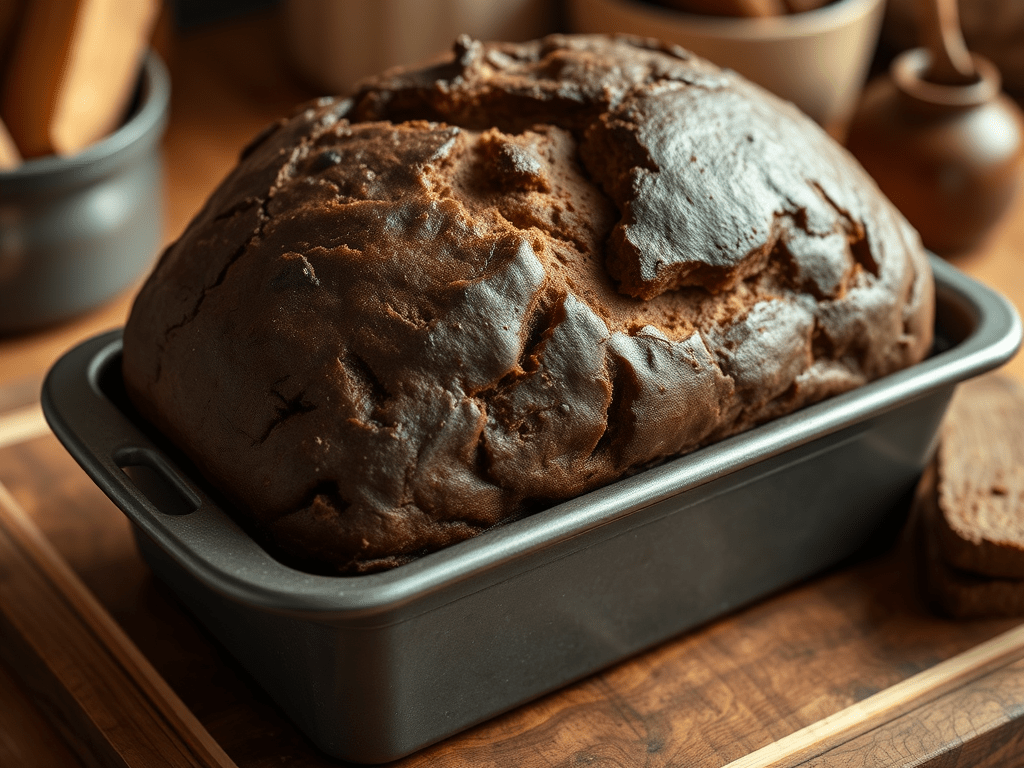
If you’ve ever had Boston Brown Bread, you might find Anadama Bread oddly familiar—but trust me, this one’s better. It’s got that same cozy, molasses-sweet flavor but without the dense, almost cake-like texture. Instead, you get a beautifully soft, slightly chewy loaf with a hint of nuttiness from the cornmeal. I wasn’t sure what to expect when I made it, but after one bite, I knew I’d definitely be making it again. The only catch? It does require a bit of patience—there are a few resting periods to let the yeast do its thing—but luckily, no excessive kneading. Totally worth it.
A Little History—Because This Bread Has Some Drama
Anadama Bread has its roots in New England, specifically Rockport, Massachusetts, and has been around since at least the 1890s. Legend has it that a fisherman, fed up with his wife Anna’s endless servings of cornmeal and molasses porridge, decided to throw some flour and yeast into the mix in a fit of frustration, muttering, “Anna, damn her!”—and boom, Anadama Bread was born. While the story is probably just a fun myth, the bread itself became a regional staple in bakeries across New England, prized for its hearty texture and slightly sweet flavor.
By the 1920s, Anadama Bread was a common sight in homes and bakeries, often served with butter or used for sandwiches. It was the kind of old-school, comforting bread that paired perfectly with a hot bowl of chowder or a thick spread of jam.
So if you’re looking for a bread recipe that’s got history, flavor, and a little bit of an attitude—this one’s for you. Stick around for the recipe, and get ready to taste a New England classic!
Ingredients:
- ½ cup yellow cornmeal
- ⅓ cup molasses
- 3 tbsp lard
- 2 tsp salt
- 1 cup boiling water
- 1 packet active dry yeast (2¼ tsp)
- 3 cup whole wheat flour
Instructions:
- In a large heatproof bowl, mix the cornmeal, molasses, lard, and salt. Pour in the boiling water and stir until everything melts together into a smooth mixture. Let it cool until it’s just warm to the touch, check temp and ensure it is within the range of the heat needed mentioned on your yeast packet.
- Once the mixture has cooled, stir in the yeast and let it sit for 5 minutes. It should look foamy—if not, your yeast may be dead (RIP, yeast). See historical method below if you don’t have yeast!)
- Stir in 2 cups whole wheat flour. Now, mix it like you mean it—for about 3 minutes—to build up some structure. Slowly add the remaining cup, kneading until you get a smooth, slightly tacky dough.
- Cover the bowl and let the dough rise for 30-40 minutes in a warm place until it gets nice and puffy.
- Take the dough out and give it a quick knead on the counter. Shape it into a log that fits your loaf pan (9×5 inches). Keep the seams on the bottom.
- Transfer the dough to a greased loaf pan, smooth side up. Cover it and let it rise again for 1 to 1½ hours, until it puffs up over the edges of the pan.
- Pop it into a 350°F (180°C) oven for 45-55 minutes. It should be golden brown and sound hollow when tapped.
- Transfer to a wire rack and let it cool completely before slicing. Yes, I know it smells amazing, but cutting too soon can mess with the texture—so resist the temptation!
Notes:
Traditionally, Anadama Bread wouldn’t have used active dry yeast, since it wasn’t commercially available until the 1940s. Instead, bakers used natural fermentation (sourdough starter) or cake yeast (compressed yeast, available in the late 1800s). If you want to go old-school, swap the active dry yeast for either a sourdough starter or fresh yeast and adjust the method as follows.”
Historical Method Using Sourdough Starter or Fresh Yeast:
- Sourdough Starter Alternative:
- Instead of active dry yeast, use ½ cup (120g) active sourdough starter.
- Reduce the flour by ¼ cup and the water by ¼ cup to balance hydration.
- After mixing the dough, allow for a much longer rise (6-8 hours for the first rise, 2-4 hours for the second) since natural fermentation is slower.
- Fresh Yeast Alternative (More Historical, Late 1800s-1920s):
- Use ½ oz fresh cake yeast instead of the dry yeast.
- Dissolve it in ¼ cup warm water (below 100°F/38°C).with a pinch of sugar before adding it to the dough.
- Rising times will be closer to modern times but slightly longer—1-2 hours for the first rise, 1 hour for the second.
To check if your Anadama Bread is done baking, use one (or more) of these methods:
1. Tap Test (Most Traditional Method for 1920s Baking)
- Remove the loaf from the oven and tap the bottom of the bread. If it sounds hollow, it’s done. If it sounds dense, it needs more time.
2. Internal Temperature (Modern & Most Accurate)
- Use a kitchen thermometer and insert it into the center of the loaf. The bread is done when it reaches 190–200°F (88–93°C).
3. Visual Cues
- The crust should be deep golden brown. The loaf should pull slightly away from the sides of the pan.
4. Firmness Check
- Gently press the top of the loaf. If it springs back, it’s ready. If it leaves an indentation, bake for a few more minutes.
If the bread isn’t quite done but is browning too quickly, cover it loosely with foil and continue baking. Let it cool completely before slicing for the best texture!
 Time Traveling Table
Leave a comment