
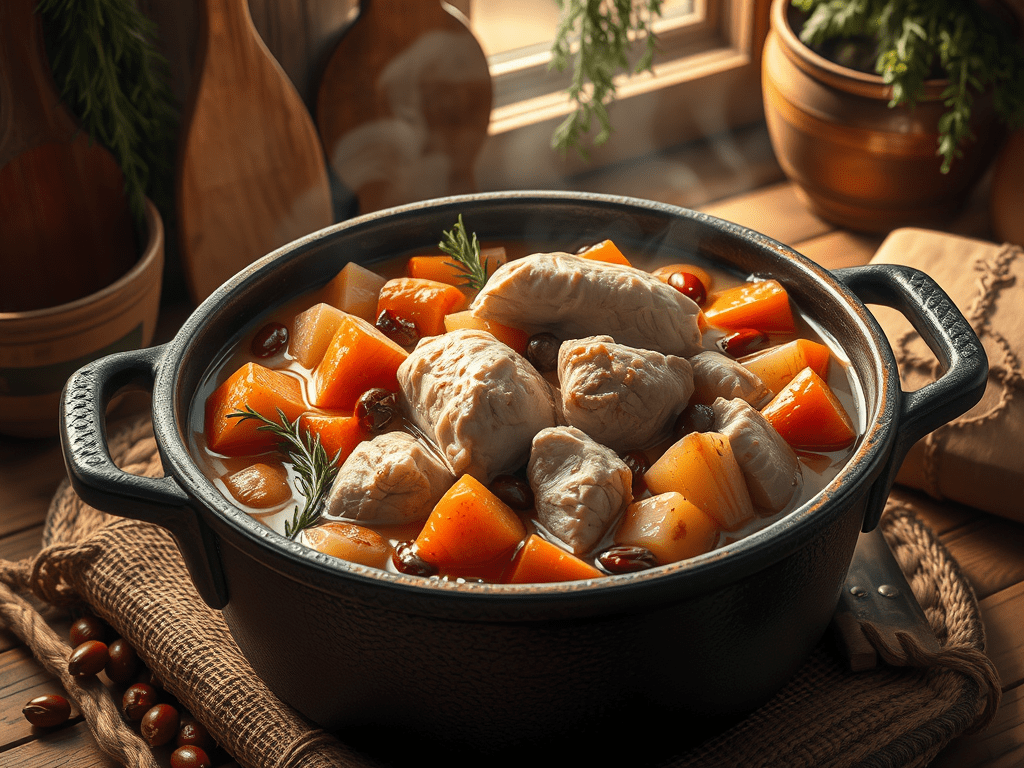
If you think turkey is just for Thanksgiving, think again—because in the 1600s, it was a year-round staple, especially in places like colonial Virginia. Back then, a hearty potage (a thick, rustic soup) was the ultimate comfort food, warming bellies and stretching ingredients to feed an entire household. This wasn’t the refined consommé you’d find in a fancy dining hall; it was a no-frills, slow-simmered meal that made the most of whatever was on hand.
This turkey potage brings together some of the most essential ingredients of the time—wild turkey, root vegetables, wild onions, and dried cranberries for a tart, slightly sweet kick. It’s simple, nourishing, and exactly the kind of meal that would have been simmering over an open hearth as settlers braced themselves for a long winter. With every spoonful, you’re tasting history—one that’s full of resilience, resourcefulness, and, most importantly, really good soup.
Ingredients
- 2 pounds turkey pieces (bone-in preferred for flavor)
- 6 cups water
- 1 cup dried cranberries
- 2-3 wild onions or 1 small modern onion, chopped
- 1 turnip, peeled and diced
- 2 carrots, peeled and diced
- 1 parsnip, peeled and diced
- 1-2 medium potatoes, peeled and diced
- A pinch of salt (if available)
- Optional: wild thyme, bay leaves, or sage for seasoning
Instructions
- Prepare the Turkey Stock
- In a large pot, combine the turkey pieces and water.
- Bring to a boil over a hearth or open flame, then reduce to a simmer. Skim off any foam that rises to the surface.
- Add a pinch of salt (if available) and any herbs like bay leaves or thyme. Let simmer for about 1 hour, or until the turkey is tender and the broth is flavorful.
- Add the Vegetables
- Remove the turkey pieces from the pot and set aside to cool slightly.
- Add the diced parsnips, carrots, wild onions, and potato to the broth. Continue to simmer for 20-25 minutes, or until the vegetables are soft.
- Add the Dried Cranberries
- Stir the cranberries into the pot and let them soften and release their flavor for about 10 minutes.
- Shred the Turkey
- Once cool enough to handle, shred the turkey meat off the bones and return it to the pot. Discard the bones.
- Finish and Serve
- Let the potage simmer for another 5-10 minutes to meld the flavors. Adjust seasoning with more salt or herbs if needed.
Notes
- Texture: For a thicker potage, mash some of the cooked root vegetables into the broth.
- Can I use store bought onions? You can definitely substitute with modern onions or shallots for convenience.
- Can I use fresh cranberries? Yes, you can use fresh cranberries in place of dried cranberries for your Turkey Potage, though it will slightly alter the texture and flavor. Fresh cranberries are more tart and less sweet than dried ones, so the dish will have a sharper, tangier taste.
- Adjustments for Fresh Cranberries: Use 1.5 cups of fresh cranberries instead of 1 cup of dried. Rinse and discard any soft or spoiled ones, then add them to the pot during the last 15 minutes of cooking to soften and burst, releasing their flavor and slightly thickening the broth. If the tartness is too strong, balance it with a small amount of honey (if historically accurate) or embrace the natural tanginess.
- What kind of potatoes to use? For an authentic 1600s Turkey Potage in Virginia, the best and most historically appropriate option would depend on trade routes and local cultivation at the time:
- Most Authentic Choice: Sweet Potato
are native to Central and South America and were introduced to the southeastern United States well before European colonization. They were widely adopted in colonial Virginia and are an excellent historical choice. Their sweetness pairs well with the tart cranberries and savory turkey. - Other Options: Red Potato or Yukon Gold Potatoes originated in the Andes and were brought to Europe in the 1500s, eventually making their way to colonial America.
Red potatoes or Yukon Golds are good secondary choices for authenticity, as they reflect early potato varieties. They add creaminess and a neutral flavor to the soup. - Less Likely Options:
- Russet: were not yet developed in the 1600s, so they are less authentic but still work if authenticity is not a priority.
- Purple Flesh (Okinawa Sweet Potato): While visually stunning, this variety originated in Asia and was unlikely available in colonial Virginia during the 1600s.
- Yam: True yams are native to Africa and Asia. They were brought to the Americas through the transatlantic trade but are less authentic than sweet potatoes in this context.
- Most Authentic Choice: Sweet Potato
- Can you can use ground turkey instead? Absolutely, though it will slightly alter the texture of the dish. Ground turkey will break down more easily, creating a smoother, more uniform texture for the soup, as opposed to the chunkier, more rustic texture from using whole turkey pieces.
- Adapting for Ground Turkey: Brown the ground turkey separately to enhance flavor, then add it to the simmering broth with root vegetables and cranberries. Since ground turkey cooks faster, simmer for 10-15 minutes until the flavors meld and vegetables are tender. While it won’t provide the same meaty texture as bone-in turkey, it still creates a hearty, flavorful soup and offers a quicker, more convenient alternative.
This hearty potage brings together the rich flavors of savory turkey, sweet-tart cranberries, and earthy root vegetables—just the kind of warm, nourishing meal that would have been a staple in 17th-century Virginia. Whether you’re embracing historical cooking or just craving a cozy, rustic dish, this recipe offers a taste of the past with every spoonful.
 Time Traveling Table
Leave a comment