
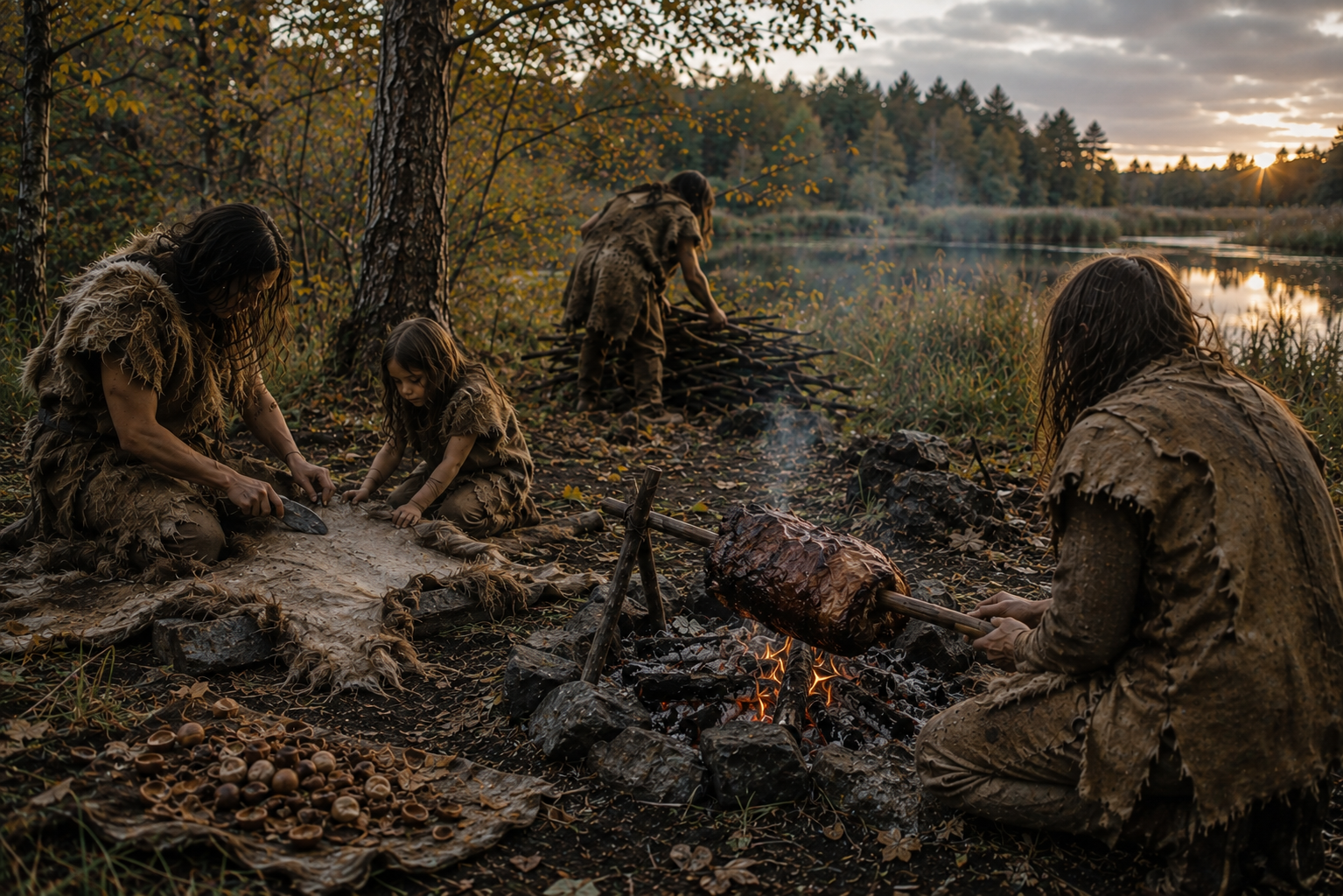
England, Nearly 900,000 Years Later
The last time we visited England, we stood on the muddy edge of an ancient estuary at Happisburgh, nearly 900,000 years ago. People walked across the mud there, leaving behind footprints that survived just long enough for archaeologists to find them in 2013. Along with stone tools found nearby, they gave us an extraordinary glimpse of some of the earliest people known to have lived in Britain.
Now, we’re jumping forward roughly 895,000 years.
That does not mean people have been living here continuously since our last visit. Far from it. During the enormous stretch of time between our two stops, Britain’s climate repeatedly swung between warmer and bitterly cold periods, sometimes forcing people out entirely. Around 25,000 years ago, worsening conditions drove humans from Britain once again. By roughly 20,000 years ago, the last glacial period was near its most severe, with ice covering much of Britain. Humans remained absent for more than 10,000 years before eventually returning.
By 4500 BC, the England we step into is almost unrecognisable from the one we left behind. Coastlines have shifted. The climate has changed. Woodlands and waterways dominate the landscape, and the people living among them have technologies and ways of navigating their environment that would have been unimaginable during our first visit.
So this time, rather than simply examining the stone tools these people left behind, we’re going to try something harder.
We’re going to reconstruct what it might actually have felt like to live here.
Just so we’re all on the same page. Please ensure you’ve made yourself acquainted with my disclaimer
An England You Would Barely Recognise
By 4500 BC, the brutal cold of the last Ice Age is long gone. England is now in the warmer Holocene period, and the climate is probably fairly comfortable by English standards. This falls within a generally warm part of the Holocene, although temperatures varied by region and from year to year.
We obviously don’t have a weather station giving us the forecast for July 4500 BC, but climate reconstructions can give us a reasonable idea of what conditions were like.
- Summer
- Daytime: ~16–21°C (61–70°F)
- Nighttime: ~8–13°C (46–55°F)
- Winter
- Daytime: ~3–8°C (37–46°F)
- Nighttime: -2–4°C (28–39°F)
Southern England would generally have been milder than northern and upland areas, and individual hot spells or hard freezes could obviously fall outside those ranges.
The relatively mild, moist climate supported extensive woodland, with oak, elm, lime and hazel common across many areas and alder thriving around rivers and wetter ground. But this wasn’t one enormous, closed forest. The density and mix of trees varied with soil, elevation and moisture, creating a landscape of thicker woodland mixed with more open areas, river valleys, wetlands and clearings. Large grazing animals could help keep some areas open as well.
The actual shape of Britain had changed enormously since our last visit too.
Around 450,000 years ago, during one of Britain’s harshest glaciations, ice sheets helped trap an enormous lake to the east. Eventually, the lake broke through the land holding it back. The resulting flood was powerful enough to help carve the beginnings of what would become the English Channel.
That didn’t immediately turn Britain into the island we know today. Over hundreds of thousands of years, growing and melting ice sheets caused sea levels to fall and rise repeatedly. Sometimes Britain was connected to continental Europe by dry land. At other times, rising seas cut that connection.
One of those lost landscapes was Doggerland, which once stretched across a large part of what is now the North Sea. This wasn’t just a narrow land bridge. It was a substantial landscape. As the climate warmed after the last Ice Age and melting ice raised sea levels, Doggerland was gradually submerged. By 4500 BC, Britain was firmly separated from continental Europe by water.
The Animals of a Changing England
If we could watch England’s wildlife change between our visits, it wouldn’t look like a slow march from Ice Age animals to the species we know today. Animals repeatedly arrived, disappeared and sometimes returned as Britain’s climate and connection to continental Europe changed.
And there were some very different versions of England along the way.
During colder periods, mammoths roamed Britain. Several mammoth species lived here during the Pleistocene, with cold-adapted woolly mammoths becoming part of Britain’s later Ice Age fauna. Woolly rhinoceroses were here too, built for the cold, open environments that existed during glacial periods. Both eventually disappeared completely, becoming globally extinct.
Around 125,000 years ago, Britain was experiencing a warm interglacial period. Sea levels were actually higher than they are today, flooding some low-lying areas around places such as Norfolk and Lincolnshire. Hippos wallowed in the Thames, while lions prowled through the area where Trafalgar Square now stands.
The swings continued. By the closing stages of the last Ice Age, another spectacular animal could be found in Britain: the giant deer, often called the Irish elk despite not actually being an elk. The males grew antlers that could reach an absurd 3.5 metres (11.5 feet) across and weigh around 40 kilograms (88 pounds). By 4500 BC, however, giant deer were gone.
The reason these animals disappeared wasn’t always the same. Britain repeatedly shifted between cold, open environments and warmer, more wooded ones. Sea levels rose and fell, changing whether animals could move between Britain and continental Europe. Some species simply shifted their ranges as suitable habitat moved. Others, including mammoths, woolly rhinoceroses and giant deer, eventually became extinct everywhere.
So what is actually walking around England when we arrive in 4500 BC?
Red deer and roe deer share the landscape with wild boar and aurochs, the enormous wild cattle that once lived across much of Europe. There are also wolves, brown bears, Eurasian lynx and beavers, alongside smaller mammals and a wide variety of birds and fish. Animal-bone evidence from Mesolithic Britain frequently shows red deer as particularly important, alongside wild boar, roe deer and aurochs.
Let’s check out aurochs, because I had never heard of these before. Imagine a cow, and then remove basically everything about the situation that makes a cow reassuring. Aurochs were large, powerful wild bovines. Adult bulls could stand around 1.6–1.8 metres (5.2–5.9 feet) at the shoulder, with some estimates reaching closer to 2 metres (6.5 feet). They had long legs, muscular bodies and large horns that curved forward and inward. So we’re not talking about a slightly bigger version of a cow standing peacefully in a field. This was a genuinely imposing wild animal.
That is perhaps the biggest difference between the wildlife of 4500 BC and the wildlife most of us associate with England today. The woods aren’t simply full of deer and cute woodland creatures.
Humans share them with some very large animals.
Just How Many People Are Here?
Not many… and moving on.
Okay, but for real. Putting an exact number on the population of Britain in 4500 BC is basically impossible. There are no written records or censuses, and the archaeological record is incomplete.
Researchers’ estimates vary, sometimes by a lot. Depending on the assumptions used, published estimates for Mesolithic Britain range from only a few thousand people to around 20,000.
And that’s across all of Britain, not England alone.
People obviously weren’t sprinkled evenly across the landscape. Rivers, lakes, estuaries and coasts offered concentrated resources, and archaeological evidence shows people returning to particularly useful locations again and again. Some areas may have supported relatively regular occupation while others saw very little human activity.
Communities themselves were probably small, often consisting of only a few dozen people. Groups could split up and come back together throughout the year, and occasionally meet with other communities.
That last part matters. Living in a sparsely populated country doesn’t mean spending your entire life with the same twenty people.
But we should get rid of one idea completely: mobile does not mean wandering.
These people weren’t walking through England hoping they happened to stumble across dinner before dark. They knew where rivers ran, where particular plants grew, where animals were likely to be found, where useful stone could be collected and which places were worth returning to at particular times of year.
Their home wasn’t necessarily one permanent settlement.
It could be an entire familiar landscape.
What Counts as Home When You Move?
We don’t have a standard 4500 BC English house that we can neatly reconstruct. Homes made largely from wood and other plant materials have a bad habit of disappearing after 6,500 years. What we do have are traces of structures from Mesolithic Britain that give us some idea of what people were capable of building.

Reconstructed Mesolithic round-house near Howick, Northumberland. © Andrew Curtis / Geograph, CC BY-SA 2.0.
At Howick in Northumberland, archaeologists found the remains of a substantial circular structure dating to around 7800 BC. Postholes marked where wooden supports once stood, and evidence suggested that the structure was repaired or rebuilt over time. At Star Carr in North Yorkshire, archaeologists found an even earlier structure measuring around 3.5 metres (11.5 feet) across.
These earlier examples show us that Mesolithic people in England could construct substantial shelters and return to particular places repeatedly.
Not every home needed to last for generations, either. People in Mesolithic England were mobile, moving between useful parts of the landscape as resources changed throughout the year. Some locations were used repeatedly, while others may have been occupied much more briefly. A shelter that was relatively quick to build, repair or abandon could make perfect sense if you expected to move again.
The same practicality probably affected possessions. Portability mattered. Anything brought from place to place had to be transported somehow, although that doesn’t mean people owned almost nothing or carried every object everywhere they went. Some belongings could potentially be left at places people expected to return to.
Food Without Farms
There isn’t a single field, orchard or vegetable patch producing dinner in 4500 BC England. Everything people eat ultimately has to come from the landscape around them.
What was available depended heavily on where you lived and the time of year. People hunted, gathered and fished from the resources around them, so someone living near the coast could have a very different diet from someone farther inland.
There was no breakfast, lunch and dinner schedule that we know of. People ate when they had food and when it made sense to eat. That might mean one larger meal one day and just snacks another.
And getting the food was only the beginning. Kill a deer and congratulations, you now have an enormous amount of work to do.
The animal has to be butchered. Useful portions need to be transported. The hide can be removed and processed. Meat needs to be prepared and possibly preserved, while bones, antler, sinew and other parts can become useful raw materials. Plants can require work too. Nuts need collecting and cracking, roots have to be dug up, and many foods need cleaning or cooking before they are particularly useful.
Where you lived could make a major difference to what you ate. Coastal communities had access to marine foods that inland communities didn’t, and incredibly, we can sometimes see that difference in human bones.
Researchers can measure stable isotopes of carbon and nitrogen preserved in bone collagen. Different foods leave different chemical signatures, which means someone’s bones can sometimes tell us whether much of their protein came from animals on land or food from the sea. Because bone collagen changes slowly, it can preserve information about years of diet.
We actually have a late Mesolithic example from England. A woman’s femur found at Staythorpe in Nottinghamshire, dating to approximately 5730–5630 BC, was analysed for carbon and nitrogen isotopes. The results suggest that during roughly the last decade of her life, most of her dietary protein came from animals living on land rather than marine foods. Elsewhere in Mesolithic Britain, isotope analysis has found people whose diets relied much more heavily on food from the sea.
Plants are harder to see in the archaeological record. Hazelnuts are one of our archaeological superstars because their shells can become charred and survive for thousands of years.
But the evidence is lopsided. Animal bones, shells and charred hazelnut shells preserve considerably better than leafy greens or soft berries.
Food availability also changed throughout the year. Nuts and berries ripened at particular times, plants had growing seasons and animal behaviour changed seasonally. Knowing when food would be available was just as important as knowing where to find it.
And sometimes there simply wasn’t enough food. A hunt could fail. Bad weather could interfere with gathering or fishing. A useful seasonal resource might produce poorly. Food that had been stored or preserved could run out. A prolonged shortage wasn’t merely inconvenient. It could mean malnutrition and, in severe cases, starvation.
Exactly how all of this food was cooked is frustratingly difficult to reconstruct. Hearths tell us people used fire, and food could be roasted over or beside it. Other cooking methods are possible, but sometimes the most accurate answer is simply: we don’t know.
Feeding yourself required far more than finding something edible. You needed to know what to look for, where to find it, when it would be there, how to obtain it and what to do with it once you had it.
The OG
We can’t know exactly what one person ate in a single day in 4,500 BC, so this menu brings together foods that were available to hunter-gatherers in England rather than recreating a documented day of eating. And this would have been a particularly lucky day. A successful hunt alongside plenty of seasonal plants, nuts and fruit meant food was abundant, something that certainly couldn’t be counted on every day.
Morning
- Wild berries: Fresh seasonal berries gathered from the surrounding landscape.
- Hazelnuts: Wild hazelnuts cracked from their shells and eaten by hand.
- Water
A Bite Along the Way
- Wild greens: Fresh edible leaves gathered and eaten raw during the day’s activities.
- Water
The Main Gathering
- Fire-roasted wild boar: Wild boar roasted over or beside the fire.
- Ember-cooked wild roots: Gathered edible roots buried among hot ashes and embers until charred outside and tender within.
- Water
Something Sweet
- Fire-roasted wild apple: A small wild apple warmed beside the fire until soft, sweet and lightly charred.
- Water
The Modern: 6,500 Years Later
The same basic ingredients get a serious upgrade
Breakfast
- Hazelnut Cream & Summer Berry Sourdough: Toasted sourdough layered with roasted hazelnut cream, smashed blackberries and raspberries, a drizzle of honey and flaky sea salt.
- Blackberry-Elderflower Sparkling Water: Sparkling water infused with blackberry and fragrant elderflower.
A Little Snack
- Seasonal Greens & Herb Salad: Tender greens and fresh herbs tossed with toasted seeds and a bright elderflower vinaigrette.
- Cucumber & Herb Sparkling Water: Chilled sparkling water with cucumber and fresh herbs.
The Main Event
- Juniper-Roasted Pork: Roasted pork seasoned with juniper and thyme and finished with a rich blackberry jus.
- Embered Parsnips: Deeply roasted parsnips with charred edges and a silky parsnip purée.
- English Pinot Noir: A light, fruit-forward English red paired with the pork and blackberry.
Dessert
- Ember-Roasted Apple: Caramelised roasted apple topped with brown-butter hazelnut crumble and cultured cream.
- Hot Spiced Apple & Elderflower: Warm apple infused with elderflower and aromatic spices.
Much More Than “Stone Age”
Calling this the Stone Age can give a slightly misleading impression of the technology people actually used. Stone dominates museum displays because stone is very good at surviving for thousands of years. Wood, bark, leather and plant fibres generally aren’t.
Occasionally, though, we get extraordinarily lucky.
At Star Carr in North Yorkshire, waterlogged conditions preserved materials that would normally have disappeared. Alongside thousands of pieces of worked flint, archaeologists found worked wood, bone and antler tools, birch bark and resin. The site even preserves a timber platform that Historic England describes as the earliest known evidence of carpentry in Europe.
Stone was only one part of the toolkit. At Star Carr, archaeologists have found beautifully worked barbed antler points, probably used in hunting or fishing, as well as tools made from bone and antler. People were also working timber and using birch resin, a naturally sticky substance that could be used as an adhesive.
Additionally woodworking certainly wasn’t new. About 420,000 years ago, someone in what is now Essex shaped a piece of yew into the point of a wooden spear. Known as the Clacton spear, it is the oldest preserved wooden spear currently known.
By 4500 BC, people weren’t at the beginning of some technological learning curve. Humans had been selecting materials, making tools and passing those skills between generations for hundreds of thousands of years.
What Did People Actually Look Like?
We can reconstruct some parts of a person’s appearance in Mesolithic England surprisingly well. Others are almost completely lost.
Cheddar Man gives us one of our best examples. His nearly complete skeleton was discovered in Gough’s Cave in Somerset and dates to around 10,000 years ago, several thousand years before our visit. He stood about 166 centimetres (5 feet 5 inches) tall and died in his twenties. Ancient DNA also suggests that he had dark skin, dark brown hair and blue eyes. Other Mesolithic remains from Europe suggest that the combination of darker skin with blue or green eyes wasn’t unique to him.
That doesn’t mean we can simply make everyone in 4500 BC England look like Cheddar Man. He was one person who lived thousands of years earlier, and ancient DNA gives us probabilities rather than a photograph. But he does show just how different combinations of physical traits could be among Mesolithic Europeans.
Then we get to clothing, and suddenly the evidence gets considerably worse.
Animal hides and plant materials could provide practical clothing in England’s cool, wet climate, but leather, fibres and other organic materials rarely survive for thousands of years.
We do know that people decorated themselves. At Star Carr, archaeologists found beads made from shale, animal teeth and amber, along with other unusual objects including an engraved shale pendant. Whatever these objects meant, somebody took the time and skill to make things that could be worn rather than simply making another hunting tool.
How Dangerous Was Everyday Life?
There were plenty of ways to get hurt in 4500 BC England, and none of them came with an urgent care clinic at the end. Bones and teeth preserve evidence of some of the health problems people lived with.
- Injuries: Hunting wild animals carried risks, but so did ordinary life. Falls, burns, cuts and accidents with tools could all become serious problems. Broken bones are particularly interesting when they healed, because healing tells us that the person survived the original injury long enough for their body to repair it. A serious injury that limited someone’s ability to walk or gather food may also have made help from other people especially important.
- Infections: A cut that we’d clean, stitch or treat with antibiotics today could become much more dangerous. Wounds could become infected, and without antibiotics a serious bacterial infection could potentially become life-threatening. Some severe or long-lasting infections even reached the bone, leaving evidence archaeologists can identify thousands of years later.
- Teeth: No dentists, toothpaste or fillings, but also no refined sugar and a very different diet. Their dental problems weren’t necessarily ours. Teeth can also preserve evidence of illness or nutritional stress during childhood. If enamel formation is disrupted while a tooth is developing, the defect remains, meaning an adult tooth can essentially keep a record of a rough patch during childhood.
- Parasites & Disease: Small, mobile communities had a different disease environment from the crowded settlements of later periods. Some contagious diseases have difficulty circulating continuously when there aren’t enough people around to keep transmission going. But parasites remained a problem, including those acquired through contaminated food, animals, soil and water.
- Pregnancy & Childbirth: Complications such as severe bleeding, obstructed labour and infection could become life-threatening for the mother, baby or both.
What about medicine? People knew their landscape extraordinarily well, including the plants growing around them, so medicinal knowledge is certainly possible. We just can’t take herbal remedies recorded thousands of years later and automatically give them to people in 4500 BC.
Life Beyond Your Own Camp
Living in a community of only a few dozen people didn’t mean those were the only people you ever knew. Mesolithic groups were connected across the landscape, and maintaining relationships beyond your immediate community provided opportunities to find partners, maintain family and social ties, exchange knowledge and learn what was happening elsewhere.
There was no money, marketplace or economy in anything resembling the modern sense. But we should be careful about replacing money with the equally tidy idea of barter. Finding a piece of stone far from its original source doesn’t tell us that somebody swapped three hides for it. Materials could move because people travelled themselves, or through gifts, exchange, obligations and relationships between communities.
What archaeology can show us remarkably well is that materials moved.
In northern England, flint and chert have been found considerable distances from the places they originated. At Lismore Fields near Buxton, for example, Mesolithic people were using flint originating from the Wirral as well as material from the Yorkshire Wolds. Archaeologists have also found east-coast flint farther inland in the Pennines.
And travelling that far yourself isn’t as ridiculous as it might initially sound. A journey of about 300 kilometres (185 miles), roughly the distance of a modern coast-to-coast walk across northern England, might take a Mesolithic traveller somewhere around three to five weeks once you allow time for finding and processing food, resting, dealing with weather and crossing difficult terrain. Someone travelling lightly and with a purpose could potentially do it faster.
That changes how we should think about materials found far from their source. A piece of flint from the other side of England didn’t necessarily need to pass through ten different communities to get there. Someone could actually have travelled that distance themselves. We can’t know whether that’s what happened in any particular case, but the distances involved were completely within human travelling range.
Either way, these objects show that Mesolithic communities weren’t isolated little dots on the map. England may have had only a tiny population, but people, materials and information moved across surprisingly large distances.
How Do We Know?
Reconstructing England in 4500 BC
Archaeology can pull an astonishing amount of information from very little. A few fragments of bone, microscopic grains of pollen or a patch of darkened soil can help reconstruct a world that disappeared thousands of years ago. The trick is understanding what survived and what that evidence can actually tell us.
Most of 4500 BC Is Gone
One of the biggest problems is preservation bias, which is a fancy term for the fact that some things survive much better than others.
Stone is excellent at sticking around. Bone and antler can survive under the right conditions, while burning can preserve things such as nutshells and seeds that would otherwise decay. Waterlogged environments can occasionally preserve wood and other organic materials.
Meanwhile, clothing, leather, wooden tools, baskets, cordage, food and countless other everyday objects usually disappear.
That creates a distorted picture. If archaeologists excavate hundreds of pieces of flint and only a handful of wooden objects, it doesn’t necessarily mean people owned hundreds of times more stone equipment. What archaeologists find isn’t necessarily what people used most. It’s what had the best chance of surviving.
Pollen Can Rebuild a Forest
One of the coolest ways to reconstruct prehistoric England involves something tiny: pollen.
Pollen can become trapped in peat, lake beds and other sediments that accumulate in layers over time, allowing specialists to identify which plants were growing nearby.
By taking a core through those layers and examining the pollen at different depths, researchers can watch the environment change. A layer containing lots of oak, elm and lime pollen tells a different story from one dominated by grasses or plants associated with wet ground.
Bones Tell More Than You’d Think
Finding a bone tells us considerably more than something died here.
Animal bones can often be identified by species, allowing archaeologists to see which animals were present. The age of an animal at death can sometimes be estimated, while cut marks can show where a carcass was butchered and burning can provide evidence about what happened to the bone afterward.
Human bones and teeth can preserve different information. Healed fractures show that someone survived an injury. Changes to bone can sometimes reveal disease, while teeth preserve wear, damage and even disruptions that occurred while they were developing during childhood.
Media You Can Watch or Read Today
Want to spend a little longer in prehistoric England? These books, documentaries and podcasts explore the archaeology, people and landscapes of the Stone Age, while a few fictional picks help younger readers imagine what life in a hunter-gatherer world might actually have felt like.
For Adults
- A History of Ancient Britain (BBC)
Neil Oliver travels through Britain’s prehistoric past, using archaeological sites, reconstructed landscapes and surviving evidence. For our visit to 4500 BC, Season 1, Episode 2, “Age of Ancestors,” is the one to watch. It explores post-Ice Age Britain, the changing landscape and the lives of Mesolithic hunter-gatherers. If you want to actually see someone walk through the world we’ve been exploring, start here. - Britain BC by Francis Pryor (Book)
This is the heavier-learning option, but Francis Pryor is interested in prehistoric people as people, not simply as manufacturers of archaeological artefacts. He uses settlements, landscapes and everyday archaeological evidence to build a picture of Britain and Ireland long before Rome. It covers far more than 4500 BC, but it’s an excellent next step if this article has left you wondering just how much British history happened before anyone wrote it down. - Ancestors: A Prehistory of Britain in Seven Burials by Alice Roberts (Book)
Alice Roberts uses seven British burials alongside archaeology, genetics and ancient DNA to investigate the people who lived in prehistoric Britain. It isn’t specifically about 4500 BC, but it asks one of the same fascinating questions: how much of a human life can we reconstruct from what survived in the ground? - Secrets of the Stone Age (Channel 4)
Anthropologist Richard Rudgley investigates just how technologically and socially sophisticated Stone Age societies could be. The three-part documentary travels much farther geographically and chronologically than Mesolithic England, so don’t treat it as a recreation of 4500 BC. Instead, watch it for the bigger question: how much human knowledge and technology has disappeared simply because the materials people used didn’t survive? - The British History Podcast
One of my personal favorite podcasts. The opening episodes begin with Britain’s earliest inhabitants before gradually working towards the later dates. It’s conversational, funny and wonderfully interested in what life was actually like, making it an especially good companion for a journey through England’s history.
For Kids
Finding children’s media specifically about late Mesolithic England is surprisingly difficult, which is frankly rude. These aren’t all set in exactly 4500 BC, but each gives a useful way into prehistoric life, archaeology or the hunter-gatherer world.
- Stone Age Boy by Satoshi Kitamura (Book)
Ages: 4–8
A modern little boy accidentally finds himself thousands of years in the past and befriends a Stone Age girl who shows him around her world. It’s fictional and set considerably earlier than our 4500 BC visit, but it’s a really approachable introduction for younger kids to the idea that Stone Age people had homes, skills, tools, food and communities. There’s plenty to look at and talk about without making it feel like you’ve secretly assigned them homework. - Wolf Brother by Michelle Paver (Book)
Ages: 9–13
Twelve-year-old Torak lives as a hunter-gatherer in prehistoric northern Europe, where survival depends on understanding forests, animals, weather and the people around him. There are supernatural and fantasy elements, so this is definitely not a documentary disguised as a novel, but Michelle Paver did extensive research into hunter-gatherer life while creating the world. It’s a particularly good choice for kids who love adventure and want to imagine what it might actually feel like to live without farms, towns or supermarkets. - The Boy with the Bronze Axe by Kathleen Fidler (Book)
Ages: 9–12
Two children living at Skara Brae encounter a mysterious stranger carrying a strange new kind of axe, beginning a story filled with prehistoric village life and changing technology. This one is later than our visit and takes place in Neolithic Orkney rather than Mesolithic England, so keep that distinction in mind. It’s still a lovely choice for kids who enjoy historical fiction where people actually cook, work, argue and solve everyday problems instead of simply standing around looking “prehistoric.”
Could you handle life in 4500 BC England, moving with the seasons, gathering wild food and knowing that one badly infected cut could become a serious problem? Or does a world of woodland, campfires and absolutely no alarm clocks sound surprisingly appealing? Leave your thoughts below or tag me on social!
Leave a Reply