
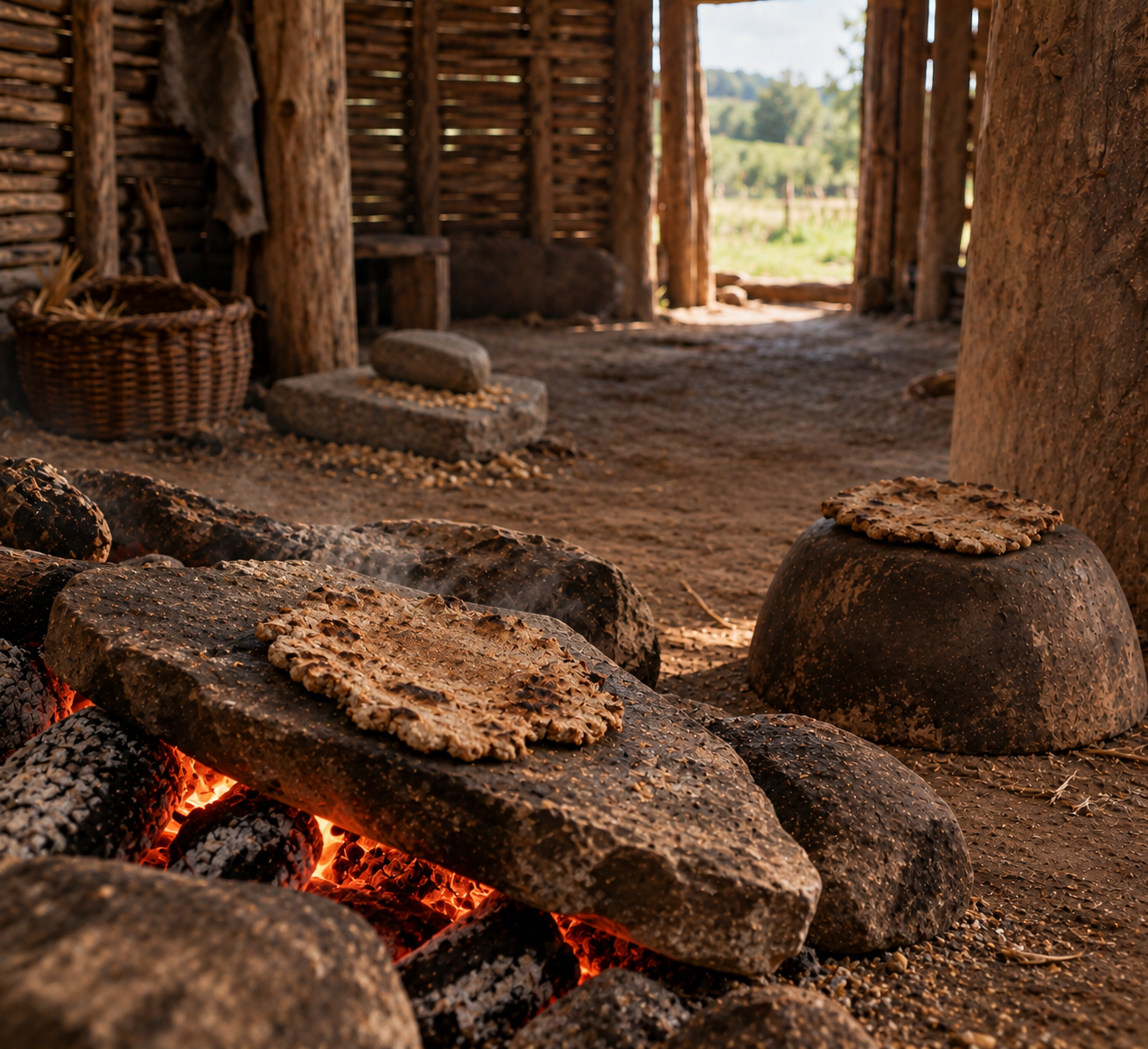
These flatbreads are a reconstruction, not a surviving historical recipe, but they’re built from what we know was available in Early Neolithic England. By around 4000 BC, emmer was one of the cereals being grown by England’s first farming communities. Grain could be ground on a stone quern, mixed with water and cooked on or beside the hearth, making simple unleavened breads a very plausible part of Neolithic food. We don’t know exactly what those breads looked like, how thick they were or precisely how they were cooked, but after making these, one thing suddenly made a lot of sense to me. This is incredibly practical food.
To my knowledge, I’d never had emmer before this. I didn’t even know it existed before starting this journey, and these were intense! They were dense, filling and held together ridiculously well for something made with only two ingredients. I was legitimately impressed. I could completely see someone using something like this as travel food. Chuck one in a bag and I feel like it would survive the journey better with it.
Taste-wise, these were probably the least exciting part. I didn’t dislike them, but they’re definitely more interesting than delicious. I’m glad I made them, and I was genuinely impressed by how substantial two ingredients could become, but I don’t think they’ll be joining my regular bread rotation. Unless I need a base for a protein bar, because actually, these might be perfect for that.

Makes: About 10 small flatbreads
Prep time: 20 minutes, plus 45–75 minutes if grinding by hand
Cook time: Approximately 25–35 minutes
Total time: Approximately 1 hour 30 minutes–2 hours 10 minutes when grinding by hand
Ingredients
- 475 g (2½ cups) whole emmer berries
- 180–300 ml (¾–1¼ cups) water, as needed
Method
- Grind the emmer. Working with approximately 2–3 tablespoons of emmer at a time, use a stone grinding surface to crack the dry berries and then continue grinding them into a coarse flour or fine meal. Some gritty or irregular pieces are completely fine. If grinding the full amount by hand, allow approximately 45–75 minutes.
- Make the dough. Place the freshly ground emmer meal in a large bowl. Add 180 ml (¾ cup) water and mix with your hands. Continue adding water 15 ml (1 tablespoon) at a time until the mixture forms a cohesive dough. Do not automatically use the full amount; hand-ground emmer can vary considerably in how much water it absorbs. The finished dough should be soft and mouldable but not wet or sticky.
- Rest the dough. Cover and leave for 15–20 minutes. This resting period allows the coarse flour to absorb the water; the dough is not being fermented. If it cracks badly when pressed after resting, work in another 5–10 ml (1–2 teaspoons) water.
- Shape the flatbreads. Divide the dough into 10 roughly equal pieces. Shape each piece into a ball, then press it by hand into a rough disc approximately 10–13 cm (4–5 inches) across and 3–6 mm (⅛–¼ inch) thick. The discs do not need to be perfectly round. If the coarse dough breaks apart when pressed thin, make the flatbreads slightly smaller and thicker rather than adding substantially more water.
- Heat the cooking surface. Heat a dry cast-iron skillet or griddle over medium to medium-high heat until thoroughly hot. Do not add oil. For a closer prehistoric reconstruction, the flatbreads can be cooked on an appropriate heated surface beside a hearth; a dry cast-iron pan provides a practical modern substitute.
- Cook the flatbreads. Place the flatbreads on the hot, dry surface without overcrowding the pan. Cook for approximately 2–4 minutes on the first side, then turn and cook for another 2–3 minutes. Look for scattered browned or lightly charred patches and an interior that is cooked through without becoming completely dry. These are dense, rustic cereal cakes rather than soft, fluffy modern flatbreads.
- Keep warm and serve. Stack the finished flatbreads and loosely cover them with a clean cloth until serving. Serve them whole or tear them into pieces by hand at the table.
While I was cooking these, I started wondering if they might be a little too dense for anyone wanting a softer bread alongside their meal. I had some leftover emmer pottage, so I fried some of that on the hot surface instead.
And honestly? It worked surprisingly well. It was almost like a funky little emmer pancake.
There’s no archaeological evidence telling us people in 4000 BC England fried yesterday’s pottage into pancakes, so this is firmly my experiment, not part of the historical reconstruction. But if you’re wanting a softer option, this might be your better choice.
Leave a Reply