
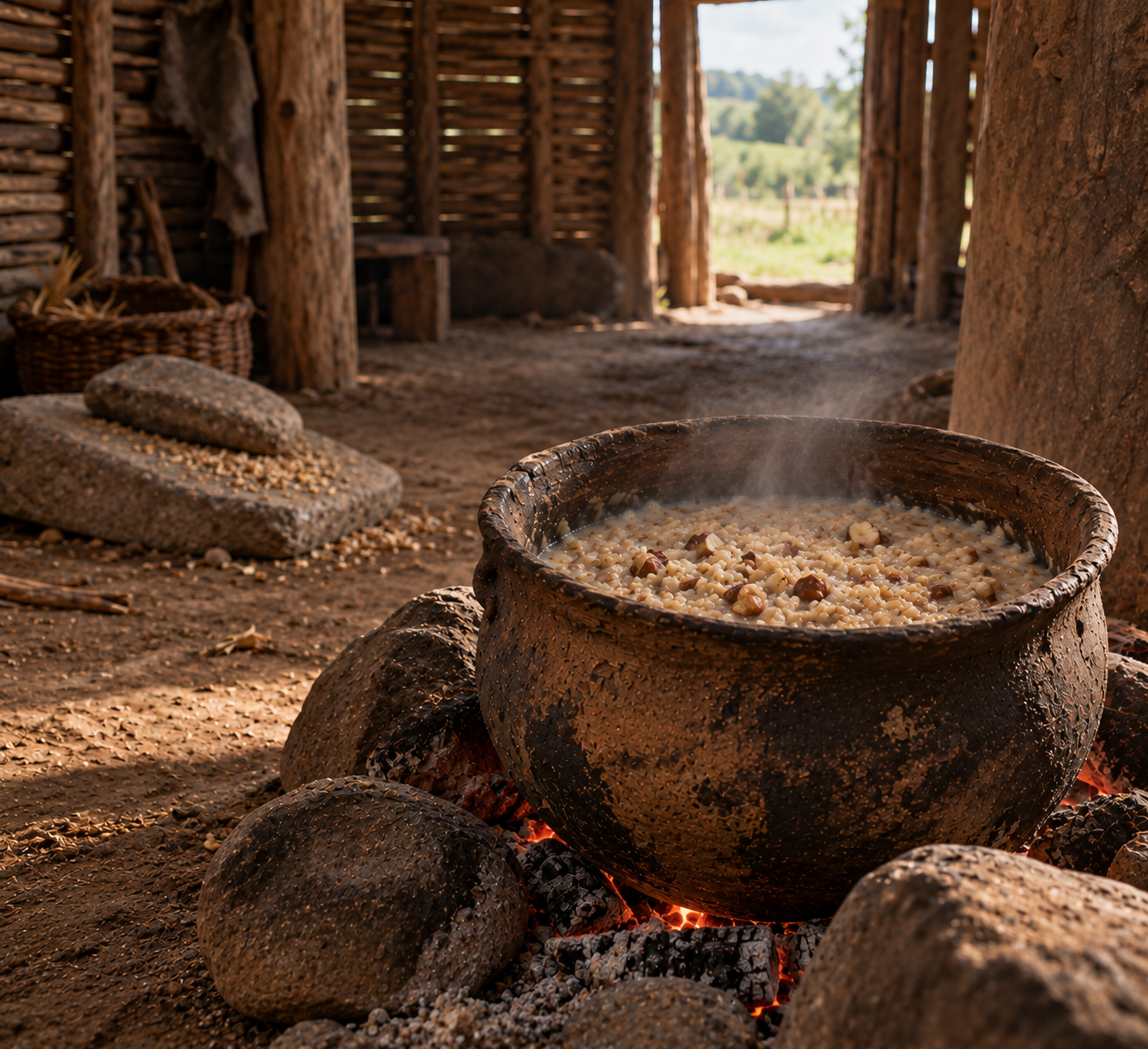
There is, unfortunately, no Neolithic cookbook telling us what someone in England was having for breakfast in 4000 BC. But we do know they had the ingredients and equipment to make something along these lines. Emmer was one of the cereals brought to Britain with the arrival of farming, dairy became an important part of the diet, hazelnuts were already a familiar wild food, and people had pottery that could sit over a hearth and turn grain and liquid into dinner. Or breakfast. Or whatever meal you eat when clocks haven’t been invented yet.
We can’t say anyone combined these exact ingredients in these exact proportions, but grain cooked with liquid into a thick pottage is about as practical as food gets. It also sits right at that interesting point in English food history when new farmed foods and much older gathered foods were being eaten side by side: cultivated emmer, milk from domesticated animals and hazelnuts collected from the surrounding landscape.
To my knowledge, I’d never had emmer before this. I didn’t even know it existed before starting this journey, and in a fairly plain pottage, I wasn’t expecting all that much from it. But surprisingly, it was good. I enjoyed my bowl of pottage and actually went back for seconds.
Honestly, I think I liked it better without the hazelnuts. It was just a nice bowl of cosy. Warm, simple and filling without being heavy. I feel like this would be the perfect breakfast for a cold, rainy morning, which, conveniently, England is more than capable of providing.

Servings: 4
Prep time: 20–30 minutes, plus grinding and soaking
Cook time: 45–60 minutes
Make ahead: Can be prepared the night before and reheated
Ingredients
A Quick Note on the Ingredients: If there’s an ingredient below that doesn’t appeal to you or isn’t available at your store, don’t stress, just skip it, find a similar substitute, or let this recipe inspire you to add your own twist. Back in this time period, recipes didn’t exist in the structured way we know them today. People used whatever they had on hand, and measurements were more of a “feel it out” situation. So embrace the spirit of the age and make it yours!
- 190 g (1 cup) whole emmer berries
- 590 ml (2½ cups) water
- 240 ml (1 cup) whole milk, plus approximately 60 ml (¼ cup) or more for reheating
- 65–70 g (½ cup) whole hazelnuts
Method
- Coarsely grind the emmer. Working with approximately 2–3 tablespoons of emmer at a time, place the dry berries into a coarse stone mortar. Pound them first to break the berries, then use a pressing and grinding motion. Do not grind them into flour. You want a texture resembling very coarse cracked wheat: some halves, plenty of smaller pieces, coarse meal and a little fine flour.
- Soak the emmer. Place the cracked emmer in a bowl with 590 ml (2½ cups) water. Cover and refrigerate for at least 1–2 hours. Do not drain, the soaking water will be used to cook the grain.
- Prepare the hazelnuts. While the emmer soaks, lightly toast 65–70 g (½ cup) hazelnuts in a dry pan until fragrant. Allow them to cool, then roughly crush them with a mortar. Keep them in small pieces rather than grinding them into a flour. Set aside.
- Cook the emmer. Transfer the soaked emmer and all its soaking water to a heavy saucepan. Bring just to the boil, then reduce the heat to a gentle simmer. Cook for 30–40 minutes, stirring occasionally. The finer particles should gradually thicken the liquid while the larger pieces become tender and chewy. If the mixture becomes very thick before the larger pieces are tender, add a small amount of water.
- Add the milk. Once the emmer is mostly tender, stir in 240 ml (1 cup) whole milk. Simmer gently for another 15–20 minutes, stirring regularly to prevent the milk and finely ground grain from catching on the bottom of the pan.
- Add the hazelnuts. Stir approximately three-quarters of the crushed hazelnuts into the pottage during the final few minutes of cooking, reserving the remainder for serving. The finished pottage should be thick and spoonable, with obvious pieces of grain and hazelnut. It should not pour like a thin gruel, but should still be soft rather than stiff.
- If making ahead, refrigerate overnight. Allow the pottage to cool, transfer it to a covered container and refrigerate promptly. It will thicken considerably as it sits.
- Reheat and serve. Place the pottage in a saucepan over low heat. Add approximately 60 ml (¼ cup) whole milk and stir as it warms, adding another tablespoon or two of milk as necessary. Keep the finished texture substantial and coarse rather than thinning it into a smooth modern porridge. Heat until steaming throughout, then scatter the reserved hazelnuts over the top.
Leave a Reply