
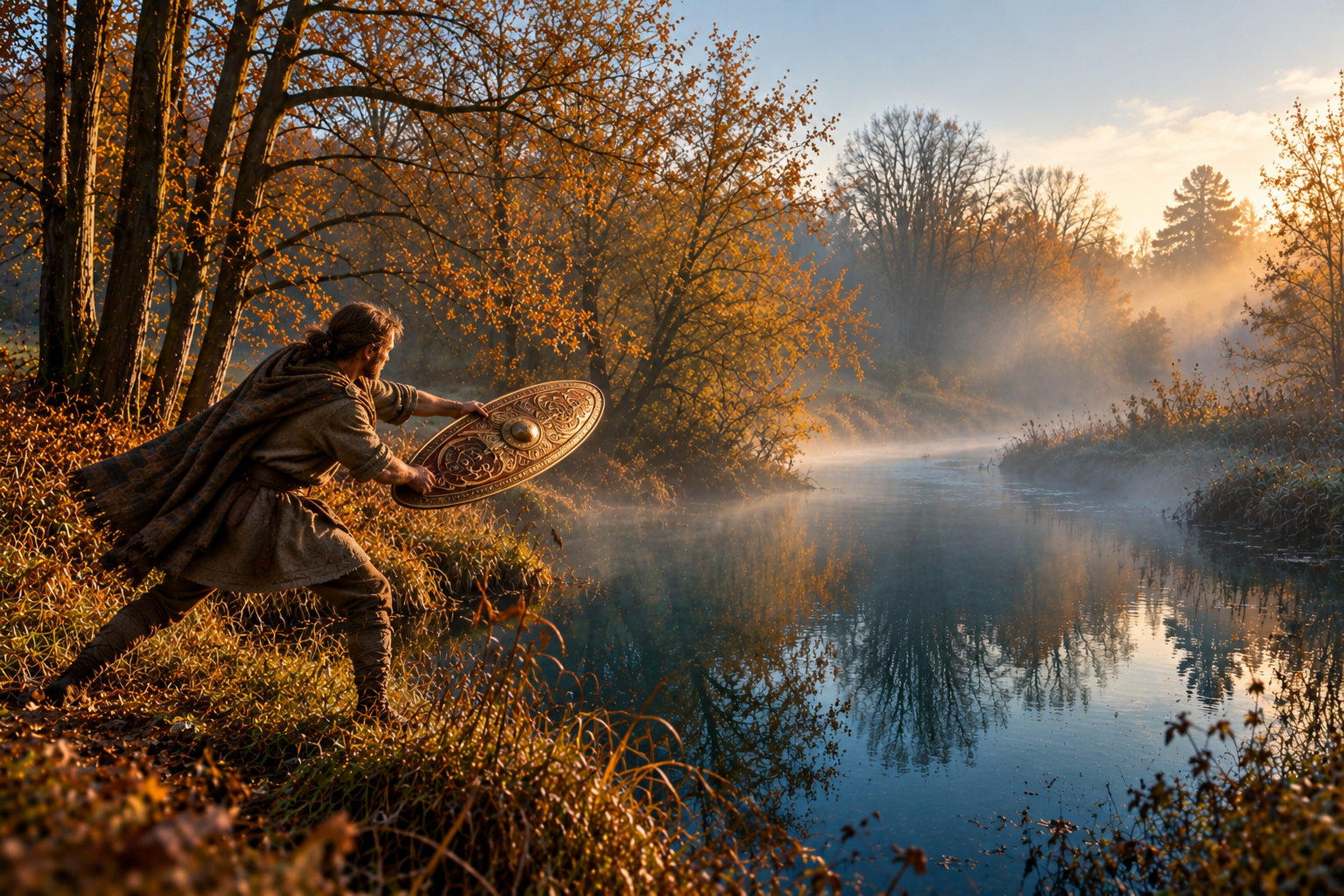
The fields are green, the roundhouses are smoking, and somewhere across the Channel, the Romans are taking a rather keen interest in an island they haven’t quite managed to conquer.
Just so we’re all on the same page. Please ensure you’ve made yourself acquainted with my disclaimer
Welcome to Britain, AD 1
It’s AD 1, and we’re arriving in a countryside that might initially look quite familiar. Cattle graze in enclosed pastures, sheep pick their way across the hills, and patches of woodland break up a landscape increasingly shaped by farming. Smoke curls through the thatched roofs of roundhouses, while nearby someone is grinding grain, tending a fire or trying to persuade an uncooperative animal to go where it’s supposed to.
If you joined us for our previous visit to Britain in 800 BC, you’ll remember Must Farm, the extraordinary Bronze Age settlement in Cambridgeshire where a devastating fire preserved an almost unbelievable glimpse of everyday life. We saw homes filled with pottery, textiles, tools and the ordinary possessions of people who lived nearly three thousand years ago. Well, we’ve travelled another eight centuries forward, and quite a lot has changed.
Ironworking is now firmly established, specialised craftspeople produce increasingly sophisticated goods, and powerful communities are reshaping the political landscape. Some rulers even issue their own coins. Trade networks stretch across the Channel, bringing imported pottery, wine and other goods into parts of southern Britain. Not everyone encounters these luxuries, of course. For most families, life still revolves around farming, food preparation, livestock and the changing seasons.
And then there’s Rome.
Julius Caesar crossed the Channel twice, in 55 and 54 BC, but neither expedition resulted in a permanent conquest. Nevertheless, Roman goods, diplomatic relationships and political influence are already reaching British shores. The island is becoming increasingly entangled with a powerful Mediterranean world, even while its communities remain independent.
So, before the legions return in AD 43, let’s have a proper look around. There’s an entire Iron Age world here, and it deserves to be understood on its own terms.
What Happened Since 800 BC?
Around 600 BC: The Rise of the Hillforts
Across Britain, communities began constructing increasingly impressive earthworks. One of the finest examples is Maiden Castle in Dorset, where an early hillfort enclosed roughly 16 acres. Over the following centuries, it expanded to approximately 47 acres, with enormous banks and ditches that still dominate the hillside today.
These weren’t necessarily just military fortresses. Some provided defended settlements, gathering places, livestock enclosures or demonstrations of political authority. Constructing them required substantial communal labour, suggesting that certain groups could organise hundreds of people for major projects.
Around 400 BC: A Better Way to Grind Grain
For generations, people had ground grain using saddle querns, rubbing a smaller stone backwards and forwards across a larger one. During the Iron Age, rotary querns gradually appeared in Britain, allowing grain to be ground between two circular stones using a turning motion.
It was a significant development for households spending considerable time preparing cereals. Adoption varied across Britain, however, and older grinding methods did not disappear overnight.

Image by Linda Spashett Storye, Wikimedia Commons, licensed under CC BY 3.0.
Around 320 BC: A Greek Explorer Visits Britain
Around 320 BC, a Greek explorer named Pytheas set sail from Massalia, modern-day Marseille in southern France, on an ambitious voyage into northern Europe. He reportedly travelled around Britain, observing its geography, climate and inhabitants.
Although his original account has been lost, later Greek and Roman writers preserved some fascinating details. In Strabo’s Geography, we learn that Pytheas described northern communities bringing their harvested grain into large buildings to thresh it, rather than working outdoors where frequent rain made the process difficult. He also reported that people with access to grain and honey used them to make alcoholic drinks. Apparently, finding ways to enjoy a drink despite the weather has quite a long history.
Pytheas also investigated the unusually long summer days of northern Europe, eventually describing a distant northern region called Thule, where daylight behaved very differently from anything familiar in the Mediterranean.
His journey also helped introduce Britain to the wider Mediterranean world, including a name recorded in Greek as Prettanikē, an early form associated with the name Britain. The island was also known as Albion, while the Romans would eventually call it Britannia. The exact origins of these names remain uncertain, but it’s rather fascinating to see the beginnings of a name we still use more than two thousand years later.
55–54 BC: Julius Caesar Comes Calling
In 55 BC, Julius Caesar crossed the Channel with his army, partly because he believed the Britons had been helping his enemies in Gaul (modern-day France). His first visit didn’t accomplish much, so he returned the following year with a much larger force. After fighting his way inland and securing agreements from several British leaders, he headed back to Gaul.
Britain remained unconquered, although its relationship with Rome was becoming rather more complicated.
Look Around: Landscape, Population and Settlements

A Countryside Full of People
That’s quite a population jump since our last visit in 800 BC! More people meant more mouths to feed, and England’s countryside was certainly being put to work.
Across southern and eastern England, you’d find fields of grain, grazing livestock, scattered farmsteads and well-used tracks connecting communities. Further north and in the western hills, cooler, wetter conditions made growing crops more challenging, so livestock farming was especially important in many areas.
There were still plenty of woodlands, marshes and stretches of open countryside. But England was hardly an untouched wilderness. People had been clearing, farming and reshaping the landscape for thousands of years.
Major Settlements
England didn’t yet have cities like the ones we know today, but several important centres were taking shape. Some were known as oppida, large Iron Age settlements or territories associated with political power, trade and impressive defensive earthworks.
- Camulodunon (modern Colchester, Essex): An important centre of the Trinovantes, established during the first century BC. Its growing network of banks and ditches would eventually surround thousands of acres of farmland, workshops and settlements.
- Verlamion (modern St Albans, Hertfordshire): A developing centre of the Catuvellauni, a powerful tribe in southeastern Britain. By around 10 BC, its rulers were minting coins bearing the settlement’s name, giving us an unusually early written record of the place.
- Calleva (modern Silchester, Hampshire): An important centre associated with the Atrebates, established towards the end of the first century BC. Unlike many scattered Iron Age settlements, it already had an organised layout of streets, building plots and timber structures.
And here’s what’s fascinating: being inside one of these important centres didn’t necessarily mean you were surrounded by buildings. At Camulodunon, you might find yourself standing in a field, with roundhouses scattered across the landscape. Not quite the bustling city centre you might expect.
Inside an Iron Age Home
Roundhouses were still a familiar sight across much of England, whether tucked inside the enormous earthworks of a hillfort or standing on a farmstead surrounded by fields and livestock. Some families lived in small clusters of homes, while others had fewer neighbours nearby.
And these weren’t all tiny huts. A roundhouse might measure 20–40 feet across, giving its occupants roughly 300–1,250 square feet of floor space. That’s a respectable amount of room, particularly when you consider that some houses were even larger.

Reconstructed Iron Age roundhouses at St Fagans National Museum of History in Wales. Photograph by Immanuel Giel, July 2007. Wikimedia Commons. Public domain.

The walls were commonly built using wattle and daub, a framework of woven branches coated with a mixture of earth, clay and other materials. Sturdy wooden posts helped support a steep roof covered with thatch. The materials were largely gathered locally, and the thick roof offered protection from England’s famously uncooperative weather.
But what was it like inside?
Step through the doorway, often facing east or southeast, and you’d enter a space considerably darker than a modern home. With no glass windows, daylight came mainly through the entrance, while a hearth provided warmth, cooking heat and additional light. Smoke was certainly part of indoor life, although experimental reconstructions suggest it could escape gradually through the thatch rather than requiring a chimney. The smoke also helped preserve the roofing materials, although the interior could certainly become smoky.
There wasn’t a separate kitchen, living room and workshop. Around the hearth, people cooked, repaired tools, worked with textiles and carried out countless other household tasks. Pottery, baskets and wooden containers held food and supplies, while furniture and other possessions varied according to the household.
One particularly interesting place to explore all this is Butser Ancient Farm in Hampshire. Archaeologists and experimental researchers there have reconstructed roundhouses using evidence from excavated buildings, then experimented with how they were built, heated and maintained. It’s one thing to identify a circle of ancient postholes in the ground. It’s quite another to work out how those posts once supported an entire house.
What Was for Dinner?
If you arrived at an ordinary Iron Age farmstead around mealtime, you might find a clay pot bubbling beside the hearth, filled with barley, beans, greens and perhaps a little meat. It wouldn’t be a recipe everyone across England followed. What went into the pot depended on the season, the region and what the household had managed to grow or obtain.
What’s on the Menu?
For an ordinary farming household in AD 1, these were some of the foods you might regularly encounter:
- Grains: Spelt wheat and barley were important staples, with emmer still grown in some places. These could become thick porridge, hearty pottage or bread.
- Vegetables and pulses: Field beans and peas were useful, filling crops that could be dried and stored for winter.
- Meat: Cattle, sheep and pigs supplied beef, mutton and pork. Meat might be fresh, cooked into a stew or preserved for later. How often it appeared depended on the household’s livestock and resources.
- Dairy: Milk from cattle, sheep or goats could be consumed or processed into cheese and other dairy foods.
- Wild foods: Hazelnuts, blackberries, sloes and other gathered plants added variety when they were in season. Fishing and hunting also contributed, although farming supplied much of the everyday food.
- Drinks: Water was an everyday necessity, and grain-based beer was being produced in Iron Age Britain. Imported wine was available to some wealthy households, but it certainly wasn’t an ordinary farmer’s daily tipple.
Most of this food came from the household’s own fields, animals and surrounding countryside, although exchange with neighbours and other communities could provide things they didn’t produce themselves.
When it came time to eat, there was no elaborate table setting or procession of courses. A pot of warm pottage, perhaps accompanied by bread or cheese, would have made a satisfying meal. People had pottery bowls, wooden vessels and knives, but exactly how families arranged themselves around the hearth is anyone’s guess. And with children to feed, livestock to tend and work that followed the seasons, mealtimes probably looked rather different from one household to the next.
A Day of Eating in AD 1 England
Based on Late Iron Age ingredients and cooking methods, with experimental reconstructions where exact recipes have not survived.
Morning Food
- Warm Barley Pottage: Coarsely ground barley slowly simmered over the hearth until thick and creamy, finished with a splash of fresh sheep’s milk.
- Drink – Fresh Water: Cool water collected from a local spring or other suitable freshwater source.
Snack
- Gathered Hazelnuts: Fresh autumn hazelnuts collected from woodland edges, cracked open and enjoyed for their naturally rich, buttery flavour.
- Drink – Fresh Water
Main Communal Meal
- Beef, Broad Bean & Barley Hearth Stew: Tender beef slowly simmered with broad beans, a scattering of barley and fresh garlic mustard, creating a rich, earthy pottage cooked over the household fire.
- Spelt Bread Twists with Whipped Cream: Stone-ground spelt dough wrapped around wooden sticks and gently baked beside glowing embers until golden and lightly crisp, served with freshly whipped dairy cream. An experimental reconstruction inspired by Butser Ancient Farm.
- Drink – Honey Mead & English Apple Spritz: Traditional English honey mead brightened with crisp orchard apple juice, a splash of sparkling water and a fragrant sprig of fresh thyme. Light, floral and refreshing, with a delicate honeyed sweetness that complements the rich, slow-braised beef.
Sweet Item
- Autumn Hedgerow Fruits: Ripe blackberries and small wild apples gathered from the surrounding countryside, offering a naturally sweet and pleasantly tart finish.
- Drink – Fresh Water: Cool water to accompany the freshly gathered fruit.
From Roundhouse to Gastropub
A modern English countryside menu inspired by the grains, livestock and hedgerow ingredients of Iron Age. Familiar ancient foundations are transformed into contemporary dishes with richer flavours, refined textures and a few centuries’ worth of culinary improvements.
Breakfast
- Creamy Barley Porridge with Roasted Pear & Honey: Silky pearl barley slow-cooked in whole milk, crowned with buttery roasted English pears, a drizzle of golden honey and a crisp toasted barley crumble.
- Drink – English Breakfast Tea: Robust black tea served steaming hot with a splash of milk.
Snack
- Rosemary-Roasted Hazelnuts: Golden English hazelnuts tossed in nutty browned butter, fresh rosemary and sea salt, roasted until fragrant and irresistibly crunchy.
- Drink – Pressed English Apple Juice: Freshly pressed orchard apples with a naturally sweet, refreshing finish.
Dinner
- Slow-Braised Beef, Barley & Broad Bean Casserole: Succulent English beef slow-braised in rich ale gravy with tender pearl barley, buttery broad beans, caramelised onions and a fragrant hint of wild garlic.
- Fire-Baked Spelt Bread Twists with Whipped Herb Butter: Soft, golden spelt bread twists brushed with garlic butter, finished with flaky sea salt and served warm for dipping into the casserole.
- Drink – Honey Mead & English Apple Spritz: Traditional English honey mead brightened with crisp orchard apple juice, a splash of sparkling water and a fragrant sprig of fresh thyme. Light, floral and refreshing, with a delicate honeyed sweetness that complements the rich, slow-braised beef.: A smooth, malt-forward English ale with gentle caramel notes and a balanced, lightly bitter finish.
Dessert
- Blackberry & Apple Crumble with Vanilla Custard: Juicy English blackberries and tart orchard apples baked beneath a golden, buttery crumble topping, served with warm vanilla custard.
- Drink – Warm Spiced Apple Juice: English orchard apple juice gently warmed with cinnamon and cloves for a fragrant autumn finish.
Work, Trade and the Arrival of Money
Farming wasn’t exactly a nine-to-five job, but by this point, some people were becoming known for doing something other than growing food.
You might have a blacksmith who made tools for the surrounding farms, a potter whose vessels travelled beyond their own settlement, or a skilled metalworker producing jewellery for wealthy customers. These weren’t necessarily full-time jobs in the modern sense. A craftsperson might still help with the harvest or tend animals of their own.
Skilled craftspeople had been around for centuries, of course, but some were producing goods for communities beyond their own. And those goods could travel surprisingly far.
Trade networks connected settlements across Britain and beyond. At Hengistbury Head in Dorset, imported pottery and wine containers reveal connections with communities across the Channel. But access to these goods varied. Someone living near the southern coast had different trading opportunities from a family in the northern uplands, and wealthy households were generally better positioned to obtain expensive imports.
So how did people pay for things?
Not necessarily with money. Goods could be exchanged directly, while gifts, favours and obligations helped maintain relationships between households and communities. Powerful leaders could also collect and redistribute resources, strengthening their influence over the people who depended on them.
Hang On, Are Those Coins?
By this point, parts of southern and eastern England had their own coinage.
Take Tasciovanus, a ruler associated with the Catuvellauni. He issued coins bearing his name, which is quite a statement when most people around you weren’t leaving written records. It’s essentially saying, ‘Remember who’s in charge.’

Photograph by Numisantica, via Wikimedia Commons, licensed under CC BY-SA 3.0.

But don’t picture farmers heading to a village shop with pocketfuls of change. Coins hadn’t replaced exchanging goods, giving gifts or fulfilling obligations to powerful leaders. Some were probably used for important payments and political relationships, while their role in everyday transactions remains less clear.
For most families, wealth still meant land, livestock, stored food and useful possessions. For powerful rulers, it also meant controlling resources, maintaining alliances and displaying their influence.
And having your name stamped on a gold coin was certainly one way to do that.
Family, Childhood and Growing Old
Imagine growing up in a world where your neighbours might have known your grandparents, your parents and eventually your own children. Communities were often small enough for people to know one another, and family relationships could influence everything from who helped bring in the harvest to whom you could turn to when things went wrong.
Families were part of wider networks of relatives, neighbours and communities belonging to peoples such as the Catuvellauni, Trinovantes and Atrebates. We often call these groups tribes, although their relationships and leadership were more complicated than that single word suggests.
Growing Up in an Iron Age Household
Children didn’t spend their days in classrooms. Instead, they learned by watching and helping the adults around them. A young child might gather kindling or help tend animals, gradually learning to spin wool, prepare food or use tools. By adulthood, some of these skills would have been practised for years.
And of course children played! We can’t identify many Iron Age toys with certainty, but it’s difficult to imagine a childhood without games, make-believe and the occasional stick becoming something considerably more exciting.
Everyone Had a Part to Play
Keeping a household running was a shared effort. Children learned to contribute as they grew. Older family members could pass down decades of experience, whether that meant knowing how to manage a difficult harvest, care for animals or practise a specialised craft.
Dogs had jobs, too. They could guard homes and livestock, assist with hunting and perhaps help move animals between pastures. A useful dog was another working member of the household, earning its keep alongside everyone else.
Families also depended on one another beyond their own homes. Relatives and neighbours might help with harvesting, building or other work that required extra hands. But not everyone was equally wealthy or influential. Some households controlled far more land and livestock than others, and powerful families could command the labour or loyalty of people with fewer resources.
Clothing, Fashion and Appearance
Forget the endless parade of muddy brown tunics you see in historical dramas. Iron Age clothing could be colourful, carefully made and surprisingly stylish. Just because someone lived in a roundhouse didn’t mean they had no interest in looking good.
What Was Everyone Wearing?
Wool was one of the main materials used for clothing, with linen also available. Women and men could wear tunics, while cloaks offered protection against the weather. Trousers were known in parts of the Celtic world, although we shouldn’t assume everyone in England wore them.
Clothes were generally made from woven pieces of fabric, sewn or fastened together rather than cut into the complicated shapes of modern clothing. Leather footwear helped protect feet, and a good cloak would have been particularly welcome during an English winter.
And clothing didn’t have to be dull. Plants could provide dyes in reds, yellows, blues and other shades, while different weaving techniques created patterns and textures. We can’t reconstruct everyone’s wardrobe, but there’s no reason to picture an entire village dressed in identical shades of beige.
A Little Something Shiny
Jewellery wasn’t simply decoration. Brooches held clothing together, while bracelets, rings and neck ornaments could show off someone’s wealth or status.
Some Iron Age metalwork was beautifully elaborate, with swirling patterns and carefully worked details. Wealthier people could afford more impressive ornaments, while simpler fasteners and accessories served everyday needs.
People also cared for their appearance. Archaeologists have found combs, razors, tweezers and mirrors from Iron Age Britain, suggesting that grooming and personal presentation mattered.
And then there’s the famous blue body paint.
Julius Caesar wrote that Britons coloured themselves with a substance he called vitrum, often interpreted as woad. Whether he meant painted skin, tattoos or something else remains debated. We don’t have enough evidence to claim that everyone wandered around covered in blue designs, however entertaining that would be.
Health, Height and How Long People Lived
Living without modern medicine certainly had its disadvantages. A broken bone, infected tooth or difficult childbirth could turn dangerous remarkably quickly. And while people were perfectly capable of living into old age, getting there wasn’t always easy.
How Healthy Are You?
Let’s start with the numbers.
- Average adult male height: ~ 5 ft 6 in (168 cm).
- Average adult female height: ~ 5 ft 2–3 in (159–162 cm).
- Adult lifespan: Many people who survived childhood died between the ages of 35 and 45, although roughly one-third of adults lived beyond that age range. Some reached their fifties, sixties or older. Precise averages for Iron Age England are difficult to establish.
- Child mortality: Around 45–50% of children died before reaching age 15, based on studies of ancient and premodern societies.
That last number is rather sobering. In comparable historical populations, nearly half of children never reached adulthood.
What Could Actually Kill You?
There were plenty of ways for life to go horribly wrong, and unfortunately, most didn’t involve anything as dramatic as a sword fight.
- Infections and disease: Without antibiotics, even an infected wound could become dangerous. Respiratory illnesses, intestinal infections and other diseases could be serious, especially for young children.
- Pregnancy and childbirth: Heavy bleeding, obstructed labour and infections could threaten both mother and baby. Without modern obstetric care, complications were particularly frightening.
- Accidents and injuries: Working with sharp tools, managing large animals and spending time around open fires came with risks. A badly broken bone could leave someone unable to work, while an infected injury might prove fatal.
- Food shortages and malnutrition: A failed harvest could mean a difficult winter, especially for households without substantial food stores. Children were particularly vulnerable to nutritional shortages during growth.
- Violence and warfare: Iron weapons, defensive earthworks and injured skeletons remind us that conflict was a genuine danger. That doesn’t mean every settlement was permanently under attack, but violence could have devastating consequences.
What Could Your Bones Tell Us?
Quite a lot, actually.
Archaeologists can identify healed fractures, worn joints, evidence of disease and damage to teeth. Years of demanding physical work could leave their mark, particularly on the spine and joints.
And let’s talk about those teeth. Cavities, abscesses and heavy wear all appear in Iron Age remains. Imagine having a raging toothache without a dentist, antibiotics or even the prospect of a root canal. Absolutely not, thank you.
Parasites were another problem. Remember Must Farm from our 800 BC visit? Researchers found evidence of intestinal parasites in the settlement’s ancient waste, including fish tapeworm eggs. Its watery surroundings provided opportunities for some particularly unpleasant infections.
But some discoveries tell us something more encouraging. A badly broken bone that healed suggests its owner survived the injury and continued living afterwards. Someone may have helped them through their recovery, even if we can’t tell exactly what that care looked like.
And that’s perhaps the most interesting thing about these skeletons. They don’t just tell us how people died. They can also reveal what their bodies endured, and what they managed to survive.
Gods, Rituals and the Unseen World
Imagine standing beside a river, holding something valuable. Perhaps it’s a beautifully decorated sword, a piece of jewellery or an object that’s been in your family for years.
And then you throw it into the water.
Not because you’ve lost your temper or decided to have a dramatic clear-out, but because the river itself might be a sacred place.
When the Landscape Was Sacred
Across Iron Age Britain, people deliberately left valuable objects in rivers, lakes, bogs and springs. Weapons, jewellery and other metalwork have been recovered from watery places, sometimes in circumstances suggesting they were offerings rather than accidental losses.
One particularly spectacular example is the Battersea Shield, discovered in the River Thames in 1857. Dating to approximately 350–50 BC, its elaborate bronze facing shows no obvious signs of battle damage. The shield may have been made for display or ceremonial purposes rather than ordinary combat, although its original use remains uncertain.

Photograph by Geni, via Wikimedia Commons, licensed under CC BY-SA 4.0.

Why give away something so valuable? Perhaps to thank a god, ask for protection or fulfil a promise. We don’t know exactly what the person who deposited the shield believed, but they apparently considered it worth surrendering.
And worship wasn’t confined to rivers. Sacred groves, springs and special gathering places may have been important, while offerings were also deliberately buried in pits and ditches.
Druids, Sacrifices and Roman Gossip
Now, what about the druids?
Julius Caesar described druids as important religious figures who taught beliefs, settled disputes and conducted ceremonies. He also claimed they practised human sacrifice, including the infamous image of enormous wicker figures filled with victims.
It’s certainly a memorable description. But Caesar was writing for a Roman audience while pursuing his own political ambitions, so his account deserves a healthy dose of scepticism.
That doesn’t mean human sacrifice was entirely invented.
In 2010, archaeologists excavating an Iron Age settlement at Winterborne Kingston in Dorset discovered the skeleton of a woman in her late twenties, lying face down near the bottom of a deep pit.
Her bones revealed a difficult life. She had considerable wear on her spine, a rib broken several weeks before her death and, most disturbingly, an unhealed cut to her neck made by a sharp blade. Her hands may even have been tied.
But what really caught the archaeologists’ attention was what lay beneath her: a deliberately arranged collection of animal bones, including remains of horses and cattle.
Researchers believe she may have been killed as part of a ritual ceremony, possibly inside the pit itself. It’s a chilling possibility, particularly because the arrangement seems so deliberate.
And she wasn’t the only one.
Further excavations around Winterborne Kingston have uncovered several more unusual burials. By 2025, archaeologists had identified five people buried face down in large pits across two nearby Iron Age enclosures. They were mostly young adults, and several showed signs of physically demanding lives or injuries. One recently discovered burial was that of a teenage girl whose body had been placed face down, with her wrists positioned close together.
It’s an unsettling pattern. Were these people outsiders? Had they been enslaved? Were they deliberately chosen for ritual killings? Researchers are investigating those possibilities, but we don’t yet have definitive answers.
The evidence doesn’t establish that every unusual burial was a human sacrifice, or that the practice was widespread across England. But it does suggest that the woman discovered in 2010 may not have been an isolated case.
What Happened When Someone Died?
Burial customs varied considerably. In East Yorkshire, some people were buried in graves, occasionally accompanied by possessions. Elsewhere, archaeologists find human bones in pits or scattered remains suggesting that bodies were sometimes treated differently before their final deposition.
There’s no single Iron Age funeral we can confidently describe for every community.
And that’s perhaps what makes their religious world so intriguing. We can find the offerings, examine the burials and read what outsiders wrote about them, but we rarely get to hear what ordinary people believed.
Language, Art and Having a Good Time
Life in Iron Age England wasn’t all farming, cooking and occasionally worrying about the Romans. People also gathered with friends, celebrated, told stories and made some rather extraordinary things.
And while their conversations and music have disappeared, some of their artwork has survived beautifully.
The Language of Ancient Britain
Most people in England would have spoken varieties of a Celtic language we now call Brittonic, an ancestor of Welsh, Cornish and Breton.
So, if you speak Welsh today, you’re hearing a distant descendant of the language spoken here two thousand years ago. Not the same language, mind you. Two thousand years is quite a long time for vocabulary and pronunciation to change.
We have very little direct evidence of everyday conversations, but storytelling was probably an important way to pass along family histories, traditions and knowledge. Unfortunately, nobody was taking notes for us.
Art You Could Actually Carry
Iron Age artists weren’t particularly interested in leaving us enormous marble statues. Instead, some of their finest surviving work appears on jewellery, weapons, shields and other portable objects.
One spectacular example is the Snettisham Great Torc, discovered in Norfolk in 1950. Made around 150–50 BC, this gold-alloy neck ring weighs more than a kilogram (2.2 lb) and consists of 64 individual wires twisted into an elaborate design.

Having a good time
People also knew how to enjoy themselves. Communal feasts brought people together to eat, drink, strengthen relationships and perhaps demonstrate their wealth. A generous host could make quite an impression, particularly when imported wine was involved.
And there’s evidence for games! A wealthy burial at Welwyn Garden City in Hertfordshire contained 24 beautifully decorated glass gaming pieces, dating to the second half of the first century BC. There were six pieces each in white, yellow, red and green, all decorated with spiral patterns.
That’s particularly interesting because the four colours suggest this might have been a game for four players. Unfortunately, the board and rules haven’t survived. We have the pieces, but absolutely no idea who was winning.
What survives gives us glimpses of a lively cultural world, even if we’ll never hear its songs or know what made its people laugh.
Media You Can Watch or Read Today
Continue your journey with these books, films, television shows and podcasts.
For Adults
- The British History Podcast (Podcast) Ever wondered what British history sounds like when someone tells it as an enormous, occasionally ridiculous adventure? Host Jamie Jeffers takes listeners from prehistoric Britain through the Roman invasions and beyond, unpacking the personalities, politics and conflicts along the way. Start with the early episodes covering Iron Age Britain and Julius Caesar’s expeditions in 55–54 BC. It’s detailed history with enough personality to make the ancient world feel surprisingly close.
- A History of Ancient Britain (BBC Documentary Series, 2011) Historian Neil Oliver explores Britain’s prehistoric past, following the changes that transformed scattered communities into increasingly complex societies. Expect archaeological discoveries, ancient monuments, spectacular landscapes and plenty of questions about the people who lived here before written history. It’s an excellent choice if you want something more grounded in actual archaeology.
- The Ancient Celts by Barry Cunliffe (Nonfiction Book) Forget the idea of one enormous Celtic civilisation where everyone dressed alike and worshipped the same gods. Archaeologist Barry Cunliffe explores the communities, artwork, languages and traditions of Iron Age Europe, including Britain. It’s a fascinating look at how these cultures developed and interacted, with plenty of archaeological discoveries along the way. A good choice if you want to understand the wider world that England belonged to around AD 1.
- The Celts: Blood, Iron and Sacrifice (BBC Documentary Series, 2015) Archaeologist Alice Roberts and historian Neil Oliver investigate the peoples known as the Celts, travelling across Europe to examine their extraordinary metalwork, religious practices and encounters with Rome. There are beautiful artefacts, surprising discoveries and plenty of discussion about what the word Celtic actually means. Particularly good if the sections about druids and Iron Age jewellery caught your attention.
For Kids
- Asterix in Britain (Animated Film, 1986) Ages: 6–12 Asterix and Obelix travel across the Channel to help the Britons resist Julius Caesar’s Roman army, armed with their usual magic potion and absolutely no respect for historical accuracy. It’s silly, colourful and packed with slapstick humour. Great for kids who enjoy adventure cartoons, ridiculous characters and watching the underdogs outsmart the grown-ups. Set during Caesar’s campaigns in the first century BC.
- Horrible Histories: Cut-throat Celts by Terry Deary (Book) Ages: 7–12 If your child loves disgusting facts, terrible jokes and asking questions about things you’d rather not discuss over dinner, this one’s probably going to be a hit. It introduces Celtic warriors, druids, unusual customs and conflicts with the Romans through cartoons and wonderfully gruesome humour. Brilliant for reluctant readers, although some of the more dramatic claims deserve a little fact-checking.
- Horrible Histories: Cut-throat Celts (TV Sketches) Ages: 7–12 Imagine a history lesson delivered by comedians who think severed heads and ancient superstitions are excellent material for jokes. These sketches introduce Celtic Britain through funny songs, ridiculous interviews and short scenes that make historical characters memorable. Particularly good for kids who prefer watching something to reading about it. Expect deliberately gross humour and exaggerated history.
- Asterix the Gaul by René Goscinny and Albert Uderzo (Graphic Novel) Ages: 7–12 Meet a tiny Gaulish warrior, his enormous best friend and an entire village that refuses to surrender to Rome. With magic potions, absurd Roman soldiers and plenty of wordplay, it’s a fun introduction to the wider Iron Age world. It’s set in Gaul rather than England, but the Roman expansion and Celtic cultural backdrop fit this period beautifully. Perfect for children who enjoy comics and don’t necessarily want to sit down with a history textbook.
A World About to Change
For most people living in England in AD 1, this wasn’t a particularly remarkable year. Nobody was celebrating the start of a new millennium or wondering what the history books would say about them.
There were fields to tend, animals to feed, children to raise and neighbours to gossip about. Somewhere, a craftsperson was making something beautiful, a family was gathering around a meal and someone was probably complaining about the weather. Some things never change.
Rome was becoming increasingly influential across southern Britain, but everyday life carried on. That wouldn’t last forever. In AD 43, Emperor Claudius would send a Roman army across the Channel, beginning a conquest that would transform much of England.
But that’s a journey for our next stop at Time Traveling Table.
So, what do you think? Could you have made a life for yourself in Iron Age England, or would you have missed modern comforts too much? Leave your thoughts below or tag me on social!
Leave a Reply