
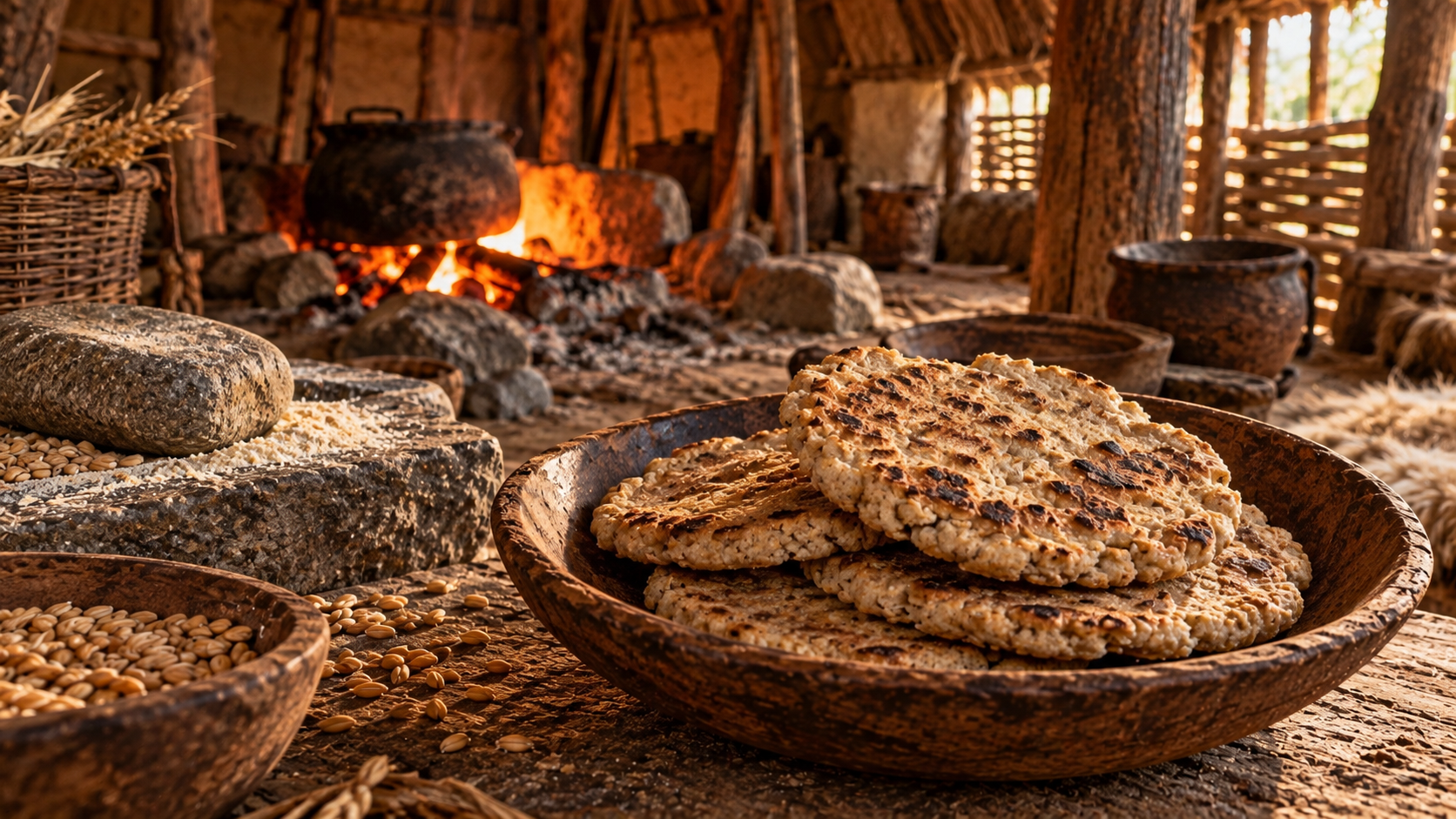
By around 2500 BC, barley had been grown in Britain for well over a thousand years. People had the grain, grinding stones to turn it into meal, hearths for cooking, and pottery for mixing and storing food. What we don’t have is a Neolithic recipe telling us to add precisely this much water, pat the dough into little cakes, and cook them for five minutes per side. These barley hearth cakes are a reconstruction, but they’re built from ingredients and cooking methods that make sense for Late Neolithic England.
And I have to say, I liked these better than the emmer cakes. Both were good, but the barley was a smidge less earthy and just really pleasant. They’re still extremely simple, obviously. We’re working with barley and water here. There are limits to the culinary fireworks available to us.
What surprised me more was the work involved. I spent about 2½ hours grinding the barley by hand, which gives you a rather different appreciation for something as basic as a little grain cake. Once the flour actually existed, making and cooking them was easy. Getting to the flour was the event.
Flavor wise, though, I don’t have some grand tasting note to give you. They were dense, pleasant and genuinely good warm. Sometimes apparently the historical verdict can just be: yep, I’d eat that again.

Serves: 4 (8 small cakes)
Grinding time: About 2½ hours by hand, or a few minutes with a grain mill or food processor
Rest time: 15–20 minutes
Cook time: 10–14 minutes per batch
Total time: About 55 minutes using pre-ground barley flour, or 3½ hours when grinding the barley by hand
Ingredients
- 380 g (2 cups) whole hulled barley
- 300 ml (1¼ cups) water, approximately
Method
- Grind the barley. Using a saddle quern, grinding stone, or other suitable grinding surface, grind the 380 g (2 cups) barley into a relatively fine meal. I find that smashing it before grinding helps a ton. A little coarseness is appropriate, but avoid large, hard shards. For these cakes, you want the barley noticeably finer than for the barley porridge. Modern shortcut: You can also use a food processor. Pulse the barley until it resembles coarse whole-grain flour, stopping before it becomes completely fine and powdery.
- Add the water gradually. Place the ground barley in a bowl and begin with 240 ml (1 cup) water. Mix thoroughly with your hands, then gradually work in up to another 60 ml (¼ cup), adding a little at a time until the barley holds together firmly when squeezed. You may need slightly more or less depending on how finely your barley was ground. The dough should be moist and cohesive without becoming wet or sloppy.
- Let it rest. Leave the mixture for 15–20 minutes. Freshly ground barley takes a little time to absorb the water, and the rest will make the cakes easier to shape.
- Check the dough. You’re looking for something closer to damp modeling clay than bread dough. It will not stretch or become elastic like wheat dough. A little residue on your hands is fine, but it should not be wet or sloppy. If it crumbles when pressed, work in another small splash of water. If it’s too sticky, give it a few more minutes to absorb the water before changing anything.
- Shape the cakes. Divide the dough into 8 portions. Press each firmly between your palms into a round about 8–10 cm (3–4 inches) across and 6 mm (¼ inch) thick. Keep them fairly thin so the centers cook before the outsides become too hard.
- Heat the cooking surface. For a practical modern recreation, heat an ungreased cast-iron skillet or griddle over medium-low heat. If using an electric griddle, aim for approximately 165°C (330°F). Historically, these could plausibly have been cooked on a suitable heated surface at the hearth.
- Cook slowly. Place the cakes on the hot surface and cook for about 5–7 minutes per side. You’re looking for a dry, firm exterior with scattered toasted brown patches, not a deeply browned or fried crust.
- Check the center. Break open one cake. The inside should be firm and cooked through while retaining a little moisture. It should not contain wet paste or noticeably hard pieces of raw grain. These are barley cakes, not modern wheat flatbread, so expect them to be dense and somewhat crumbly rather than soft, stretchy, or fluffy.
- Serve warm.
Leave a Reply