
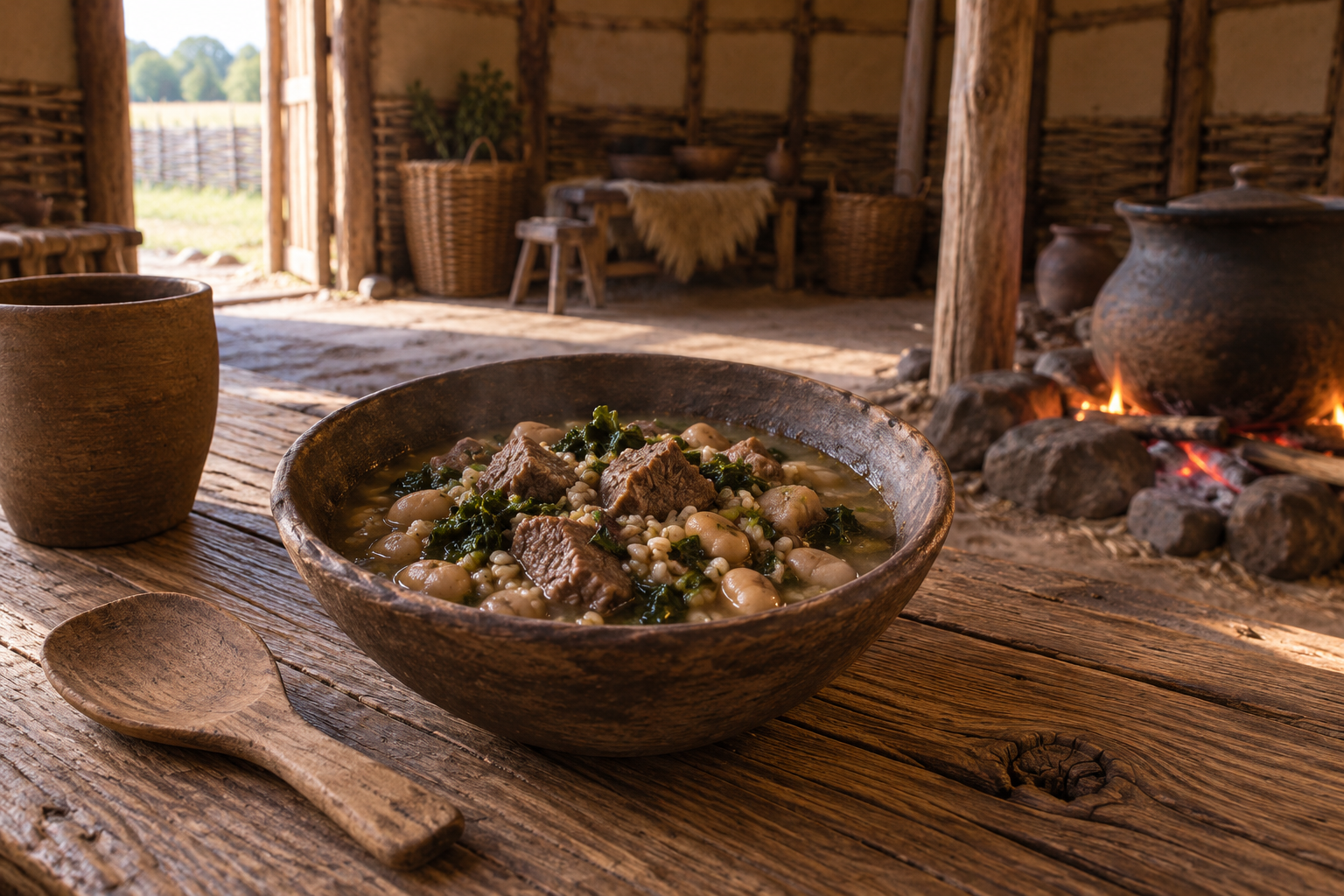
By AD 1, people in southern England were growing barley and broad beans, raising cattle, and cooking meals over household hearths. These ingredients would have been familiar to Iron Age communities, and combining them into a hearty stew makes plenty of sense. Add some leafy greens, and you’ve got a simple, filling meal made from foods available in England around this time.
And visually? I think we nailed it. You know those bowls of hodgepodge soup you see in historical movies? This looked exactly like that. I half expected someone in a wool tunic to wander over with a wooden bowl.
As for the flavor, it was solid. Not amazing, not terrible, just a good, hearty stew. The beef was wonderfully tender, and the barley was surprisingly delicious. Seriously, I think I need to reevaluate my personal soup-making habits because barley deserves to appear in more of them. The texture and nutty flavor were fantastic.
But can we talk about fava beans for a second? Hot dang, those things are MASSIVE. I don’t think I’ve ever eaten a fava bean before, and honestly, I don’t think I’d ever even seen one. My entire knowledge of fava beans came from famous line from The Silence of the Lambs. So that was a promising start. They were enormous when they were dry, and somehow they just kept getting bigger. So much bean in one bite! And I really liked them. The weird part? I started the stew at 2 PM, and by 6 PM, after FOUR HOURS of simmering, about half the beans were still on the firm side. How?! The ones that softened properly were delicious, though.
I also learned about something called favism while making this recipe. Apparently, people with an inherited condition called G6PD deficiency can have a serious reaction (like you could die) to eating fava beans. I’d never heard of it before, and it absolutely blew my mind. Who knew my little Iron Age cooking experiment would come with a genetics lesson?
Would I make this stew again? Probably not. It was good, and I enjoyed trying the ingredients, but it’s more of a one-time historical cooking experience for me. The barley, however, is absolutely coming back into my kitchen.

Servings: 6
Preparation Time: 15 minutes, plus overnight soaking
Cooking Time: Approximately 3–4 hours, or longer as needed
Ingredients
A Quick Note on the Ingredients: If there’s an ingredient below that doesn’t appeal to you or isn’t available at your store, don’t stress. Just skip it, find a similar substitute, or let this recipe inspire you to add your own twist. If you have favism (G6PD deficiency), avoid the fava beans and substitute another suitable ingredient. Back in this time period, recipes didn’t exist in the structured way we know them today. People used whatever they had on hand, and measurements were more of a “feel it out” situation. So embrace the spirit of the age and make it yours!
- 1.1–1.4 kg (2½–3 lb) bone-in beef shank, preferably cross-cut, with approximately 680–900 g (1½–2 lb) of meat
- 170 g (approximately 1 cup) dried whole broad beans (fava beans)
- 45 g (¼ cup) whole dehulled barley
- 45–60 g (1½ cups) roughly chopped green kale, tough stems removed
- 1.4–1.9 liters (6–8 cups) water, plus additional hot water as needed
- 5 g (approximately 1 tsp) fine sea salt, plus more to taste
- Additional cold water for soaking the broad beans
Instructions
1. Soak the broad beans overnight.
Place the dried broad beans in a large bowl and cover generously with cool water. Leave them to soak for approximately 12 hours. The beans will expand considerably, so make sure there’s plenty of water.
Drain and rinse the beans before cooking.
2. Begin the stew.
Place the beef shank and soaked broad beans in a large, heavy-bottomed pot. Add 1.4 litres (6 cups) of fresh water and the salt.
Bring to a rolling boil and boil for approximately 10 minutes, then reduce the heat to maintain a gentle simmer.
Partially cover the pot with a lid.
3. Simmer the beef and beans.
Allow the beef and broad beans to simmer gently for approximately 60–90 minutes, stirring occasionally.
Skim away any foam that collects on the surface, if desired. Add additional water whenever necessary to keep the ingredients submerged.
4. Add the barley.
Stir in the whole dehulled barley and continue simmering for approximately 60–90 minutes, or until the barley is tender.
Check the broad beans regularly. Depending on their size, age, and how thoroughly they were soaked, they may require considerably more cooking time.
Important: Do not rely on the cooking time alone. Continue simmering until the broad beans are completely tender throughout, with no firm or chalky centres.
If the barley becomes tender before the beans, simply continue cooking at a gentle simmer, adding water as necessary.
5. Add the kale.
Once the beef is tender and the broad beans are nearly finished cooking, stir in the chopped kale.
Simmer for another 20–25 minutes, until the greens have softened and incorporated into the stew.
The beef should be tender enough to pull apart easily with a fork.
6. Finish the stew.
Remove the beef shank from the pot and carefully separate the meat from the bones. Discard the bones and any unwanted connective tissue, then return the meat to the stew.
Stir everything together and adjust the salt to taste.
If the stew has become too thick, add a little more water. If it seems too thin, simmer uncovered until it reaches your preferred consistency.
7. Rest and serve.
Remove the pot from the heat and allow the stew to rest for approximately 5 minutes.
Serve warm in individual bowls, making sure each portion contains beef, broad beans, barley, greens, and plenty of broth.
Leave a Reply