
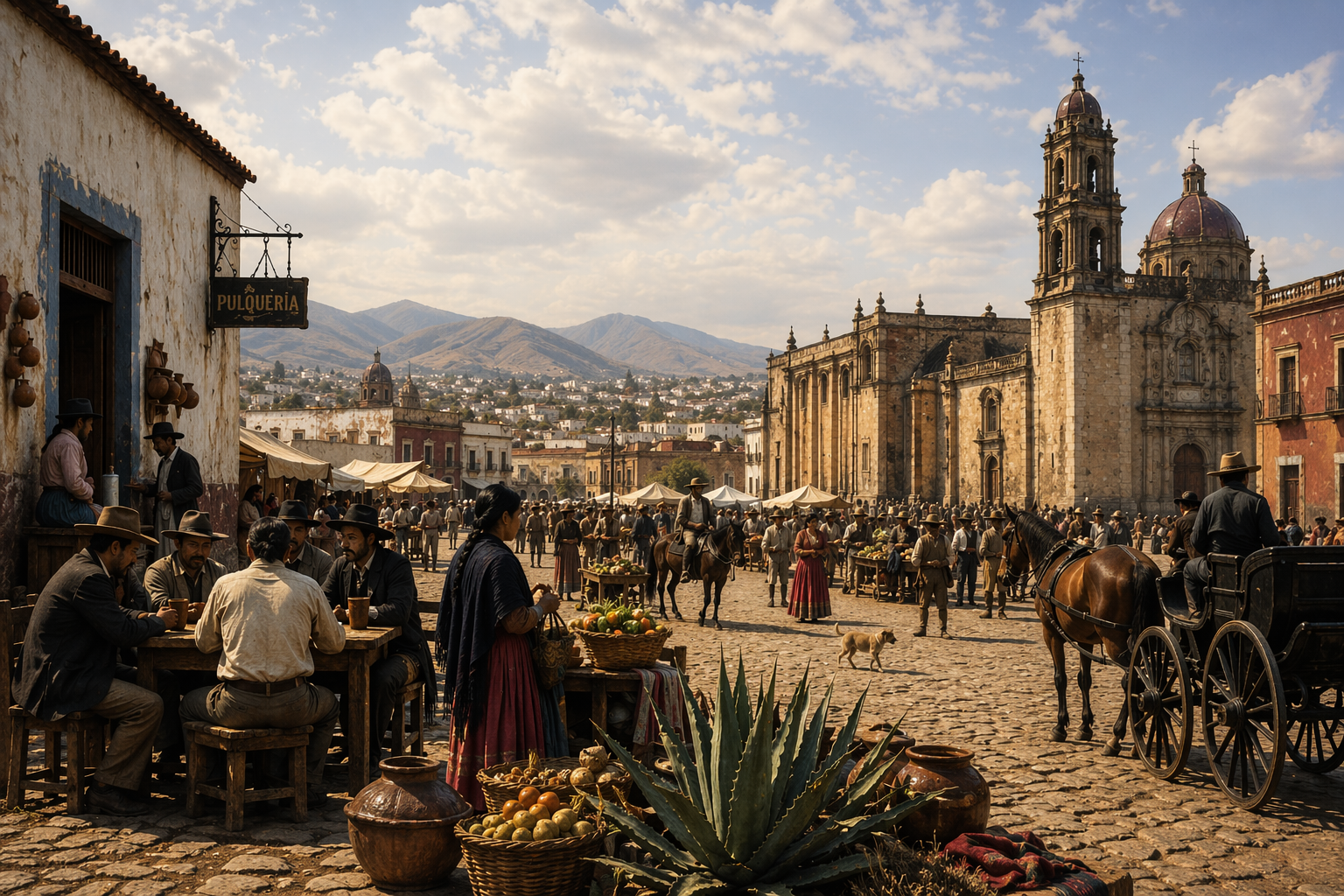
Step into a different moment with me. Not the kind you read about in a timeline, but the kind you can almost hear if you slow down for a second. In this post, we are getting into what daily life actually felt like in Mexico in 1857. From the way mornings began to what was simmering on the stove by midday, this is the lived-in version of history, not just the dates.
Sit with me for a second. Picture a plaza somewhere in central Mexico. The bells are ringing, vendors are calling out, and people are arguing. Not just about prices, but about the future of the country. If you’ve already walked through Mexico in 1810, you know this tension didn’t come out of nowhere. That earlier moment was about breaking away. This one is about figuring out what comes next.
Because 1857 is not a quiet year. It is the year Mexico tries to redefine who belongs, who has power, and what kind of nation it wants to be. New laws are being written, old systems are being challenged, and regular people are caught right in the middle of it all, still working, still cooking, still raising families.
So instead of just talking about constitutions and politics, let’s ground this. What did a home feel like? What did people eat on a normal day? How did family life actually function when the country itself felt uncertain?
That is where we are going. Not just the big story, but the everyday one, that is where history really lives.
Just so we’re all on the same page. Please ensure you’ve made yourself acquainted with my disclaimer
Home Life
Step inside a home in 1857, and you quickly see how space, routine, and daily life worked together.
What a “house” meant in 1857
Before anything else, we have to reset what we mean by a house. Most people were not living in neatly divided homes with labeled rooms. For the majority, especially in rural areas and among working families, home was compact and flexible.
A typical setup looked like:
- One or two rooms total
- Roughly 15 to 40 square meters (160 to 430 sq ft)
- Built from adobe, stone, or wood with thick walls
- Packed earth or brick floors
- Roofs of tile or thatch depending on region
In wealthier urban areas like Mexico City or Puebla, homes expanded around central courtyards, with multiple rooms opening into a shared interior space. These could reach 100 to 300 square meters (1,000 to 3,200 sq ft), but that was not the everyday experience.
Instead of thinking small versus large, it makes more sense to think multiuse versus specialized. That is the real divide.
Sleep and daily rhythm
Sleep followed the sun more than the clock.
Most people woke at sunrise, worked through daylight, and settled down not long after dark. The rhythm was practical and tied directly to light and labor.
Beds depended on access and region:
- Petates, woven reed mats placed directly on the floor
- Simple wooden frames with straw or wool stuffing
- Hammocks in warmer climates
There was no real pajama culture for most people. Sleepwear was usually undergarments or loose cotton clothing that was breathable and easy to wash.
Children stayed close. Younger kids often slept with parents, while older siblings shared space.
Staying clean
Cleanliness mattered, just within real limits.
Full baths might happen weekly or less depending on water access. Daily hygiene focused on washing the face and hands, along with cloth-based cleaning.
- Soap existed, especially in cities, but was not universal
- Public bathhouses remained important in urban areas

What’s shifting since 1810
This is where you start to feel change.
Compared to 1810, homes in 1857 still relied on older systems, but new materials and goods were becoming more visible, especially in cities.
You begin to see:
- More imported goods
- Glassware, ceramics, and metal tools
- Shifts in textiles with factory-made fabrics alongside handmade ones
- More furniture like tables, chairs, and storage chests
- Early industrial influence, still subtle but growing

At the same time, the core of the home stayed consistent:
- Metate for grinding maize
- Comal for cooking tortillas
- Clay pots for stews and beans
- Petates for sleeping and sitting
Homes were not replacing the old with the new. They were layering them together.
Fashion & Beauty Standards
Clothing in 1857 did more than cover the body. It signaled identity, status, and where someone stood in a changing world.
The bigger picture
Before getting into specifics, you need one idea in mind. Clothing in Mexico at this time was deeply tied to class, region, and identity. This was not a moment where everyone dressed the same.
You had:
- Indigenous and rural communities wearing regionally rooted dress
- Urban working classes mixing practical clothing with small European influences
- Elite groups leaning heavily into European fashion, especially French styles
Men

For men, clothing centered on structure and presentation, especially in public. The goal was to look controlled, respectable, and intentional.
Common elements included:
- Cotton or linen shirts, usually white or off-white, worn loose but tucked
- Straight-cut, high-waisted trousers secured with buttons
- Jackets in urban settings, often made of heavier fabrics for structure
- Sarapes or cloaks outside elite spaces, practical and culturally rooted
Accessories carried weight:
- Wide-brimmed sombreros for sun protection, with style and quality signaling status
- Leather shoes or boots, with sandals more common in rural or Indigenous settings
Facial hair and grooming mattered. Mustaches and short beards were common, though clean-shaven styles also appeared depending on profession and class. Hair was typically short to medium length and kept neat, especially in cities.
Looking put together relied on restraint. Nothing excessive, but nothing careless.
Women
Women’s clothing reveals even more about social expectations, especially around modesty, labor, and presentation.
Most outfits were built in layers:
- Blouses made of cotton, often embroidered, loose and breathable
- Full, ankle-length skirts designed for movement
- Rebozos, used for warmth, modesty, carrying children, and daily work
Materials varied by access:
- Cotton for everyday wear
- Wool in cooler regions
- Silk and finer fabrics among elites
Fastenings were simple, usually ties, buttons, or pins.
Hair was a major part of presentation. Long hair was the norm, styled in braids or buns, sometimes wrapped with ribbon. Jewelry followed class lines, from simple pieces to gold, silver, and imported items among wealthier women.
Children
Children were not dressed in a separate culture the way they are today. Their clothing closely mirrored adult styles, just simplified.
- Babies were wrapped in cloth or simple garments, with practicality first
- Young children wore loose clothing that allowed movement
- As they aged, expectations tightened into adult styles
Girls transitioned into skirts and blouses, boys into shirts and trousers.
Beauty and grooming
Daily care mattered, even without modern products.
Hair was washed less frequently than today but kept styled and maintained using oils, combs, and braiding. Soap existed, especially in cities, often made from animal fats and plant materials. In rural areas, people relied more on water, cloths, and natural cleansers.
Cosmetics were minimal for most people, with occasional use of natural pigments. Heavy makeup was not part of everyday life.
This connects directly to what we saw in home life. Cleanliness was about presentation and care, not constant washing.
Diet & Daily Meals
Food was not about variety or convenience. It was about rhythm, labor, and a deep connection to land and tradition.
How people thought about food
Food was not entertainment or endless choice. It was stability. You ate what your region produced and what your household could sustain.
For most people, that meant repetition, but not in a negative way. It was dependable. Meals followed patterns that had worked for generations.
Staple foods
Across most of the country, daily eating relied on a small group of core ingredients. These were not side dishes. They were the meal.
- Maize in every form
- Tortillas at nearly every meal
- Atole in the morning or evening
- Tamales for travel or special days
- Beans, boiled or stewed
- Chile, fresh or dried, used in sauces
- Squash, including flesh, seeds, and flowers
- Tomato and tomatillo as sauce bases
Depending on region and access, you also begin to see:
- Rice, especially in central Mexico
- Wheat bread in urban areas
- Lard used more frequently for cooking
This was not a cuisine built on abundance. It was built on deep familiarity with a few ingredients.
Protein and meat
Meat was present, but not daily for most people.
For many households, protein came from:
- Beans as the primary source
- Eggs when available
- Small animals like chickens
Beef, pork, and goat were less frequent and usually tied to:
- Market days
- Celebrations
- Religious events
Hunting existed in some regions, but it was not the foundation of the diet. Farming was far more reliable. Meat was not the center of the plate. It was something added when possible.
Drinks
Drinks say a lot about daily life, and here they were just as important as food. Everyday options included:
- Atole, warm and maize-based, often a breakfast staple
- Fresh drinks made from fruit, seeds, or grains mixed with water
- Chocolate, especially in urban or wealthier settings
Alcohol varied by class and region:
- Pulque, made from fermented maguey, widely consumed among working classes
- Mezcal, present but more regional
- Wine and imported liquors among elites
Pulque shows up constantly in 19th century accounts because it was not occasional. It was part of everyday life.
How meals were structured
Meals followed labor and daylight, not a strict clock.
A typical rhythm looked like:
- Early morning: atole or a light tortilla-based meal
- Midday: the largest and most important meal
- Evening: a lighter meal, often leftovers or simple foods
The main meal happened when work paused, not at the end of the day.
Food was not plated individually. Dishes were set out, and people built their own bites using tortillas. Eating was shared and practical.
The labor behind food
This is the part that is easy to overlook.
Food required constant work. It was not something you grabbed. It was something you produced and prepared daily.
Much of the day could be spent on:
- Farming, including planting and harvesting
- Grinding maize by hand using a metate
- Cooking everything from scratch
- Buying, selling, or trading in markets
Grinding maize alone could take hours and was often a daily task within the household.
Eating a tortilla was the final step of a long, physical process.
A Real Day of Eating in 1857 Central Mexico
- Morning Food + Drink
- Fresh nixtamal tortillas made at dawn
- Refried beans (mashed beans cooked in lard and reheated)
- Queso fresco (crumbled over beans or on the side)
- Atole with piloncillo and cinnamon
- Eaten quickly and informally, tortillas used to scoop beans and cheese
- Midday Snack + Drink
- Seasonal fruit such as guava, prickly pear, or mamey
- Pan de trigo (a small piece of simple wheat bread)
- Agua fresca (lightly sweetened fruit water)
- Eaten while working or near markets, not a structured meal
- Main Communal Meal (Comida) + Drink
- Horchata de arroz (rice-based drink with cinnamon, lightly sweetened)
- Caldo de verduras (vegetable broth, served first but not as a formal course)
- Pollo en salsa de chile (chicken in a guajillo-based red chile sauce)
- Frijoles de olla (whole beans simmered with lard and epazote)
- Fresh tortillas, continuously made
- Arroz rojo (tomato-based rice, lightly seasoned)
- Salsa molcajeteada (roasted and ground by hand)
- Food placed in shared vessels, broth first, then transition into tortillas, beans, and chicken
- Tortillas used as utensils, spoons mainly for broth, eaten communally until satisfied
- Sweet Item + Drink
- Arroz con leche (rice pudding with piloncillo and cinnamon)
- Hot chocolate (cacao with water or milk)
- Not something people would have daily, but a nice treat
Same Structure, Modern Restaurant-Ready
- Morning Food + Drink
- Blue corn breakfast tacos with smoky black bean purée, soft scrambled eggs, queso fresco, charred salsa
- Oat milk horchata latte (cinnamon and espresso)
- Midday Snack + Drink
- Guava butter toast with whipped ricotta and citrus zest
- Sparkling guava-lime agua fresca
- Main Communal Meal + Drink
- Chilled horchata with cinnamon foam
- Vegetable caldo (clear broth with chayote, squash, carrot, finished with epazote oil)
- Guajillo-braised chicken tacos with pickled onions and herbs
- Charred corn arroz rojo with lime and fresh herbs
- Creamy black beans with brown butter and epazote
- Molcajete salsa trio (roasted red, smoky chile, green tomatillo)
- Served family-style, build-your-own tacos, communal but refined
- Sweet Item + Drink
- Cinnamon rice pudding with piloncillo caramel and toasted nuts
- Mexican hot chocolate with light foam, slightly bitter
Population & Top Cities
Mexico was still overwhelmingly rural, but a handful of cities shaped politics, trade, and identity in outsized ways.
How many people were there
Let’s be clear up front. There is no perfectly precise census number for 1857. Mexico did not yet have a modern national census system, so historians rely on regional counts and later reconstructions.
Most estimates place the population somewhere between 7 and 8 million people in the mid 19th century.
Mexico at this point is not urban. Cities matter, but they are not where most people live.
The top cities and why they mattered
These cities were not just population centers. Each one played a specific role in shaping the country.
Mexico City – Estimated population: 150,000 to 200,000
The political and cultural center of the country. This is where laws are written, where elites gather, and where European influence is most visible. The city is layered, built on top of Tenochtitlán, which means Indigenous, colonial, and national histories are all present at once.
Puebla
A key industrial and regional center, especially known for textile production. Its location between Mexico City and Veracruz makes it economically strategic.
Guadalajara
A strong regional hub connected to agriculture and trade. Guadalajara links rural production to urban markets and plays a central role in the western economy.
Veracruz
The primary port of the country. This is the entry and exit point for goods, people, and ideas. Trade with Europe and beyond moves through Veracruz, making it strategically essential.
Guanajuato
A center of mining and resource wealth. Known for silver production, Guanajuato remained economically important even as output fluctuated. Its urban density is tied directly to mining activity.
Economy & Jobs
Daily life ran on land, labor, and relationships. Money mattered, but it was only part of how people survived.
How people earned a living
Mexico was still overwhelmingly agrarian. Most people were tied to land, trade, and local systems of exchange rather than steady wages.
Common work included:
- Farming within the milpa system
- Labor on haciendas
- Small trades in towns and cities
- Selling goods in local markets
Industrial work existed, especially in places like Puebla, but it was still limited.
Money and exchange
Money existed, but it was not used in every transaction.
Silver pesos and smaller coins circulated widely, backed by real metal value. At the same time, daily exchange often relied on:
- Direct trade
- Labor
- Goods
Credit and trust played a major role, especially outside cities. Money was part of the system, not the whole system.
Class and structure
This was not a society with a large middle class.
- A small group of landowners and political elites controlled most wealth
- A limited urban middle group included artisans and merchants
- The majority were rural laborers and the urban poor
The gap between these groups was significant.
Debt and dependence
One of the most important forces shaping daily life was debt. On haciendas, workers were often paid through a mix of wages, goods, and credit. That credit was tracked and repaid through labor, but prices at estate stores could keep people in ongoing debt.
In practice, this could limit movement. Leaving while in debt was difficult.
Instability and change
The 1850s were politically unstable, and that affected the economy.
- Trade routes could shift
- Prices could fluctuate
- Land ownership became contested
For people already living close to the edge, these changes mattered immediately.
Health
Staying healthy depended on environment, knowledge, and access. People understood the body in practical ways, but many outcomes were still out of their control.
Life expectancy and childhood
The numbers can be misleading if you do not separate them.
Average life expectancy at birth sat around 30 to 40 years, but that includes high infant and child mortality. If someone made it past early childhood, living into their 50s or beyond was realistic.
The real challenge was survival early in life:
- Only about half of children reached adulthood
- Many deaths occurred in infancy or early childhood
Healthcare and healing
Care existed in layers, not a single system.
People relied on a mix of:
- Traditional remedies
- Early Western medicine
- Religious practices
For most households, healing started at home. Herbal infusions, plant-based treatments, and steam remedies were common, using ingredients like arnica, chamomile, and epazote. This knowledge was passed through families and communities, often led by women.
Midwives played a central role in childbirth and early care. They guided pregnancy, delivery, and recovery, especially outside cities where doctors were less accessible.
Doctors were present in urban areas, trained in European traditions. Treatments could include bloodletting, herbal compounds, and early chemical medicines. Hospitals existed, but they were not widely used and were often associated with serious illness.
Medicine was developing, but it had not replaced traditional systems.
Common health risks
Daily life came with constant exposure to risk.
Common causes of illness and death included:
- Infectious diseases such as cholera, typhus, and smallpox
- Respiratory illnesses, especially in crowded or smoke-filled spaces
- Gastrointestinal disease linked to water quality
- Injuries from labor and daily work
- Complications in childbirth
Disease spread quickly in a world without modern sanitation or antibiotics.
Hygiene and daily care
Hygiene was practiced, but within clear limits.
Bathing depended on access to water and was not always daily. Public bathhouses were still used in cities.
Other forms of care included:
- Basic cleaning of hands and face
- Cloth-based washing
- Simple dental care using cloth or natural tools
- Menstrual care managed with reusable cloth
Waste disposal systems were limited, often relying on outhouses or open areas, which contributed to the spread of disease in dense spaces.
The bigger picture
Health was not something you assumed. It was something you worked to maintain.
People relied on experience, community knowledge, and attention to their bodies, but many outcomes still depended on environment and circumstance.
Staying healthy required effort, awareness, and often a measure of luck.
Social & Family Structure
Family shaped daily life, work, and survival. Households were connected, multi-generational, and built on shared responsibility.
What family looked like
Family was not limited to parents and children. It was broader and more connected, often spanning multiple generations.
You commonly see:
- Extended households with parents, children, and grandparents
- Or family members living nearby within the same community
Space and responsibility were shared. Childcare, work, and resources were distributed across the group.
Family was not just who you lived with. It was the system that supported daily life.
Marriage
Marriage was expected for most people and shaped strongly by Catholic norms.
- Typically monogamous
- Influenced by family involvement
- Connected to social and economic stability
Ceremonies were religious and community-centered, usually held in a church.
Typical ages:
- Women: mid to late teens
- Men: early to mid twenties
Marriage was less about individual choice at the start and more about building a stable household.
Children
Children were valued, but expectations started early.
- Children contributed to the household
- Learning came through observation and participation
- Formal schooling existed but was not widespread
Family size could be large, but not all children survived to adulthood, which shaped how families approached care and attachment.
Childhood existed, but it transitioned quickly into responsibility.
Elders
Elders held important roles within both families and communities.
- Respected for experience
- Involved in decision-making and conflict resolution
- Helped maintain traditions
In many areas, especially rural and Indigenous communities, elders played a key role in preserving social structure. Age brought authority and influence.
Community life
Even outside the household, life was collective.
- Shared labor in farming, building, and food preparation
- Community gatherings through markets, festivals, and religious events
People depended on each other in practical ways.
Independence may have defined politics, but interdependence defined daily life.
The bigger picture
Family life was active, shared, and closely connected.
- More people living and working together
- Less separation between individual roles
- Strong reliance on community
It was not always simple or peaceful, but it was structured around connection.
Family was not just part of life. It was the foundation that everything else depended on.
Childhood & Parenthood
Being a child or a parent was not separate from daily life. It was tied directly to work, family, and survival.
What parenting looked like
Parenting was structured, communal, and practical.
Children were not raised by two people alone. Responsibility was shared across a wider family network.
You typically had:
- Mother handling daily care, food preparation, and early teaching
- Father acting as provider and authority figure
- Grandparents offering experience, guidance, and continuity
- Godparents providing support beyond the immediate household
- Extended family helping with childcare and daily responsibilities
Raising a child was a shared responsibility, not an individual task.
Discipline and affection
Parenting leaned toward structure and obedience.
Children were expected to:
- Listen
- Show respect
- Contribute to the household
Discipline could include verbal correction and, in some cases, physical punishment.
At the same time, affection was present through care, protection, and teaching. It was not always expressed verbally, but it showed up in daily actions.
Love was demonstrated more through responsibility than through words.
Expectations of children
Children were treated as future adults in training.
From a young age, they were expected to:
- Follow rules
- Help with household or field work
- Learn through observation and participation
Education varied:
- Formal schooling existed, especially in cities
- Many children learned through apprenticeship or family work
For girls in particular, reputation and skill mattered. Abilities like cooking, sewing, and managing a household were tied to future stability.
Childhood was shorter, and responsibility came earlier.
Animals in daily life
Animals were part of the household, but usually with a purpose.
Common animals included:
- Dogs for protection and companionship
- Chickens for eggs and food
- Donkeys or horses for transport and labor
- Cats for pest control
Some families formed strong emotional bonds with animals, especially dogs, but most animals had a practical role first.
Animals were part of daily life, not separate from it.
Pros and cons: being a parent
Pros
- Strong family support system
- Children contributed to the household early
- Clear social role and identity
- Cultural traditions passed down daily
- Close family bonds
Cons
- High child mortality
- Constant physical and emotional labor
- Limited resources
- Social pressure around raising well-behaved children
- Very little personal freedom
Parenthood carried meaning, but it also carried weight.
Pros and cons: being a child
Pros
- Strong sense of belonging
- Early development of practical skills
- Freedom of movement in some environments
- Close sibling relationships
- Clear expectations
Cons
- High risk of illness and death
- Early responsibility
- Limited access to formal education
- Strict discipline
- Pressure to contribute to the household
Growing up meant stepping into responsibility early, but within a strong support system.
Leisure & Recreation
Free time was limited, so people made it count. Leisure was not separate from life. It happened in shared spaces, in passing moments, and in community.
Adults
For adults, leisure was rarely private. It happened in groups and in shared spaces.
Common pastimes included:
- Gathering in plazas, courtyards, and markets
- Music and dancing, from informal moments to larger celebrations
- Religious events, including feast days and processions
- Taverns and pulquerías, especially for men
Pulquerías stood out as major social spaces. They were not just about drinking. They were places to talk, unwind, and stay connected to community.
Theater and performances
In larger cities, especially Mexico City, theater offered a more structured form of entertainment.
- Dramatic plays
- Comedic performances
- Musical events
Audiences varied depending on the production, with stronger European influence in more elite spaces.
Physical activity
Organized sports in the modern sense did not really exist, but physical recreation still showed up in daily life.
- Informal games
- Horse-related activities in rural areas
- Public displays tied to festivals
Recreation was unstructured and often spontaneous.
Children and family
For children, play blended directly into everyday life. It was not set apart or scheduled. Common games included:
- Tag-style games
- Hoops rolled with sticks
- Simple ball games
- Riddles and storytelling
- Dolls or handmade toys
Most toys were not purchased. They were made, repurposed, or shared. Play came from imagination, not consumption.
Family-centered time
Leisure within families often overlapped with daily routines.
- Cooking and preparing food together
- Going to markets
- Attending religious events
- Visiting extended family
Time together did not require stopping work. It was built into it.
Public events and celebrations
This is where daily life opened up the most.
Major events included:
- Religious feast days and church festivals
- Market days that doubled as social gatherings
- Seasonal or harvest-related celebrations
These moments brought together food, music, trade, and community. They marked time in a world without fixed schedules or personal calendars.
Birthdays and milestones
Birthdays were not widely celebrated in the way they are today.
They were more common among urban or wealthier families, but for most people, other moments carried more weight:
- Baptism
- Marriage
- Religious milestones
Small family acknowledgments could happen, especially for children, but they were simple. Identity was tied more to life stages than to yearly celebration.
Culture, Language & Religion
This is where belief, expression, and identity come together. It shows how people understood the world and their place in it.
Religion and daily life
Mexico remained overwhelmingly Catholic, shaped by centuries of colonial influence. Even as liberal reforms began to challenge the Church politically, daily routines were still deeply tied to religious practice.
You saw it in:
- Prayer at home
- Life events like baptism, marriage, and burial
- Churches dominating public space
- Feast days organizing the calendar
Catholicism shaped ideas about morality, gender roles, and social expectations.
At the same time, many communities blended Catholic practices with older traditions. This was not a clean separation. It was lived experience.
- Saints connected to local beliefs
- Rituals tied to land and season
- Community-specific practices
Religion was not just belief. It was rhythm and structure.
Rituals and social expectations
Religion shaped behavior in practical ways.
- Strong emphasis on marriage and family stability
- Expectations around sexual morality, especially for women
- Respect for authority and elders
Rituals marked major life stages:
- Baptism soon after birth
- Marriage as a formal union
- Funerals as both social and spiritual events
Religion was not optional. It was expected.
Art and visual culture
By the mid 19th century, artistic style was shifting.
Mexico was moving away from colonial Baroque influence and toward neoclassical and early romantic styles, especially in cities.
Key trends included:
- Neoclassical influence with clean lines and European inspiration
- Costumbrismo, showing everyday life, social roles, and local scenes
- Portraiture, especially among elites, focused on status and identity
Artists and artisans worked across multiple mediums:
- Oil painting
- Printmaking and lithography
- Textiles
- Ceramics, including Talavera
- Religious imagery


Costumbrista prints are especially valuable because they show clothing, work, and daily activity in detail. Art was not just decorative. It documented how people lived.
Language
Mexico was not linguistically uniform.
Spanish dominated in cities, government, education, and written and legal systems.
At the same time, Indigenous languages remained widely spoken across the country, including:
- Nahuatl
- Maya languages
- Zapotec
- Mixtec
In many communities, Indigenous languages were still primary, with Spanish used secondarily or not at all.
Language shift after independence
After independence, the balance began to shift.
National priorities included:
- Promoting Spanish as a unifying language
- Expanding Spanish-based education
- Reducing administrative use of Indigenous languages
By the mid to late 1800s, Spanish likely became the primary language for more than half the population. This was not a sudden change, but a gradual shift tied to education, policy, and social pressure. Indigenous languages did not disappear, but their role began to change.
Literacy and access to knowledge
Literacy rates were limited.
Higher among:
- Urban populations
- Men
- Elite groups
Lower among:
- Rural communities
- Women
- Indigenous populations
Most people spoke fluently but did not regularly read or write. Printed materials existed, including newspapers, religious texts, and political writing, but access was uneven.
Political & Historical Context
Between 1810 and 1857, Mexico was not settling into stability. It was cycling through conflict, experimentation, and constant debate over what the country should become.
From independence to instability

If you came from 1810, you were at the start of a revolution. By 1857, independence had been achieved, but the outcome was still unsettled.
In 1821, Mexico gains independence from Spain and the country becomes its own nation, but independence did not bring stability.
In the decades that followed, Mexico moved through shifting forms of government, including empire, republic, and periods of military leadership.
A country still figuring itself out
Right after independence, Mexico briefly became an empire.
- 1822: Agustín de Iturbide becomes emperor
- 1823: The empire collapses
- The country shifts to a republic
From there, political power changed hands frequently. Governments moved between centralized control and federal systems, and military leaders played a major role.
One of the most visible figures was Antonio López de Santa Anna, who moved in and out of power multiple times.
Leadership was unstable, and direction was inconsistent.
War and territorial loss
The most defining event between independence and 1857 was the war with the United States.
- 1846 to 1848: War takes place
- Ends with the Treaty of Guadalupe Hidalgo
Mexico lost a massive portion of its territory, including regions that are now California, Texas, New Mexico, and Arizona.
Economic strain
War, political instability, and territorial loss put pressure on the economy.
- Trade was disrupted
- Government debt increased
- Regional economies struggled
Reform and rising tension
By the 1850s, new reforms began to push the country in a different direction.
Liberals advocated for:
- Separation of Church and state
- Reduction of Church power
- Sale of Church-owned land
These changes were meant to modernize the country and redistribute influence. But they were not widely accepted. For some, this was progress. For others, it was a threat to tradition and stability.
The Constitution of 1857
This is the defining moment for your year.
- Establishes individual rights
- Guarantees freedom of speech
- Promotes secular governance
But instead of resolving conflict, it intensified it.
Conservatives rejected the changes, and tensions escalated.
On the edge of war
By 1857, the country was already moving toward another major conflict.
- 1858 to 1861: Reform War
This was a struggle between competing visions of Mexico, not just political factions.
Cultural identity taking shape
Even with instability, something important was developing. Mexico was beginning to define its own identity through:
- Art
- Literature
- Public life
This identity was not fully formed, but it was becoming more visible.
The feeling of the moment
Living in 1857 would feel unsettled.
There was pride in independence, but also frustration with instability and uncertainty about the future. You would hear political arguments in public spaces, see changes in law, and still move through daily life.
Mexico at this moment is not stable. It is in the process of becoming.
Music & Instruments
Music was part of daily life. It moved through homes, plazas, and celebrations, carrying both tradition and change.
Instead of thinking of one “Mexican sound,” it makes more sense to think of overlap. Indigenous rhythm, Spanish structure, and local creativity all existing at the same time.
Music was not something you went to see. It was something you stepped into.
Instruments you would actually hear
Music was widely accessible because instruments were portable and often shared within communities.
Common instruments included:
- Guitar, the foundation of most everyday music
- Vihuela and other small string instruments adding higher tones
- Violin carrying melody in both informal and structured settings
- Harp in regional traditions, adding depth and rhythm
- Flutes and simple wind instruments, more common in rural areas
- Percussion through hand drums, clapping, and footwork
Musical styles and influence
The mid 19th century is a transition point.
You start to see:
- Regional son traditions blending Indigenous, African, and Spanish elements
- Jarabe forms that would later become nationally recognized dances
- European-influenced styles like waltzes and polkas entering through elite spaces
These styles often existed side by side. A formal gathering might feature a waltz, while a plaza outside carried a more local, rhythm-driven sound.
There was no single musical identity. Multiple traditions were shaping each other at the same time.
Now that you’ve walked through it, the homes, the food, the work, the music, you can see 1857 more clearly. This is not a quiet past. It is a country in motion, reshaping itself while people continue their daily lives inside that change.
Life is demanding. Resources are limited, and systems of power are real. But there is also something grounded here. Strong ties to family, land, and community. Daily life is immediate and shared.
So here’s the question.
Would you thrive in a world shaped by daylight, physical labor, and constant connection to the people around you? Or would the lack of privacy, modern medicine, and convenience wear you down?
Leave a Reply