
Just so we’re all on the same page. Please ensure you’ve made yourself acquainted with my disclaimer
When we last dropped into England in 4500 BC, people were still hunting red deer and wild boar, fishing rivers and coastlines, gathering hazelnuts and crab apples, and moving through a heavily wooded landscape. Now we’ve skipped forward just 500 years, and suddenly there are farmers, livestock, grain, pottery and great communal monuments entering the picture. If that feels suspiciously quick, you’re quite right to notice.
Five hundred years really isn’t very long when we’re bouncing around prehistory in thousand-year chunks. For a bit of perspective, Columbus reached the Americas in 1492, only a little more than 500 years ago. Think about how completely life in North America has changed since then. Entire populations moved, new animals and crops crossed oceans, landscapes were cleared and reshaped, technologies spread, settlements appeared, and ways of life that had existed for thousands of years were profoundly disrupted.
Something similarly useful helps us understand England around 4000 BC. The people already living here did not simply have a particularly productive few centuries and invent farming, pottery and animal husbandry one after another. Farming communities were arriving from continental Europe with domesticated animals, crops, pottery and generations of agricultural knowledge already behind them. Ancient DNA has made that part of the story much clearer.
The change had already begun by roughly 4300 BC, so we have arrived while England is still in the thick of it. Much of the countryside remains wooded. Hunting, fishing and gathering have certainly not packed up and gone home. Yet cattle and sheep are appearing, cereals are being cultivated, trees are being felled, pottery is being made, and people are putting serious amounts of labour into particular places, including gathering sites and monuments for their dead.
That makes 4000 BC rather more interesting than a simple switch from “hunter-gatherer” to “farmer”. We are standing in a landscape where an ancient way of life and a very different newcomer are overlapping.
The five centuries since our last visit have changed an astonishing amount. Now we get to find out what all of that meant when you actually had to live through it.
The New People Arriving in Britain
Farming did not simply arrive in Britain. Farmers did. Around 4000 BC, people began crossing the Channel carrying a way of life that had already travelled thousands of miles and taken generations to reach England.
The story actually begins nowhere near Britain. Farming had developed much earlier in the Middle East, and farming populations gradually spread into Europe. Their descendants moved west over many generations, mixing to varying degrees with the hunter-gatherers already living there. By the time some of those communities reached Britain, their closest genetic connections were with Neolithic people in western Europe, particularly populations associated with the Mediterranean route through places such as Iberia. People crossed into Britain bringing sheep, cattle, wheat, barley, pottery and farming knowledge with them.
And before you imagine complete lunatics loading cattle into boats and disappearing towards the horizon, there is an important bit of geography to remember: England and France are close. Very close. At the Strait of Dover, only about 34 kilometres (21 miles) separate them. On a clear day today, you can stand on the French coast and see England. Transporting livestock across the Channel was still an impressive, and presumably rather noisy, undertaking, but these people were not necessarily sailing blindly into the unknown. They could, quite literally, see Britain waiting on the other side.

Neolithic farming cultures appeared in areas immediately across the Channel roughly 1,000 years before they became established in Britain. Why Britain waited so long is still debated. The Channel clearly presented an obstacle, but it was hardly an impossible one. Britain’s existing hunter-gatherer communities were also successfully supporting themselves from abundant wild resources, so there was no obvious reason they had to abandon a way of life that worked. Whatever held the change back, once farming became established around 4000 BC, it spread into Britain remarkably quickly.
Did Hunter-Gatherers Become Farmers?
For a long time, archaeologists debated whether Britain’s Mesolithic hunter-gatherers encountered farming ideas from Europe and gradually adopted them themselves. It was a perfectly reasonable possibility. Pots, animals, seeds and knowledge can move between communities without an entire population moving with them.
Ancient DNA changed the picture considerably. When researchers compared DNA from Mesolithic and Neolithic people buried in Britain, they found overwhelming evidence that agriculture was introduced by incoming continental farmers. Early British farmers carried only small and geographically variable amounts of ancestry from Britain’s earlier hunter-gatherers. There was interaction and some mixing, but this was not simply the same population learning to grow wheat.
That distinction explains why England can look so startlingly different only 500 years after our last visit. New ideas were arriving, certainly, but so were new people who already knew how to put those ideas into practice. They knew how to tend crops, manage livestock and make pottery because these were not experimental new inventions to them.
For the people already living in Britain, this must have been an extraordinary period of change. We cannot know whether individual encounters involved curiosity, cooperation, marriage, avoidance, conflict or some mixture of all five. What we can see is the result. By 4000 BC, two human histories that had developed separately were meeting on this island.
England Before and After Farming
If you could stand on a hill in England around 4000 BC, the first thing you might notice is just how green everything was. Much of the country was covered in woodland, broken by rivers, wetlands, stretches of coast and naturally open ground.
The climate was relatively mild during this part of the Holocene, with a broad estimate of the mean annual temperature around 12°C (54°F) in central England. Oak, elm, lime and hazel grew across much of southern England, while wetter ground supported trees such as alder and willow. There were marshes and reed-fringed waterways, and the chalk uplands of southern England would become particularly important to Neolithic communities. Even after farming arrived, though, this remained a remarkably wooded country. Archaeological evidence from parts of England shows substantial woodland surviving well into the Neolithic.

Ancient lime tree, Monday, 7 November, 2005
Photo available for reuse under this Creative Commons licence.
What was changing was the scale at which people altered it. Hunter-gatherers had already been manipulating vegetation and creating small clearings long before farmers arrived. The Neolithic did not introduce the idea of humans changing their environment. Around 4000 BC, however, woodland clearance became more widespread and intensive. Pollen records suggest dense woodland cover across Britain declined by roughly 30 per cent with the arrival of farming populations, although this was certainly not one enormous nationwide bout of tree-felling. Some places were cleared while others remained heavily wooded or later grew back.
The reason was practical. Cattle and sheep need places to graze, crops need sunlight, and people need space to live and move. Trees could be felled with stone axes, while controlled burning helped open patches of vegetation.
England had certainly not become farmland from coast to coast. You could still walk through extensive woodland and wet country where human alterations were comparatively small. But something fundamentally had changed.
People were no longer simply finding useful places within the landscape. Increasingly, they were making the landscape they needed.
A Day in the Life
There was no such thing as an ordinary Tuesday in 4000 BC. No working week, no weekend, and certainly no checking the time before deciding whether you could squeeze something in before dinner. Daily life followed daylight, weather, animals, crops and the season. What follows is a reconstruction rather than the diary of one Neolithic family, but archaeology gives us enough evidence to build a reasonable picture.
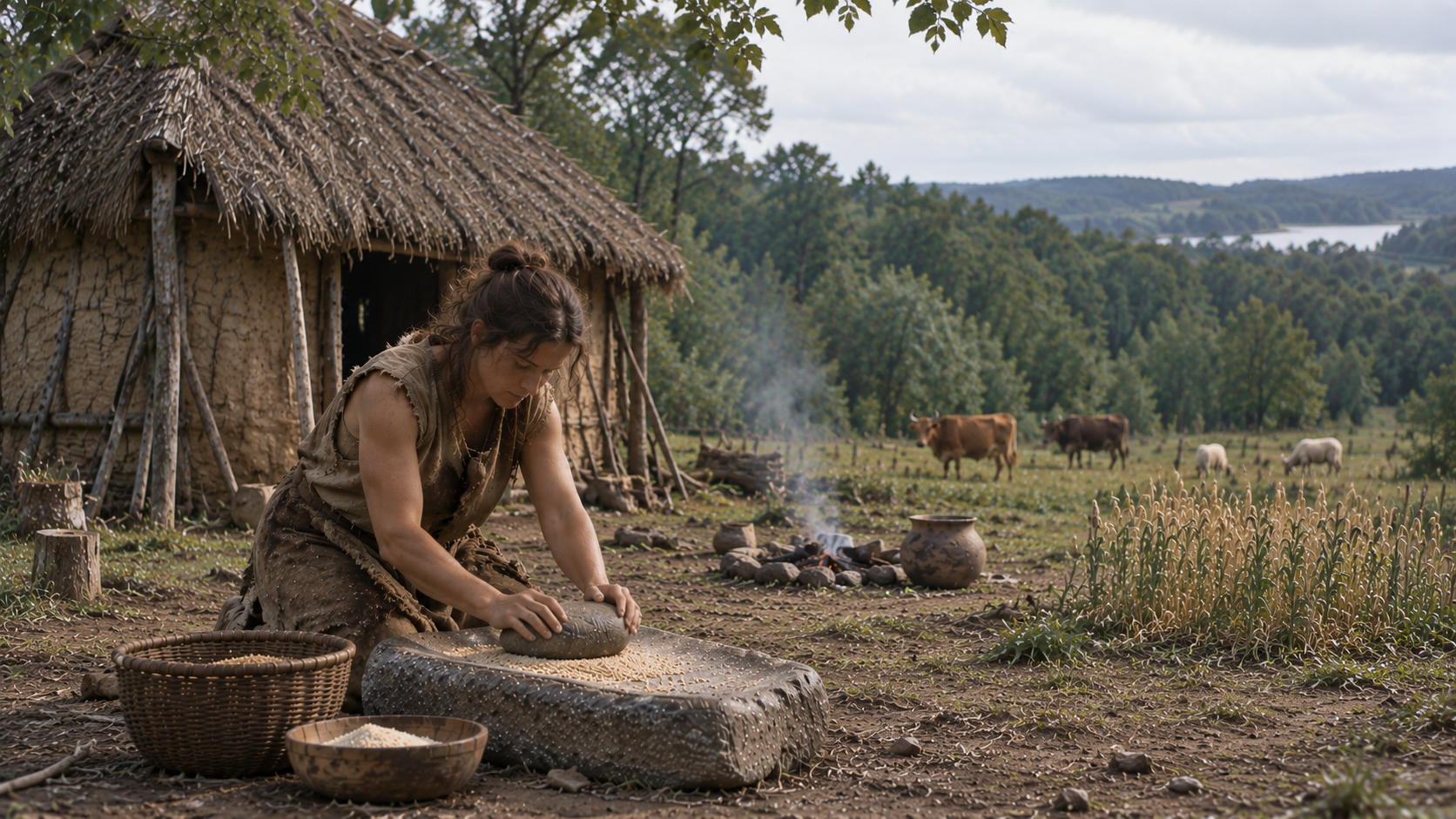
Morning began with the hearth. If embers had survived overnight, the fire could be revived rather than started from scratch. Water needed collecting, grain might need crushing or grinding for pottage or simple unleavened bread, and then there were the animals. Cattle and sheep needed checking, tending or moving, while animals being used for milk required regular attention. Wild deer never cared whether you slept late. Your own livestock very much did.
As daylight strengthened, work spread out around the household and surrounding landscape. Someone might repair a flint tool, work a hide, shape wood or make pottery. Depending on the season, there were crops to tend, livestock to manage, trees and vegetation to clear, and wild foods to gather. Farming had arrived, but hunting and gathering had certainly not disappeared.
Children would have been in the middle of this rather than tucked away in a separate children’s routine. They watched, imitated and gradually helped with useful work, learning the skills they would eventually need as adults.
As daylight faded, activity drew back towards the hearth. Food could be cooked and eaten, tools repaired and quieter jobs finished in the firelight. People presumably talked, laughed and told stories too, although those ordinary human moments are precisely the things archaeology struggles to preserve.
Tomorrow might look completely different. Harvest was not lambing season, summer was not winter, and a wet day demanded different work from a dry one. There was no tidy division between “work” and “home life” because maintaining the household was the work.
Perhaps the greatest change from our last visit was that some of their food now depended on them showing up every day. Crops had to be tended. Livestock had to be kept alive. Your cattle did not care that it was raining. They still needed you to show up.
Home: Where Did People Actually Live?
You might expect houses to become easy to find once farming arrives. People have crops, livestock and possessions now, so surely we should start seeing tidy little Neolithic villages. Archaeology, rather inconveniently, refuses to cooperate.
Early Neolithic settlement evidence in England is surprisingly patchy. Houses certainly existed, but most were built from materials that disappear. Timber posts probably supported walls of wood and other organic materials, with roofs covered in thatch or something similar. Thousands of years later, archaeologists may be left with little more than postholes, hearths and subtle changes in the soil, including darker patches where pits or wooden posts once stood and compacted surfaces where people repeatedly walked and worked.
Inside, a hearth provided heat, light and somewhere to cook. Food, tools and other possessions needed storage, and people needed space to sleep. These were probably smoky, fairly dark places, although exactly how the interiors were arranged is difficult to reconstruct.
Farming did not require everyone to remain beside the same field all year. Crops stayed put, but livestock could be moved to seasonal grazing, and people could move between repeatedly used places while remaining attached to particular fields and settlements.
Dinner Has Changed Forever
If you remember the food from our visit to 4500 BC, this is where the Neolithic transformation becomes deliciously obvious. Hazelnuts, crab apples, wild greens and meat are still around, but the new farmers have brought something England has never seen before: cultivated grain, dairy products and pottery. For the first time in our timeline, bread, milk, cereal pottage and meat can plausibly appear in the same meal.
Grain Comes to England
Cereal cultivation appears in Britain around 4000 BC, at essentially the same time as the arrival of farming communities themselves. Early crops included emmer wheat and barley appearing in the Neolithic archaeological record. These were not wild grasses that somebody happened to gather. People were deliberately planting and tending crops brought to Britain by farming populations from continental Europe.
Getting grain from field to stomach took an extraordinary amount of work. Cereals first had to be harvested and dried. With hulled grains such as emmer, threshing helped separate the grain from the stalks, but the edible kernels were still tightly enclosed in tough husks. Those had to be loosened and removed through further pounding, crushing and winnowing. The cleaned grain then needed to be stored somewhere dry and protected from pests.
And you still did not have flour.

The Wild Pantry Is Still Open
When it was time to eat, grain could be cracked for pottage or ground between stones into meal for bread. Grinding enough grain for a household was repetitive physical work, and it had to happen again and again. A field of ripe wheat was therefore not a cupboard full of food. There were several stages of human labour between the two.
Bread Enters the Picture
And yes, bread is finally here.
Do not picture a fluffy loaf coming from a Neolithic oven. Ground grain could be mixed with water and cooked into simple breads or cereal cakes, including flat, unleavened forms cooked on or near a hot hearth. Remarkably, a charred fragment interpreted as bread has actually been recovered from the Neolithic site at Yarnton in Oxfordshire.
Grain could also go into a pot. Cracked or ground emmer simmered in water would produce a thick cereal pottage, while milk could make it richer. We cannot reconstruct a standard Neolithic recipe book, but later Neolithic pottery from Britain has preserved molecular evidence of wheat and dairy being prepared together, making milk-based cereal gruels more than culinary guesswork.
Milk Is on the Menu
Dairy seems to have been remarkably important from the beginning. More than 80 per cent of analysed Early Neolithic pottery from Britain and Ireland contained dairy fats. Archaeologists have even detected cattle milk proteins trapped in the hardened dental calculus of Early Neolithic people.
That made keeping livestock a very different proposition from hunting. A successful hunt could provide a great deal of food, but the animal required nothing from you until you went looking for it. A cow or sheep was different. It needed water, grazing and protection whether you were hungry that day or not. Herds might need to be moved as the seasons changed, and keeping enough animals healthy to reproduce required thinking months and years ahead.
That gives us something wonderfully intimate. Milk does not preserve for six thousand years, but microscopic traces of it can survive inside pottery and on human teeth.
Fresh milk may not have been the only option. Fermenting, souring or separating milk into other dairy products could help it keep longer and reduce its lactose content. That would have been particularly useful because the genetic ability for most adults to digest large quantities of fresh milk was not yet widespread.
Farming did not mean everybody suddenly stopped gathering food from the woods. Hazelnuts remained important, while crab apples, berries, greens, roots and other useful plants were still available to people who knew exactly where and when to find them. Wild animals could still be hunted too.
The Neolithic diet was therefore not simply a replacement of wild food with farm food. People combined newly cultivated and domesticated foods with resources humans had been eating in Britain for thousands of years.
Pottery made those combinations much easier to cook. A pot could sit beside or over a fire while grain softened, meat simmered or milk was processed. Liquids could be carried and stored, while foods that were awkward to cook directly over flames could become pottages, soups and stews. Better still for us, fats soaked into the porous walls of those vessels and sometimes survived long enough for archaeologists to identify what had once been cooked inside them.
Five hundred years ago in our timeline, dinner depended overwhelmingly on what the landscape provided. Now people could plant some of it, raise some of it, milk some of it, gather some of it and hunt the rest.
Dinner had changed forever.
OG: Straight from the Neolithic Hearth
This menu is a historically plausible reconstruction rather than a known daily schedule or collection of surviving recipes. Where the evidence cannot tell us an exact dish (particularly flatbread and gathered roots) the preparation is based on ingredients and cooking technologies available at the time.
Breakfast
- Thick Emmer, Milk & Hazelnut Pottage: Coarsely stone-ground emmer simmered with water and milk into a thick, rustic pottage, with crushed wild hazelnuts adding richness and texture.
- Fresh Water: The everyday drink, collected from a reliable local freshwater source.
Food During the Day
- Wild Crab Apple: A small, sharp wild apple gathered in season and eaten by hand while working or moving through the surrounding landscape. This was less a scheduled “snack” than convenient food eaten when available.
- Fresh Water
Main Communal Meal
- Hearth-Roasted Pork: Pork from a domesticated pig roasted beside the fire, divided into pieces and shared among the group.
- Emmer Flatbread: Stone-ground emmer mixed with water, shaped into thin unleavened cakes and cooked on a hot hearth surface.
- Fire-Roasted Wild Roots: Edible roots gathered from the surrounding landscape and cooked beside the fire or among hot embers until tender.
- Fresh Water
Something Sweet
- Wild Berries with Rich Milk: Ripe seasonal berries eaten fresh with rich milk or naturally thickened dairy. This was not a separate “dessert course,” but represents the natural sweetness that seasonal gathered fruit could provide.
- Fresh Water
Modern: From Neolithic Hearth to English Table
Take the same basic food ideas and give them roughly six thousand years to evolve. Rather than simply making the prehistoric foods prettier, this menu imagines how those original combinations might appear on a modern English table.
Breakfast
- Toasted Emmer & Hazelnut Milk Porridge: Nutty cracked emmer slowly simmered in whole milk until creamy, finished with toasted hazelnuts, brown butter and a delicate drizzle of honey.
- English Breakfast Tea with Milk: Strong black tea served hot with a splash of milk.
Snack
- Sharp Apple & Aged English Cheddar: Crisp tart apple paired with mature English cheddar and a touch of wildflower honey
- Sparkling Apple Juice: Crisp, lightly sparkling apple juice with a bright, tart finish.
Dinner
- Cider-Roasted Pork & Root Vegetable Emmer Flatbread: Warm, charred emmer flatbread piled with tender cider-roasted pork, caramelised carrot and parsnip, sharp mustard cream and fresh herbs
- Dry English Cider: Crisp and gently fruity, with enough acidity to cut through the rich pork and roasted roots.
Dessert
- Blackberries & Honeyed Cream: Ripe blackberries spooned over softly whipped honey cream and finished with a crisp scattering of toasted emmer crumble
- Sparkling Elderflower Cordial: Fragrant elderflower cordial lengthened with sparkling water for a light, floral finish.
Animals: The Domestication Revolution
For the first time in our England timeline, people were responsible for keeping some of their food alive.
Cattle, sheep and pigs were the major domestic animals of Neolithic Britain. Goats were present too, although they appear to have been much less common. These animals arrived with farming communities rather than being domesticated from Britain’s existing wild populations. Domestic cattle, for example, were different from the enormous wild aurochs that people had previously hunted.
Wild animals had not disappeared from the menu. People continued hunting red deer, roe deer and wild boar, drawing on knowledge that stretched back through generations of hunter-gatherer life. The difference was that hunting was no longer the only way to put meat on the table.
The really revolutionary part was not simply having different animals available. It was management. People now influenced where livestock grazed, how herds moved, which animals bred and when an animal was slaughtered. Livestock provided meat and hides, while their manure could enrich the ground where they grazed or were kept. Cattle could also provide milk, giving people food without requiring them to kill the animal.
There was a considerable payoff. Keeping a cow alive could provide milk and eventually calves. Those calves could become future sources of milk, meat and hides themselves. Humans were beginning to exert far more control over when and how animal food became available.
Bodies, Health & Survival
Britain’s first farmers were not beginners. They arrived with generations of agricultural knowledge behind them, so any decline in health cannot simply be blamed on people learning how to farm badly. The uncomfortable truth is that some of the health problems associated with agriculture came from being a farmer in the first place.
Did Farming Make People Healthier?
Agriculture offered enormous advantages. Crops could be stored, livestock reproduced, milk could be obtained without slaughtering an animal, and the same landscape could ultimately support more people.
But there was a trade-off. Farming populations could become more dependent on a smaller number of staple foods. Starchy cereals changed the environment inside people’s mouths, contributing to dental disease. Agricultural work also placed repetitive strain on the body, while living in closer contact with other humans, livestock, waste and contaminated water created more opportunities for infection.
Britain’s Early Neolithic farmers complicate this picture because their diets could still be quite varied. They ate meat and dairy alongside cereals and continued using wild foods. We should not picture an exhausted population surviving entirely on bowls of emmer.
Still, the broader agricultural paradox applies: a way of life can become better at supporting a larger population without necessarily making each individual body healthier.
What Could Actually Kill You?
Most illnesses never leave recognisable marks on a skeleton, so there is no neat Neolithic cause-of-death chart. Daily life nevertheless carried plenty of risks that would be easily survivable or preventable today.
- Infection: A cut, infected wound or dental abscess could become dangerous without antibiotics.
- Injury: Farming, woodland clearance, hunting, livestock, tools and ordinary accidents all offered opportunities to get badly hurt.
- Childbirth: Pregnancy and delivery carried substantial risks to both mother and infant without modern obstetric care.
- Infancy and childhood: Babies and young children were particularly vulnerable to disease, infection and nutritional stress.
- Smoke: Indoor hearths meant repeated exposure to wood smoke, particularly for people spending long periods around the fire.
- Animals: Living closely with cattle, sheep and pigs created opportunities for diseases to pass between animals and humans. We cannot confidently assign particular livestock diseases to an English household in 4000 BC, but farming was changing the environment in which human diseases could spread.
How Long Did People Live?
Exact figures for England in 4000 BC do not exist, so these are broad estimates based on prehistoric populations rather than a Neolithic census.
- Child mortality: perhaps 30–50% of children died before reaching adulthood, with the greatest danger concentrated in the first few years of life. This is a broad prehistoric estimate rather than a figure we can measure specifically for England in 4000 BC.
- If you survived childhood: reaching your 40s or 50s was entirely possible.
- Older adults: some people could survive into their 60s, although they would have represented a much smaller part of the population.
- Height: across a large sample of prehistoric Europeans, Neolithic adults averaged:
- Men: ~ 164.5 cm (5 ft 5 in)
- Women: 151 cm (4 ft 11 in)
- These are useful ballpark figures rather than measurements specifically of England’s first farmers. Researchers have also found evidence that some Neolithic European populations were shorter than earlier hunter-gatherers, suggesting that childhood nutrition, disease and other stresses may have affected growth. Britain’s incoming Neolithic population makes a simple before-and-after comparison especially difficult.
Farming could feed larger communities and create food supplies humans had more control over, but those advantages came with new stresses on the body.
What Did They Look Like?
This is one of those questions archaeology ought to be able to answer and mostly cannot. Stone tools can survive for six thousand years. A woolly hat cannot. As a result, our picture of Neolithic clothing is heavily distorted towards the materials that happened to survive.
Animal skins and leather were almost certainly important. Hides could be scraped and worked using flint tools, then cut and stitched into clothing, bags and other useful objects. Bone awls and similar pointed tools provide evidence for piercing materials such as hide, while plant fibres could be processed into cord and other useful materials, although actual clothing almost never survives from this period in Britain. We therefore know considerably more about the tools capable of making clothing than about the clothes themselves.
Footwear is possible too. Leather shoes would have been entirely within their technological abilities.
What we do occasionally preserve suggests people cared about more than simply staying warm. Neolithic people wore beads, pendants and other personal ornaments, made from materials including stone, bone, shell and animal teeth. Clothing as well may have been considerably more interesting than the usual reconstruction of everyone wandering around in brown animal skins. Their clothing may have been fitted, decorated, varied and perhaps colourful, while archaeology has preserved almost none of it.
The Living, the Dead & a New Relationship With Place
Farming changed people’s relationship with the landscape, but it also seems to have changed their relationship with the dead. As communities invested more labour in particular fields, grazing grounds and gathering places, they also began creating permanent places for their ancestors.
The First Long Barrows
During the Early Neolithic, communities began constructing long barrows, elongated mounds of earth, and sometimes stone, containing human remains. Some incorporated timber or stone chambers, while ditches alongside the mound provided material for their construction.
These were not simply cemeteries filled with individual graves. Long barrows could contain multiple people and be returned to repeatedly, with additional remains deposited over time. They were substantial communal projects, requiring people to dig, carry and build entirely by hand.
Their location mattered too. Long barrows could stand prominently in the landscape and remain visible for generations.
Death Could Be a Process
Burial was not necessarily one event immediately following death.
Some Early Neolithic communities may have practised excarnation, allowing a body to decompose before some or all of the bones were collected and eventually deposited elsewhere.
Death may not have been one funeral. It could be a process lasting long after the person died.
Not Everything in the Ground Was Rubbish
Archaeologists also find pottery, animal bones, food remains, flint tools and other objects deposited in pits, ditches and ceremonial places. Some certainly was rubbish, but unusual combinations, careful placement and repeated deposits suggest that other objects were deliberately put there.
That distinction matters when virtually everything a person owned required considerable time, skill or resources to acquire or make. Deliberately placing a useful tool, food or valued object into the ground meant giving up something that was not necessarily easy to replace.
We cannot know exactly what these acts meant. They may have been offerings, part of ceremonies, connected with the dead or something for which we have no modern equivalent.
Building Something Bigger Than Yourself
Early Neolithic communities were beginning to build things no single household needed and no single household could easily accomplish alone.
Long barrows were only part of this new landscape. People also dug large earthworks and causewayed enclosures, quarried stone and established flint mines. All required people to coordinate their labour on a scale we have not encountered before in our England timeline.
Causewayed enclosures were large areas surrounded by interrupted ditches and banks, with gaps of undug ground forming the “causeways”. They appear to have been gathering places where people met, exchanged objects, ate together and carried out activities involving ritual and the dead.

The Trundle, West Sussex, photographed from the air in 1925. Its central enclosure covered roughly 0.95 hectares (2.35 acres), surrounded by multiple circuits of banks and interrupted ditches. Some ditch sections were up to 7 m (23 ft) wide and 1.4 m (4.6 ft) deep. All of that earth was dug and moved without metal tools, machinery or a construction crew complaining about overtime.
But who organised all this? There were no known kings, governments, wages or construction crews. One intriguing clue comes from the monuments themselves.
Kinship, obligation, belief, reciprocal labour and communal gatherings could all have encouraged people to participate. Feasting may have helped too. Archaeologists cannot reconstruct exactly who said, “Right, we’re digging a ditch today,” but clearly someone managed to get everyone there.
When Everyone Came Together
We do not know exactly what happened at causewayed enclosures, and they were probably not all used in precisely the same way. Sites such as Whitehawk near Brighton and Combe Hill above Jevington in East Sussex contain evidence suggesting gatherings, feasting, exchange, deliberate deposition and activities involving the dead.
What matters is that these places could bring people together.
Most of the year, someone might live and work among a relatively small circle of familiar people. A large gathering could suddenly put them among people from other communities, perhaps including individuals they rarely encountered otherwise. That created opportunities to exchange objects and information, maintain alliances, find partners, share food and participate in communal ceremonies.
We should be cautious about reconstructing specific events such as arranged marriages when nobody left us a guest list. But in a sparsely populated landscape, meeting people outside your immediate community was socially important. Relationships between groups mattered for exchange, cooperation and maintaining wider networks.
And the experience itself must have been exhilarating. Someone who spent most of the year among a few dozen familiar faces might occasionally walk into a gathering containing more people than they normally saw for months.
How Many People Lived Here?
Estimated population: ~10,000 across Britain
There was no Neolithic census taker wandering around with a clipboard, so any population figure for 4000 BC comes with a substantial margin of error.
Archaeological evidence shows a substantial population increase beginning around 4000–3850 BC, coinciding with the arrival and spread of farming communities. The population was also very unevenly distributed. People concentrated around favourable soils, rivers, coasts, grazing areas and other useful landscapes. Between those pockets of activity could be enormous stretches of woodland with very few people at all.
Most people lived in small communities, sometimes separated from other groups by considerable distances. There were no towns and certainly no cities.
Media You Can Watch or Read Today
Continue your journey with these books and shows.
Adults
- A History of Ancient Britain: “Age of Ancestors” (BBC, 2011)
Neil Oliver drops us almost exactly where we are, around 4000 BC, as the first farmers arrive in Britain from continental Europe. Suddenly there are crops, livestock, monuments and an entirely new relationship with the land and the dead. If you finish this article wanting someone to take you outside and physically show you what all of this looked like, start here. - Stonehenge by Bernard Cornwell
We’re jumping forward in the Neolithic here. Three brothers, tribal rivalry, religion, murder, power and the monumental task of building Stonehenge. Cornwell takes the archaeological mystery and turns it into a proper prehistoric drama. Pick this one when you want to stop learning about Neolithic Britain for a minute and just live there for a few hundred pages. - The Gathering Night by Margaret Elphinstone
This takes us backwards into Mesolithic Britain and follows a hunter-gatherer community dealing with family, survival, grief and a devastating natural disaster. It is especially fun alongside our timeline because it gives you the world that farming is beginning to replace. Think prehistoric family drama rather than cavemen running around hitting things with rocks. - The Tale of the Axe: How the Neolithic Revolution Transformed Britain by David Miles
A polished stone axe becomes the jumping-off point for the much bigger story of how farming transformed Britain. David Miles gets into migration, woodland clearance, food, monuments and the changing landscape without making the Neolithic feel like a very long museum label. This is probably the best follow-up if the massive upheaval between 4500 and 4000 BC is what grabbed you. - Ancestors: A Prehistory of Britain in Seven Burials by Alice Roberts
Alice Roberts uses seven burials to reconstruct Britain’s prehistoric past, including the arrival of the first farmers. Ancient DNA, migration, burial practices and archaeology all get tangled together in the best possible way. Read this if our sections on incoming farmers, long barrows and what happened to the dead left you wanting more. - Britain BC: Life in Britain and Ireland Before the Romans by Francis Pryor
If you are now dangerously close to becoming the person at dinner who won’t stop talking about causewayed enclosures, Francis Pryor is ready for you. This is a much broader journey through prehistoric Britain, but the Neolithic gets plenty of attention. Pryor is particularly good at asking what archaeological remains can tell us about how people actually thought, lived and organised their communities.
Kids
- Stone Age Boy by Satoshi Kitamura
Ages: 4–8
A little boy falls into the Stone Age and meets Om, a prehistoric girl who shows him around her world. There are tools, food, hunting, clothing and plenty of everyday-life details tucked into an actual story. This is a great one for younger kids who like an adventure and probably aren’t going to sit through Mum’s fascinating forty-minute explanation of how a saddle quern works. - Ug: Boy Genius of the Stone Age by Raymond Briggs
Ages: 7–11
Ug has a problem with the Stone Age: everything is horribly uncomfortable. He wants soft trousers, better food and generally thinks humanity could stand to improve things a bit. It’s deliberately silly and packed with anachronisms. Great for kids who like comics, inventions and ridiculous humour.
- 24 Hours in the Stone Age by Lan Cook
Ages: 7–11
This follows different people through a day in a Stone Age community, using illustrations and little slices of daily life to explain food, tools, hunting, crafts and survival. It’s a good pick for the kid who constantly interrupts history books to ask practical questions like, “But where did they sleep?” and “How did they make that?” - The Secrets of Stonehenge by Mick Manning and Brita Granström
Ages: 7–11
A colourful trip into prehistoric Britain centred around its most famous monument. It gives children a really good sense of the people, tools, teamwork and enormous effort behind Neolithic monument building. Excellent for kids who look at Stonehenge and immediately want to know how anybody managed to put the giant rocks up. - The Stone Age: Hunters, Gatherers and Woolly Mammoths by Marcia Williams
Ages: 7–11
Bright, busy and much more interested in making prehistory entertaining than solemn. It explores Stone Age life through comic-strip illustrations, covering everything from hunting and tools to homes and changing ways of life. A particularly good choice for kids who normally see a page full of nonfiction paragraphs and immediately remember they have something extremely important to do elsewhere.
Leave a Reply